

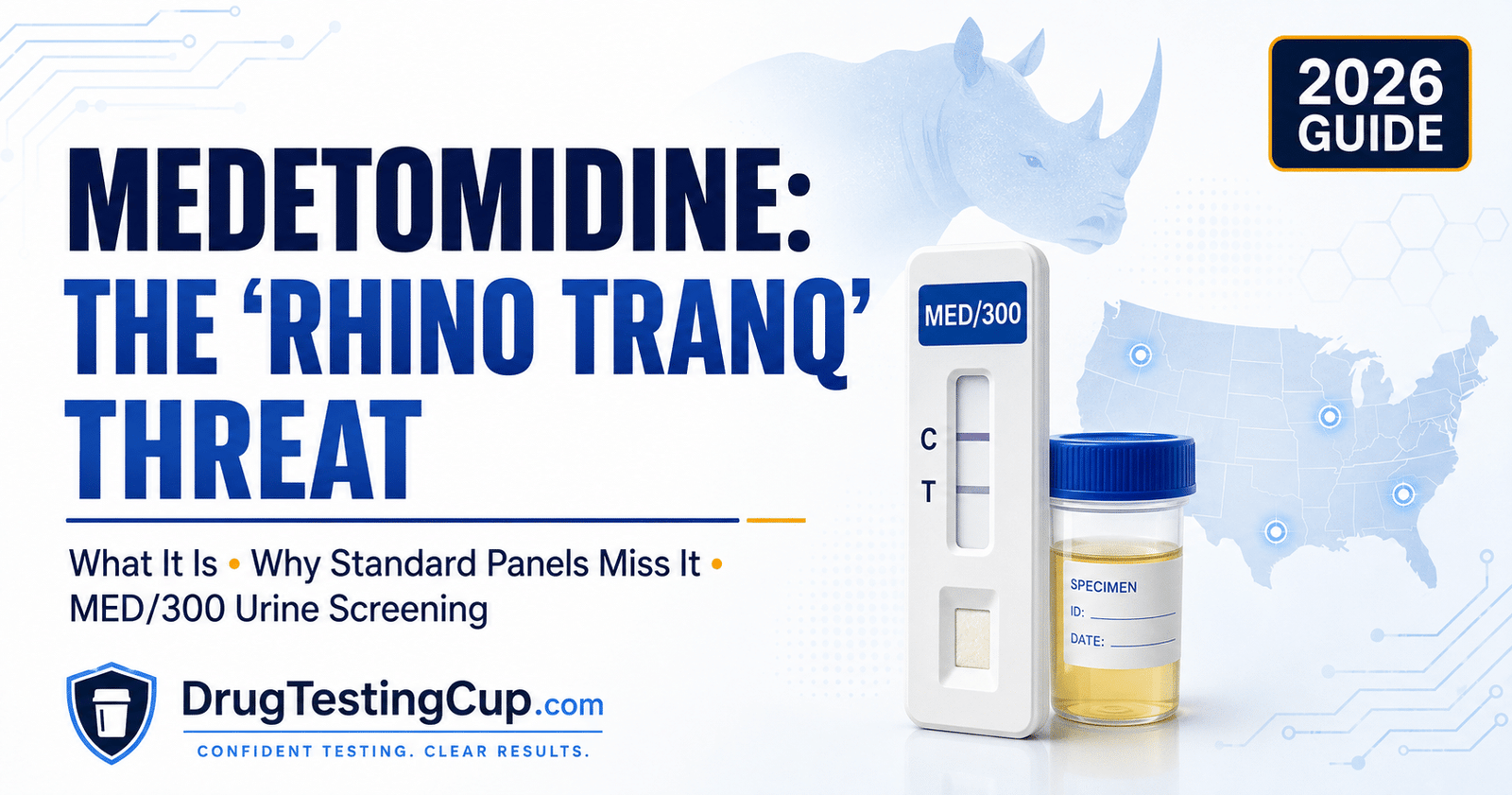

Medetomidine is a non-opioid alpha-2 agonist sedative used in veterinary medicine. It is not approved for human use. In the illegal drug supply, it is sometimes called “rhino tranq,” “mede” or “dex” and is frequently detected with illegally manufactured fentanyl.
In April 2026, the CDC issued a national health advisory after medetomidine detections increased across drug seizures, opioid-positive samples and wastewater surveillance. Reported effects include profound sedation, an abnormally slow heart rate and low blood pressure. Repeated exposure may also produce severe withdrawal involving high blood pressure, rapid heart rate, nausea, vomiting, tremors and fluctuating alertness.
Most standard 5-panel, 10-panel and 12-panel urine drug tests do not include medetomidine. Targeted screening requires a dedicated MED assay, such as a verified MED/300 urine test, or an expanded multi-panel cup that specifically lists medetomidine. A urine screening test is different from a test strip designed for powders or liquid drug samples.
Medetomidine at a Glance
| Question | Answer |
|---|---|
| What is medetomidine? | A veterinary alpha-2 agonist sedative and analgesic |
| Is it approved for people? | No |
| What are its street names? | Rhino tranq, mede and dex |
| Is it an opioid? | No |
| Is it the same as xylazine? | No |
| Is it commonly found with fentanyl? | Yes, fentanyl has been involved in most reported medetomidine overdoses |
| Do standard drug tests include it? | Most standard panels do not include a dedicated MED test |
| Is targeted urine screening available? | Yes, through a verified medetomidine-specific urine test |
Why Is Medetomidine in the News?
Medetomidine was first identified in the U.S. illegal drug supply in 2021 and began appearing with fentanyl in multiple jurisdictions during 2023 and 2024. Reports have since increased sharply.
According to the CDC’s 2026 advisory:
- National Forensic Laboratory Information System reports increased from 247 in 2023 to 2,616 in 2024.
- Reports increased again to 8,233 in 2025.
- Medetomidine was detected weekly in treated wastewater from at least one of 14 monitored states between October 2025 and January 2026.
- Ten of 20 sentinel sites detected medetomidine in almost 35% of opioid-positive samples tested between July and December 2025.
- The highest concentrations were reported in the Northeast, followed by the Midwest.
These figures measure selected drug samples, law-enforcement reports and surveillance locations. They should not be interpreted as the percentage of all drugs or people in the United States affected by medetomidine.
Why Is It Called “Rhino Tranq”?
“Rhino tranq” is an informal name used for medetomidine when it appears in the illegal drug supply. The name distinguishes it from “tranq,” which commonly refers to xylazine.
The two substances have related sedative effects, but medetomidine and xylazine are different chemicals. A drug test designed for xylazine should not be assumed to detect medetomidine.
The CDC has also reported the informal names “mede” and “dex.” However, illegal medetomidine should not be confused with medically administered dexmedetomidine, its dextro-isomer, which has approved human medical uses under controlled conditions.
What Does Medetomidine Do to the Body?
Medetomidine depresses the central nervous system and affects signals that regulate heart rate and blood pressure.
Reported signs of medetomidine exposure include:
- Profound or prolonged sedation
- A markedly slow heart rate, known as bradycardia
- Low blood pressure
- Reduced alertness
- Symptoms that continue after the opioid effects of fentanyl have been reversed
A person cannot determine whether medetomidine is present based on a substance’s appearance, smell or reported effects.
Testing also cannot determine whether a substance is safe. Illegal drug supplies may contain fentanyl, xylazine, nitazenes and other emerging synthetic opioids, benzodiazepines or additional compounds.
Medetomidine, Fentanyl and Naloxone
Medetomidine is not an opioid, so naloxone does not directly reverse its sedative effects. Nevertheless, the CDC recommends administering naloxone during a suspected overdose because fentanyl or another opioid is involved in most reported medetomidine cases.
Naloxone may restore breathing by reversing the opioid component even when a person remains sedated because of medetomidine.
A suspected overdose is a medical emergency. Call 911, administer naloxone according to its instructions and provide breathing support if trained to do so. Do not wait for a drug-test result before seeking emergency help.
Medetomidine Withdrawal
Stopping medetomidine after repeated exposure may produce severe withdrawal. The CDC reports that withdrawal can begin within hours and may require emergency or intensive care.
Reported signs include:
- Severe hypertension
- Rapid heart rate
- Anxiety and agitation
- Tremors
- Chest pain
- Nausea and persistent vomiting
- Fluctuating alertness
A CDC investigation in Philadelphia found that medetomidine withdrawal can be life-threatening and may require more intensive treatment than typical opioid or xylazine withdrawal.
Anyone experiencing possible medetomidine withdrawal should receive professional medical evaluation. A rapid urine screening strip is not a substitute for emergency assessment or clinical toxicology testing.
Medetomidine vs. Xylazine
| Feature | Medetomidine | Xylazine |
|---|---|---|
| Common street reference | Rhino tranq, mede or dex | Tranq |
| Drug type | Alpha-2 agonist sedative | Alpha-2 agonist sedative |
| Approved for human use | No | No |
| Frequently detected with fentanyl | Yes | Yes |
| Included in standard urine panels | Usually no | Usually no |
| Dedicated test required | MED panel | XYL panel |
| Naloxone directly reverses it | No | No |
| Reported wound association | CDC says an association has not been established | Associated with serious skin and soft-tissue wounds |
Because these are different substances, organizations requiring coverage for both should use separate MED and XYL panels. Review available xylazine urine test strips when targeted XYL screening is also required.
Do Standard Drug Tests Detect Medetomidine?
Most traditional 5-panel, 10-panel and 12-panel urine drug tests do not include a dedicated medetomidine panel. A test may screen for fentanyl or xylazine while providing no information about medetomidine.
The CDC also states that medetomidine is not typically included in hospital rapid drug screens. Definitive laboratory testing may require specific analysis for medetomidine or its metabolites.
A program that needs preliminary urine screening for this substance must verify that the device specifically lists:
- Medetomidine or MED
- The specimen type
- The screening cutoff
- The intended-use designation
- The reading time
- The test’s limitations
Do not assume that a general opioid, fentanyl or xylazine test detects medetomidine.
Urine Screening vs. Drug-Supply Testing
Medetomidine tests can be designed for different specimens. These products are not interchangeable.
Medetomidine Urine Screening
A urine test examines a collected urine specimen for medetomidine or a related target specified by the manufacturer. It produces a preliminary screening result concerning the specimen.
Powder or Liquid Drug Checking
A drug-checking strip examines a diluted sample of a powder, pill residue or liquid. It does not test a person’s urine and may use a different cutoff and procedure.
The Serenity MED/300 medetomidine drug test strip is designed for urine specimens. It must not be used to test powders, pills or liquid drug samples.
How the MED/300 Urine Test Works
The Serenity medetomidine urine test screens for medetomidine at a 300 ng/mL cutoff. Preliminary results are read in approximately five minutes.
The test is labeled Forensic Use Only and provides a qualitative preliminary result. It does not:
- Measure the exact concentration of medetomidine
- Determine impairment
- Establish the amount taken
- Determine the exact time of exposure
- Diagnose overdose or withdrawal
- Test powders, pills or liquid drug samples
- Prove that a person or substance is safe
Non-negative, disputed or consequential results should be confirmed through an appropriate definitive laboratory method.
Single MED Strip or Expanded Drug-Test Cup?
The appropriate format depends on the program’s required analytes.
| Testing Need | Option to Consider |
|---|---|
| Add medetomidine to an existing testing protocol | MED/300 medetomidine urine strip |
| Screen separately for xylazine | Xylazine urine test strip |
| Screen for MED, XYL, fentanyl and other emerging substances | 24-panel drug test cup |
| Obtain broader traditional and emerging-drug coverage | 28-panel drug test cup |
Always verify the exact panel abbreviations, cutoffs, intended use and manufacturer documentation before ordering.
Who May Consider Targeted Medetomidine Screening?
Depending on the product designation and applicable requirements, dedicated medetomidine screening may be considered by:
- Forensic testing programs
- Law-enforcement and correctional organizations
- Probation and parole programs
- Public-health surveillance initiatives
- Substance-use treatment and recovery programs
- Toxicology and emerging-drug monitoring programs
- Research organizations
Organizations should first determine whether a Forensic Use Only test is appropriate for their program. Review our guide to drug-test cutoff levels when building a written testing protocol.
What Should Happen After a Preliminary Non-Negative Result?
A rapid screening result should be handled according to the organization’s written testing policy.
A preliminary non-negative result should not be treated as a definitive identification or exact measurement. When the outcome may affect treatment, supervision, legal action or another consequential decision, confirmation should be performed through an appropriate laboratory method.
Emergency treatment should be based on the person’s condition—not delayed while waiting for a rapid test or laboratory confirmation.
Sources and Editorial Review
This guide was last fact-checked in August 2026 using the following primary public-health sources:
- CDC Health Advisory: Medetomidine in the U.S. Illegal Fentanyl Supply
- CDC: Medetomidine-Involved Overdoses in Chicago
- CDC: Suspected Medetomidine Withdrawal in Philadelphia
Product specifications were reviewed against the labeling and instructions for the Serenity MED/300 urine strip. This article provides educational information and is not medical advice or emergency guidance.
Frequently Asked Questions
What Is Medetomidine?
Medetomidine is an alpha-2 adrenergic agonist used as a veterinary sedative and analgesic. It is not approved for human use and has been detected with fentanyl in the illegal drug supply.
What Is Rhino Tranq?
“Rhino tranq” is an informal name for medetomidine in the illegal drug supply. It is different from “tranq,” which commonly refers to xylazine.
Is Medetomidine an Opioid?
No. Medetomidine is a sedative, not an opioid. However, fentanyl or another opioid is involved in most reported medetomidine overdoses.
Does Naloxone Reverse Medetomidine?
Naloxone does not directly reverse medetomidine. It should still be administered during a suspected overdose because it can reverse the effects of fentanyl or another opioid that may be present.
Is Medetomidine the Same as Xylazine?
No. Both are alpha-2 agonist sedatives, but they are different substances and require separate MED and XYL tests.
Does a Drug Test Detect Medetomidine?
Most traditional drug-test panels do not include medetomidine. A dedicated MED panel or verified expanded cup is required when targeted screening is needed.
What Does MED/300 Mean?
MED identifies the medetomidine panel, and 300 indicates a preliminary urine screening cutoff of 300 ng/mL for this specific test.
Can the MED/300 Urine Strip Test Powders or Pills?
No. The Serenity MED/300 strip is designed for urine specimens. A urine test should not be used for powders, pills or liquids.
IN THIS ARTICLE