
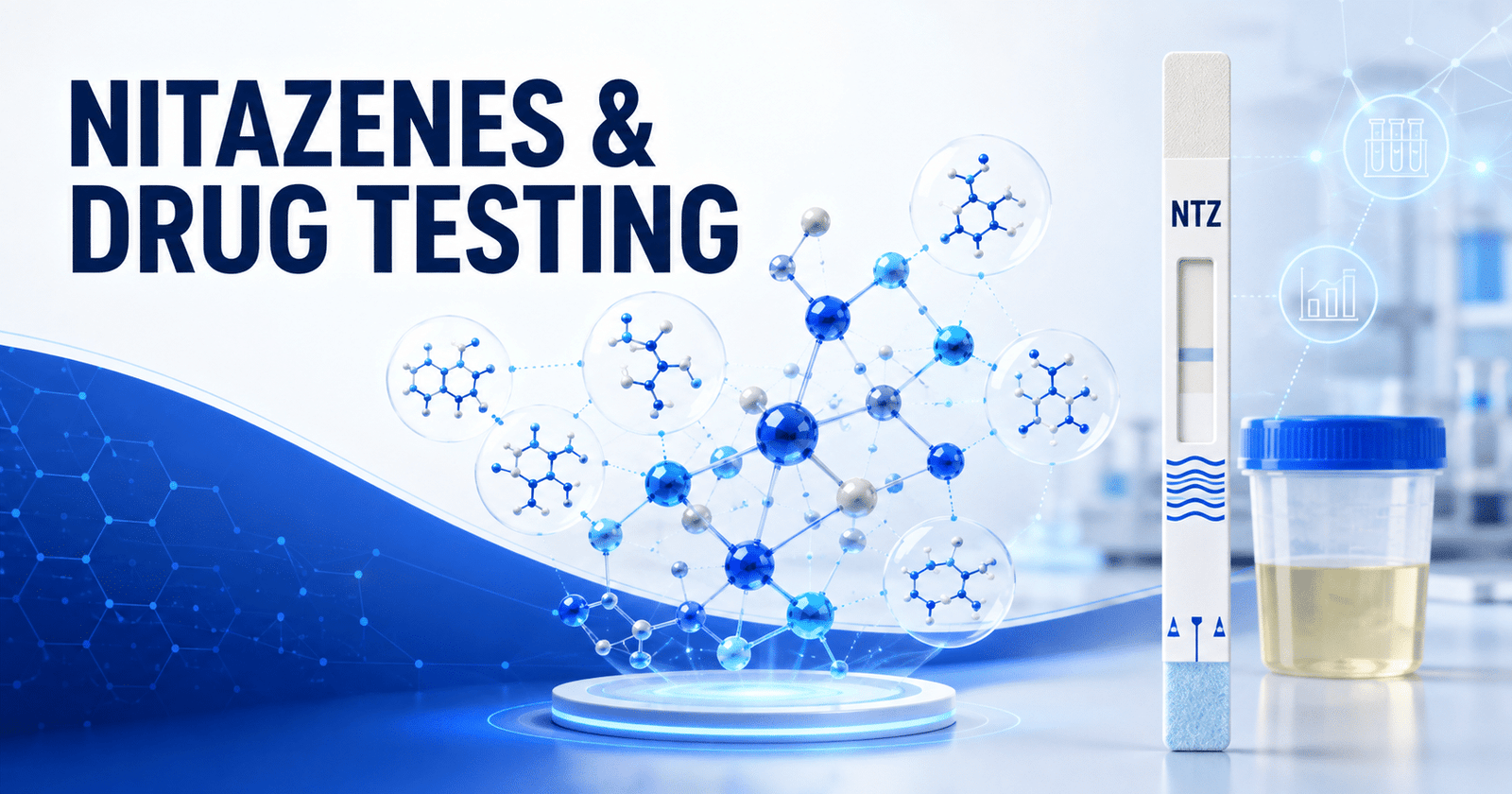

Nitazenes are a class of potent synthetic opioids derived from 2-benzylbenzimidazole. They are chemically different from fentanyl and conventional opiates, and many standard drug-test panels do not specifically screen for them. A program requiring nitazene screening must use a test that expressly lists an NTZ or nitazene target.
Nitazene potency varies substantially among compounds. Some analogues have demonstrated potency similar to fentanyl, while others have exceeded it. A single potency claim should therefore never be applied to every nitazene.
According to the United Nations Office on Drugs and Crime, 34 nitazene analogues had been reported to its Early Warning Advisory by February 2026. Nitazenes had been detected in seized samples and toxicology casework across at least 37 countries.
Nitazenes at a Glance
| Question | Answer |
|---|---|
| What are nitazenes? | A class of 2-benzylbenzimidazole synthetic opioids |
| Are they the same as fentanyl? | No. They are structurally different synthetic opioids |
| Are they approved medications in the United States? | No nitazene has been approved for medical use in the United States |
| Do standard opiate panels detect them? | They should not be assumed to do so |
| Do fentanyl panels detect them? | They should not be assumed to do so |
| Is targeted urine screening available? | Yes, through a test that specifically lists an NTZ target |
| Can one rapid test detect every analogue? | No. Detection depends on the assay and its cross-reactivity |
| Is a rapid result definitive? | No. It is a preliminary qualitative screening result |
Why Are Nitazenes Considered Emerging Synthetic Opioids?
Nitazenes were investigated decades ago as possible pain-relieving compounds but were never approved for medical use in the United States. Isotonitazene was reported to the UNODC Early Warning Advisory in 2019, followed by a growing number of related compounds.
The drug supply continues to change as new analogues appear. In May 2026, the Drug Enforcement Administration reported 22 unique nitazene compounds since 2020, 21 of which were listed as Schedule I controlled substances.
UNODC reported that protodesnitazene, one of the substances first reported during 2025 and 2026, had already been identified by nine countries across five continents. Nitazenes and structurally distinct orphine analogues represented the largest share of newly reported substances appearing across multiple continents during that period.
Where Are Nitazenes Being Found?
Nitazenes have been identified in powders, falsified pharmaceutical tablets and products sold as other drugs. Their presence may not be disclosed to the person receiving the product.
A limited UNODC dataset covering 2,679 synthetic-opioid samples reported by 12 countries between 2024 and 2026 found nitazenes most often in tablets, at 60%, followed by powders, at 33%. These percentages describe only samples with reported product-form information and should not be interpreted as worldwide prevalence.
Additional examples documented by the UNODC Early Warning Advisory include synthetic opioids appearing in falsified benzodiazepine or opioid tablets, vape liquids, powders sold as heroin or cocaine, impregnated paper and other unexpected forms.
Examples of Nitazene Analogues
The following are examples rather than a complete list:
- Isotonitazene
- Metonitazene
- Protonitazene
- Etonitazene
- N-desethyl isotonitazene
- N-pyrrolidino protonitazene, also called protonitazepyne
- N-pyrrolidino metonitazene, also called metonitazepyne
- Protodesnitazene
Each compound may have different potency, metabolites, cross-reactivity and laboratory-detection requirements. A test that recognizes one analogue may not adequately recognize another.
Nitazenes, Fentanyl, Opiates and Orphines Are Different Targets
| Drug group | Examples | Testing consideration |
|---|---|---|
| Nitazenes | Isotonitazene, protonitazene and metonitazene | Requires a specifically validated NTZ screen or laboratory method |
| Fentanyl-related substances | Fentanyl and norfentanyl | Requires a fentanyl or norfentanyl assay |
| Conventional opiates | Morphine and codeine | Commonly screened through OPI or MOR panels |
| Orphine analogues | Brorphine and cychlorphine | Structurally distinct from both fentanyl and nitazenes |
A negative OPI or fentanyl result should not automatically be interpreted as a negative nitazene result. Likewise, a nitazene test should not be assumed to detect cychlorphine or other orphine analogues.
Do Standard Drug Tests Detect Nitazenes?
Many routine urine panels do not contain a dedicated nitazene assay. A 5-panel, 10-panel or 12-panel test may screen for conventional opiates while providing no targeted information about nitazenes.
Fentanyl also requires its own assay. A test labeled FEN, FYL or NFYL should not automatically be treated as a nitazene test because the antibody and target compounds are different.
The CDC’s investigation of nitazene-related deaths noted that traditional toxicology panels do not always capture nitazenes. The appropriate test depends on the specimen, intended use, target compound, cutoff and decision being made.
Urine Screening, Drug Checking and Laboratory Testing
Products described as nitazene test strips can be designed for very different specimens. These products are not interchangeable.
| Testing method | Specimen | What it examines | Main limitation |
|---|---|---|---|
| Rapid urine screening | Human urine | A target specified by the test manufacturer after possible exposure | Does not necessarily detect every analogue |
| Drug-supply checking | Diluted powder, residue or liquid | Possible presence of a target in a drug sample | Does not test a person and does not establish safety or purity |
| Definitive laboratory testing | Urine, blood, tissue or seized material | Specific compounds using an appropriate validated analytical method | Only compounds included in the method or identified through broader analysis will be reported |
DrugTestingCup’s NTZ/1000 nitazene drug test strip is designed for human urine. It must not be used to test pills, powders, beverages, residue or liquid drug samples.
How the NTZ/1000 Urine Test Works
The NTZ/1000 strip is a single-panel urine dip test that provides a preliminary qualitative result at a listed cutoff of 1,000 ng/mL. The strip is dipped for 10 to 15 seconds, and the result is read at approximately five minutes.
Always follow the package insert when its procedure or reading window differs from general instructions. The manufacturer documentation should also be reviewed for the exact target compound and cross-reactivity profile.
Negative result
A control line and test line indicate a negative screening result. A faint test line should be interpreted according to the package insert.
Preliminary non-negative result
A control line with no test line indicates a preliminary non-negative result. It is not a definitive identification of a nitazene compound.
Invalid result
If the control line does not appear, the test is invalid and the specimen should be retested with a new device according to the instructions.
Can a Negative NTZ Test Rule Out Every Nitazene?
No. A negative result cannot rule out:
- A concentration below the test cutoff
- An analogue that the assay does not adequately recognize
- Exposure outside the test’s effective detection period
- A specimen or procedure problem
- An emerging synthetic opioid outside the nitazene class
UNODC has warned that nitazene immunoassay strips used for drug checking are generally developed around a limited subset of compounds. Structurally different analogues may have weak or no cross-reactivity. Those findings do not establish the performance of a particular urine test, but they demonstrate why product-specific validation data must be reviewed.
What Does a Preliminary Non-Negative Result Mean?
A preliminary non-negative result means the screening response met the device’s criteria at the time the test was read. It does not establish:
- The exact nitazene compound present
- The concentration in the specimen
- The dose or time of exposure
- Current impairment
- Whether the exposure was intentional
- Whether another synthetic opioid is also present
When a result may affect a legal, supervisory or other consequential decision, confirmation should be performed through an appropriate validated laboratory method capable of identifying the relevant compound.
Who May Consider Targeted Nitazene Screening?
The NTZ/1000 product is currently listed as Forensic Use Only. It should be used only by eligible users and in settings consistent with its labeling, manufacturer documentation and applicable law.
Potential forensic applications may include authorized law-enforcement, court, probation, parole, correctional or forensic laboratory programs. The product should not be presented as a universal workplace, clinical, rehabilitation or consumer testing solution.
Programs requiring broader urine screening can review the 28-panel drug test cup. Before purchasing, verify the exact NTZ target, cutoff, intended use and current package insert for the selected SKU.
Are Nitazenes Included in DOT Drug Testing?
Nitazenes are not listed as authorized analytes in the current DOT urine-testing cutoff table. Under 49 CFR 40.13, a DOT specimen cannot be tested for additional unauthorized drugs.
Any employer-directed non-DOT testing must remain completely separate from the DOT test. A rapid NTZ urine strip is not an official DOT test and should not be described as DOT compliant.
Nitazene Overdose and Naloxone
Nitazenes are opioids and can cause severe respiratory depression. Possible opioid-overdose signs include unconsciousness, pinpoint pupils and slow, irregular or absent breathing.
A suspected overdose is a medical emergency. Call 911 immediately and administer naloxone if it is available. Additional naloxone doses may be needed according to the product’s instructions and emergency guidance. Provide breathing support if trained and remain with the person until emergency help arrives.
Do not delay emergency treatment while waiting for a drug-test result. The World Health Organization states that timely naloxone and basic life support can prevent death from opioid overdose.
Sources and Editorial Review
This guide was last fact-checked in August 2026 using the following authoritative sources:
- UNODC: Increasing nitazene and orphine analogues and test-strip implications
- UNODC: Synthetic opioids appearing in new and unexpected forms
- DEA: Fentanyl mixed with emerging synthetic drugs
- CDC: Nitazene-related deaths and toxicology limitations
- 49 CFR 40.85: Current DOT urine drug-testing analytes and cutoffs
Product specifications must be checked against the current package insert for the exact SKU before publication or purchase. This article provides educational information and is not medical or legal advice.
Frequently Asked Questions
What are nitazenes?
Nitazenes are a class of potent 2-benzylbenzimidazole synthetic opioids. Examples include isotonitazene, protonitazene, metonitazene and several newer analogues.
Does a standard drug test detect nitazenes?
Many standard drug-test panels do not include a dedicated nitazene target. A test should specifically list NTZ or the applicable nitazene compound before it is used for targeted screening.
Will a fentanyl test detect nitazenes?
A fentanyl test should not be assumed to detect nitazenes. Fentanyl and nitazenes are structurally different and generally require different assays.
What does NTZ/1000 mean?
NTZ identifies the listed nitazene screening target, while 1000 indicates a cutoff of 1,000 ng/mL for this specific urine test. Review the package insert for the exact target and cross-reactivity.
Can a negative NTZ test rule out every nitazene?
No. A negative result cannot rule out a concentration below the cutoff, an analogue the assay does not adequately recognize or another emerging synthetic opioid outside the test’s target.
Is nitazene the same as nitrazine or nitrazepam?
No. Nitazene is not a synonym for nitrazine, and nitazenes are not the same as nitrazepam, which is a benzodiazepine. Product names and panel abbreviations should be verified carefully.
Are nitazenes included in DOT drug testing?
No nitazene analyte appears in the current DOT urine-testing cutoff table. DOT specimens cannot be tested for additional unauthorized drugs, and a rapid NTZ strip is not an official DOT test.
Can naloxone reverse a nitazene overdose?
Naloxone can reverse opioid effects caused by nitazenes, although additional doses may be necessary. Call 911 immediately, administer naloxone according to its instructions and provide breathing support if trained.
IN THIS ARTICLE