Drug Testing Cups Guide: Urine, Saliva & Multi-Panel Tests
This drug testing cups guide explains how to compare urine cups, oral fluid tests and dip cards, choose a multi-panel configuration, and understand preliminary screening results. Start with the specimen type, required assays and intended use before comparing product prices.
Urine drug testing cups combine specimen collection and preliminary screening in one device. Oral fluid tests and dip cards use different collection methods, so their instructions and handling requirements should be compared separately. Explore our drug testing cups alongside this guide to review the specifications of individual products.
Whether you are replacing an existing device or selecting supplies for a new testing program, the goal is the same: identify a suitable configuration, understand its limitations and establish a consistent process for using it.
Urine Drug Testing Cups, Saliva Tests and Dip Cards
Different test formats serve different collection needs. Before comparing prices, identify the specimen your program uses, the substances it needs to screen for and the setting in which the device will be used.
A product that fits one collection procedure may not be interchangeable with another. Compare the complete process, including required supplies, collection instructions and result interpretation.
Urine Drug Testing Cups
A urine drug testing cup incorporates screening panels into the collection container. Depending on the device, testing may begin through direct contact with the specimen or require a separate activation step.
Check the specific cup’s collection volume, activation method and result-reading instructions. Some configurations also include a temperature strip or other specimen checks, but these features should be verified for the individual product.
Browse our urine drug test cup collection to compare available configurations and product specifications. Review the individual listing and manufacturer’s documentation before selecting a replacement for an existing SKU.
Saliva and Oral Fluid Tests
Saliva drug tests use a swab or absorbent collector to obtain oral fluid. Collection can be observed without a restroom, which may simplify the collection process in an appropriate testing program.
Preparation, sample sufficiency and reading times depend on the device. Follow its collection instructions carefully, including any restrictions on eating, drinking or other activities before collection.
Explore our oral swab drug tests and review the instructions and permitted use of each device.
Dip Cards and Drug Test Strips
Dip cards and strips are used with a separately collected urine sample. The device is applied to the specimen as directed by its instructions, including the required dip depth and exposure time.
When comparing costs, include the collection container and other handling supplies. A lower device price does not necessarily mean a lower total cost for the complete testing process.
Our dip card tests provide another format to consider when separate specimen collection fits your procedure.
| Test format | Specimen | What to check before choosing |
|---|---|---|
| Integrated drug test cup | Urine | Panel list, activation method, collection volume and included specimen checks |
| Oral swab device | Oral fluid | Collection instructions, sample-sufficiency indicator and permitted use |
| Dip card or strip | Urine | Separate collection supplies, dip depth and the device’s reading window |
Multi-panel describes the screening configuration, not a separate specimen type. Both urine and oral fluid devices can contain multiple assays. Always check the panel list for the individual product.
Drug Testing Cups Guide: Choosing a Panel Configuration
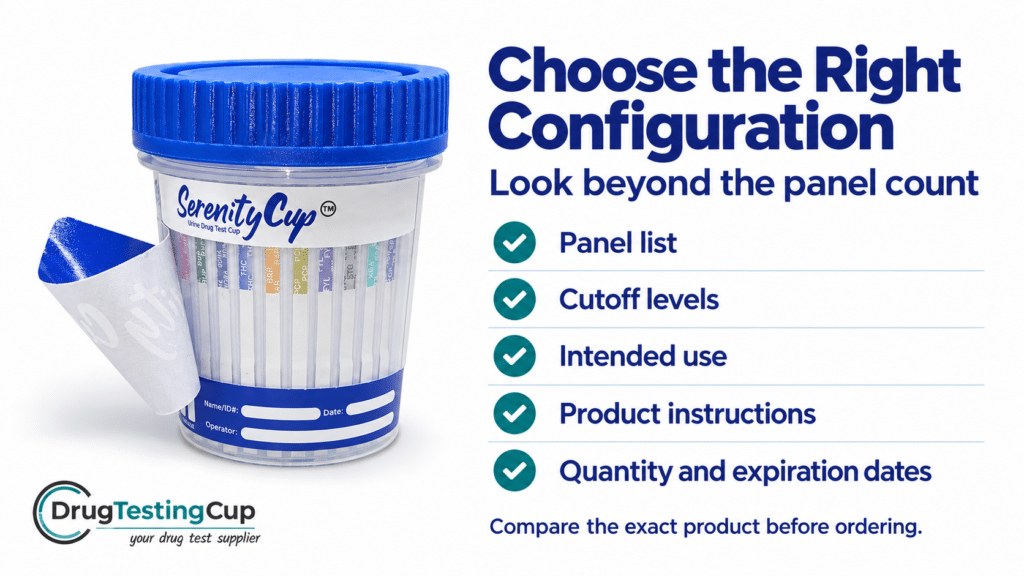
A panel count helps organize a catalog, but it does not define a universal drug list. Two products with the same number of panels can screen for different targets or use different cutoff concentrations.
Start with a written list of required targets. Record the full target name, abbreviation and cutoff shown on the product documentation. Note whether each assay screens a drug class, an individual substance or a metabolite.
These distinctions matter when comparing products. A familiar brand name or panel count does not establish that a replacement offers equivalent screening coverage.
For example, a general opiate assay does not establish that a cup also includes a dedicated fentanyl assay. Likewise, a THC panel and a synthetic-cannabinoid panel should not be treated as interchangeable. ARUP’s drug testing guidance explains why assay coverage and limitations matter.
You can review 10-panel drug test cup configurations or 12-panel drug test cup configurations as starting collections. Open the individual listings and compare their specifications side by side.
A useful purchasing rule is to compare the exact assay list, cutoffs and intended use for every shortlisted SKU. Treat a different configuration as a separate purchasing decision, even when the brand and panel count look familiar.
Add a specialty target when it serves an identified testing requirement and the selected device is suitable for that use. A higher panel count is useful only when the additional assays support your program’s needs.
 Understanding Drug Test Cup Results
 Understanding Drug Test Cup Results
Rapid drug tests provide preliminary screening information. Interpretation depends on a valid test, the targeted assay and the manufacturer’s reading instructions.
Record results using your program’s approved terminology and review them through its established process. MedlinePlus explains drug-test results and follow-up testing.
Negative Results
A negative result means the assay did not meet its positive screening criterion. It does not rule out every substance, use outside the detection window or a concentration below the test’s cutoff.
A test can only provide information about the targets included in its configuration. A negative result for one assay should not be treated as evidence about a substance the device does not screen for.
Non-Negative Results
A non-negative result is a preliminary finding that needs appropriate follow-up. It does not establish a dose, misuse of a prescription or current impairment.
Follow the program’s procedure for appropriate laboratory confirmation and review. For home-use screening, the FDA advises laboratory follow-up for preliminary positive findings before serious action is taken. Read the FDA’s explanation of drug screening results.
Invalid Results
An invalid result occurs when the required control or another validity condition is not met. Do not report the affected assay as a valid drug result.
Follow the product insert and your procedure for a repeat test or recollection. Document the issue so recurring problems with collection, handling or test performance can be investigated.
Follow the Device’s Reading Instructions
Read the result window at the time specified for the device. Do not apply one universal rule about timing or line appearance to every test format.
Use our guide to reading a drug test cup alongside the actual product insert. For additional background on screening limitations, see what can cause a false-positive drug test.
Drug Test Cutoffs and Detection Windows
A cutoff is the assay’s decision threshold. It is not a measure of how impaired a person is.
Compare cutoff values with their target, specimen type and units. A number on one configuration cannot be assumed to apply to another. Our drug test cutoff guide explains the terminology in more detail.
Detection depends on the substance, specimen, assay, timing of collection and individual factors. Oral fluid and urine have different detection characteristics, but neither offers one guaranteed time window for every drug or every person.
A screening result also cannot reliably establish an exact time of use. ARUP’s overview of drug testing provides additional context on specimen selection and interpretation.
For purchasing, the practical question is whether the documented assay supports your program’s purpose. Ask the supplier for the exact specification instead of selecting a device from a general detection-time chart.
Keep that specification with the ordering record so future staff can understand why the item was chosen. Use our drug detection times overview as background; individual timelines are not guarantees.
Collection, Storage and Quality Checks
Before introducing a device, make its instructions available to the people who will use it. Assign responsibility for checking packaging, expiration dates, specimen requirements, timing and documentation.
A change of product or insert should prompt a review of the procedure. Similar-looking devices may have different handling requirements.
Specimen Checks
Some urine cups include a temperature strip or additional checks such as pH, creatinine or specific gravity. Confirm which features are present on the exact configuration.
A temperature reading alone does not prove that a specimen is authentic. An unusual specimen check should be handled through the program’s review process rather than treated as a final conclusion by itself.
Storage and Expiration Dates
Use the storage range and handling requirements printed on the packaging. Plan stock rotation around the expiration dates of the actual lots supplied.
A general shelf-life claim cannot tell you how much usable life remains on a shipment. For recurring orders, confirm that the remaining shelf life fits your expected usage and storage capacity.
For clinical waived testing, the CDC’s waived-testing resources provide guidance on staff preparation, following instructions and maintaining consistent testing processes.
CLIA-Waived, Forensic and DOT Testing Requirements
The setting in which a device will be used is an essential part of product selection. A suitable panel list does not establish that a device is appropriate for every testing program.
Clinical Testing and CLIA-Waived Options
CLIA status applies to the specific test system. It should not be assumed from the brand name, panel count or appearance of the cup.
U.S. facilities performing applicable human diagnostic testing must meet the relevant CLIA requirements. A waived test does not remove the need to consider the facility’s certificate and responsibilities. Review the CMS CLIA overview for the program’s scope.
Use our CLIA-waived drug test cup collection to identify options, then verify documentation for the exact item. FDA clearance and CLIA categorization are distinct details to check.
Forensic and Other Labeled Uses
A Forensic Use Only designation is a meaningful restriction. It does not establish suitability for routine clinical, home or ordinary workplace screening.
Review the actual label before recommending a device for a particular audience. Our Forensic Use Only and intended-use information provides additional context.
Can Instant Drug Test Cups Be Used for DOT Testing?
Instant cups are not an authorized DOT drug-testing method.
Under 49 CFR §40.210, point-of-collection urine tests, point-of-collection oral fluid tests and instant tests are not authorized for DOT drug testing. An instant screening cup is not a substitute for the required DOT laboratory process. Read the official DOT testing rule.
For non-DOT workplace programs, product selection should follow the organization’s policy, applicable requirements and the device’s labeling. Define who authorizes testing, who reviews results and how confidential records are handled. SAMHSA’s workplace drug testing resources can help with program planning.
A Buying Checklist for Drug Testing Supplies
Use the buying checklist in this drug testing cups guide to turn your requirements into a clear product specification. Give suppliers the same required assays, cutoffs, intended-use requirements and quantities so their proposals can be compared consistently.
If an item is unavailable, ask the supplier to identify every difference in the suggested replacement.
- Describe the testing setting. State the program type, specimen and intended use. Identify who approves the device for that setting.
- List the required assays. Include target names, abbreviations, cutoffs and any required specimen checks. Attach the current specification when replacing an existing SKU.
- Confirm the full order quantity. Separate devices per pack, packs per case and total tests. Check that quoted quantities match the number of usable devices you expect to receive.
- Request documentation and lot details. Ask for the product insert, applicable status documentation and remaining shelf life. Keep the approved information with the purchasing record.
- Compare the complete supply cost. Include collection containers, other required supplies, shipping and your program’s confirmation arrangements. Clarify delivery dates and substitution terms.
- Plan the next replenishment. Base recurring orders on expected use, storage capacity and expiration dates. Record the exact approved SKU for consistent reordering.
For a multi-location organization, one shared specification can make receiving and reordering easier. Each location should know which product is approved, how to record a lot change and whom to contact if packaging or assay information differs from the purchase order.
Keep the selection process practical: make a short list, compare the documentation and resolve differences before placing the order.
To compare available options, contact DrugTestingCup for configuration assistance and bulk pricing. Include your specimen type, required assays, intended-use requirements and expected quantity.
Frequently Asked Questions
Are urine cups and oral swab tests the same thing?
No. A urine test cup collects and screens urine. An oral swab device collects oral fluid. Compare each device’s specimen requirements, panel configuration, instructions and permitted use before choosing.
Do two 12-panel cups always test for the same substances?
No. The assay list and cutoffs can differ even when the panel count is the same. Compare the exact product documentation and SKU rather than assuming that one configuration replaces another.
Does a screening result show current impairment?
No. A drug-screening result does not establish current impairment, the amount consumed or an exact time of use. Interpretation depends on the assay and the appropriate review process.
Can I use an instant drug test cup for DOT testing?
No. DOT’s 49 CFR §40.210 does not authorize instant or point-of-collection urine or oral fluid drug tests for DOT drug testing. Use the required DOT laboratory testing process.
What should happen after a non-negative screen?
Follow the program’s procedure for appropriate laboratory confirmation and review. Treat the finding as preliminary and avoid drawing a final medical, employment or misuse conclusion from the rapid screen alone.
What information should I send for a bulk quote?
Include your testing setting, specimen type, required assays and cutoffs, intended-use requirements, total quantity and delivery needs. Add the current approved SKU and documentation if you are comparing a replacement.