

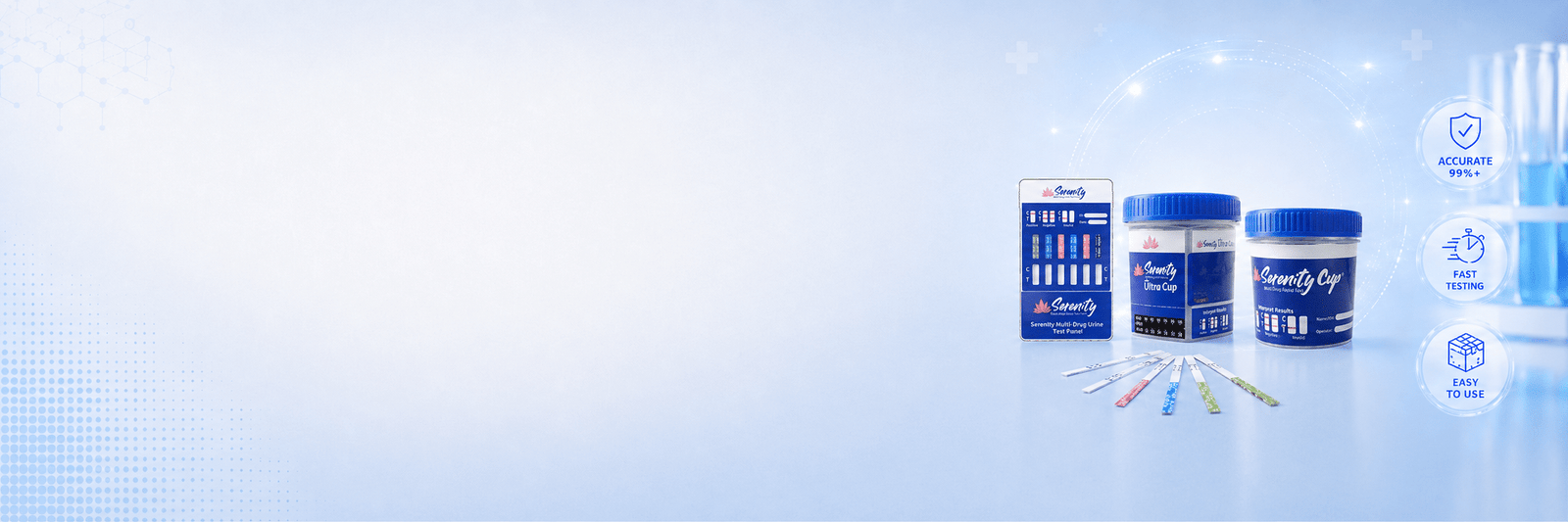
Drug Test Instructions
Serenity Cup drug test instructions must match the exact device in your package. The Serenity reference inserts reviewed for this guide specify reading the drug-screening results at five minutes and not interpreting them after ten minutes. Check your supplied insert before applying that timing to your cup.
Different devices can use different specimen requirements, activation steps and result methods. A drug-assay chart must not be used to interpret an hCG pregnancy test, an alcohol color pad or a specimen-validity pad.
First, identify the test you have
Match the product name, configuration and package insert. Check that the package is sealed, the device has not expired and its storage requirements have been followed.
| Test or indicator | Which instructions apply? |
|---|---|
| Serenity competitive urine drug assays | The matching Serenity cup insert and its drug-assay result chart |
| hCG assay | The separate hCG interpretation in the exact device insert |
| Alcohol color pad | The device-specific alcohol instructions and supplied color chart |
| Specimen-validity pads | The matching validity-pad timing and reference chart |
| Oral-fluid tests, dip cards or other devices | The instructions supplied for that exact format |
If you cannot identify the matching instructions, contact us for product-document support before testing. Include the product link or code and a clear photo of the pouch or box.
Find the instructions for your test
How to Use a Urine Drug Test Cup
These steps follow the Serenity Cup inserts reviewed for this guide. The package insert supplied with your device always takes priority.
- Check the device. Confirm the product name, panel configuration and expiration date, and that the pouch is sealed. If the cup was stored cold, let it reach room temperature before opening.
- Collect the specimen. Open the pouch just before use, label the cup and have the donor provide urine up to at least the minimum level marked on the cup. Close the cap tightly.
- Check the temperature strip. Read it within 4 minutes of collection. A fresh specimen should read between 90 and 100 °F (32–38 °C).
- Start the test. Place the cup on a flat surface. If your cup uses push-button or click activation, activate it as the insert directs. Peel off any label covering the result window and start a timer.
- Read the results. Read each drug panel at 5 minutes and do not interpret results after 10 minutes. Read any adulterant (ADLTX) pads against the color chart at the time stated in the insert.
- Record and confirm. Record each panel on a drug test result form and send non-negative specimens to a laboratory for confirmation.
How to Use a Drug Test Dip Card
Dip cards test a urine specimen that has already been collected in a separate cup.
- Prepare. Bring the dip card and specimen to room temperature (59–86 °F / 15–30 °C). Open the pouch only when you are ready, and run the test within an hour of opening.
- Collect urine in a clean, dry specimen cup.
- Dip the card. Remove the cap and dip the absorbent end straight into the urine, no deeper than the MAX line, for 10 to 15 seconds.
- Lay it flat. Replace the cap, place the card on a clean, flat, non-absorbent surface and start a timer.
- Read at 5 minutes. Check the C and T lines for each panel. Do not interpret results after 10 minutes unless your insert states a different window.
- Record and confirm non-negative results with a laboratory.
How to Use Drug Test Strips and Cartridges
Single-drug test strips and cartridges screen for one drug per device and use the same line-reading rules as cups and dip cards.
- Prepare the device and specimen at room temperature and open the pouch just before use.
- Test strip: hold the strip by the top with the arrows pointing toward the urine, dip it no deeper than the MAX line for 10 to 15 seconds, then lay it flat on a non-absorbent surface.
- Cartridge: place it on a flat surface and add the number of urine drops stated in the insert to the sample well, using the supplied dropper.
- Read at 5 minutes and do not interpret results after 10 minutes.
Fentanyl strips sold for harm reduction (drug checking) are used and read differently from urine drug tests. Follow the instructions supplied with that product.
How to Use an Oral Fluid (Saliva) Drug Test
- Wait before collecting. Most oral fluid inserts require the donor to have nothing in the mouth, including food, drinks, gum and tobacco, for at least 10 minutes before collection. Use the time stated in your insert.
- Check and open the device just before collection.
- Collect oral fluid. Place the collection sponge in the mouth as directed, usually by swabbing the cheeks, gums and tongue and then holding it under the tongue. If the device has a saturation indicator, wait until it changes color. Do not chew the sponge.
- Start the test. Insert or close the collector in the test device exactly as the insert directs, then start a timer.
- Read the results within the window stated in the insert. Our product catalog lists saliva test results in about 2–5 minutes; do not read after the maximum time. Read any alcohol (ALC) pad against its color chart at the stated time.
- Record and confirm non-negative results with a laboratory.
Saliva cutoffs are much lower than urine cutoffs, so the two cannot be read from the same chart. See the oral fluid table in our drug test cutoff chart.
How to read the drug-assay lines
Read each labeled drug assay separately and within its specified reading time.
| Control line C | Test line T | Drug-screen interpretation |
|---|---|---|
| Visible | Visible, including a faint colored line | Negative screen for that assay |
| Visible | Absent | Preliminary non-negative screen for that assay |
| Absent | Visible or absent | Invalid assay |
For the competitive drug assays in these inserts, a faint colored test line still counts as a test line. Its intensity must not be used to estimate drug concentration.
An invalid assay is neither negative nor non-negative. Review the collection and testing procedure and repeat with a new device as directed by the insert. If the problem persists, follow the insert’s instructions for discontinuing use and contacting the supplier.
For additional cross-brand explanations, see how to read a drug test cup.

Drug codes and cutoff levels: a scoped reference
The table below is an excerpt from the supplied Serenity Multi-Drug Urine Test Cup Forensic Use Only reference insert, filename beginning 1624070206. It is not a specification sheet for every cup sold on this website, and it does not establish which assays are included in your cup.
Display codes are retained from that reference insert. For example, that document uses FYL for fentanyl. Do not substitute a different display code or cutoff on a product page without checking the actual label.
| Reference-insert code | Test / reference analyte | Cutoff in that insert, ng/mL |
|---|---|---|
| AMP | Amphetamine | 1,000 |
| BAR | Barbiturates | 300 |
| BUP | Buprenorphine | 10 |
| BZO | Benzodiazepines | 300 |
| COC | Cocaine, calibrated with benzoylecgonine | 300 |
| EtG | Ethyl glucuronide | 300 |
| FYL | Fentanyl | 20 |
| K2 | Synthetic cannabinoids, JWH-073/JWH-018 reference | 50 |
| KRA | Kratom, calibrated with mitragynine | 500 |
| MDMA | Methylenedioxymethamphetamine | 500 |
| MET | Methamphetamine | 1,000 |
| MTD | Methadone | 300 |
| OPI | Morphine | 300 or 2,000, configuration dependent |
| OXY | Oxycodone | 100 |
| PCP | Phencyclidine | 25 |
| TCA | Tricyclic antidepressants | 1,000 |
| THC | Marijuana metabolite | 50 or 200, configuration dependent |
| TRA | Tramadol | 100 |
These values are screening thresholds, not detection-time promises. The table is an excerpt, not an exhaustive list of assays in the reference document. Match the exact included assays and chosen cutoffs to the device label.
hCG results use a different interpretation
Do not apply the drug-assay chart above to an hCG test. In the hCG section of the reviewed Serenity reference insert, the meanings are:
| Control line C | Test line T | hCG interpretation in that reference insert |
|---|---|---|
| Visible | Visible | Positive hCG screen |
| Visible | Absent | Negative hCG screen |
| Absent | Visible or absent | Invalid |
This is an explanation of the reference insert, not a statement that your cup includes hCG or that a Forensic Use Only device is intended for home pregnancy testing. Use the matching label, read time and permitted-use instructions for the actual device.
Alcohol and specimen-validity pads are separate
An EtG drug-assay panel and an alcohol color pad must not be treated as interchangeable result formats. Use the exact alcohol device’s instructions and supplied color chart; do not estimate a blood alcohol concentration from the drug-assay lines on this page.
Some configurations also include specimen-validity indicators. The reviewed Serenity insert with three ADLTX indicators covers pH, specific gravity and creatinine. Those indicators are not extra drug panels, and their pad colors are not read using the C-and-T drug chart.
A temperature strip or a validity-pad result alone does not establish that every form of specimen substitution or adulteration has been ruled out.

Record Results and Check Cutoffs
What a screening result can and cannot tell you
A negative screen means the target was not detected at or above the assay’s screening threshold under the test’s conditions. It does not prove that all drugs are absent or explain an individual’s history.
A non-negative screen is preliminary. Follow the exact insert and applicable program procedure for confirmation with an appropriate laboratory method, such as GC/MS or LC/MS when indicated.
A rapid urine screen does not establish impairment, amount used, exact time of use or whether a substance was used lawfully or as prescribed. Do not make those conclusions from the cup alone.
Storage and document matching
The reviewed Serenity reference inserts specify sealed storage at 2–30°C (35.6–86°F), protection from light and no freezing. Use the printed expiration date; do not assume a fixed amount of shelf life remains when ordering.
The reference documents reviewed for this guide are:
- Serenity Multi-Drug Urine Test Cup Package Insert (FDA & CLIA), filename beginning 1624068805.
- Serenity Multi-Drug Urine Test Cup Package Insert (FUO), printing version, filename beginning 1624070206.
- Serenity Multi-Drug Urine Test Cup Package Insert (FDA & CLIA), with 3 ADLTX, filename beginning 1624073502.
A document’s filename does not establish the regulatory status of every product in the brand. Match the document to your exact device. To compare available products, return to the
Serenity Cup drug tests
Serenity Cup Regulatory Information
Serenity Cup drug tests are available in multiple configurations, and regulatory status can vary by the specific test, analytes and intended use. Certain Serenity Test Cup configurations are listed in the U.S. Food and Drug Administration databases with specific analytes and regulatory designations.
Always verify the exact product configuration, cutoff levels, intended use and package insert before testing. For an official regulatory reference, see the FDA CLIA database record for Serenity Test Cup.
Frequently Asked Questions
How long should I wait before reading a Serenity Cup?
The Serenity reference inserts reviewed for this guide specify reading drug-screening results at five minutes and not interpreting them after ten minutes. Use those instructions only when they match your exact device; another model or revision may differ.
Does a faint test line mean a non-negative drug result?
For the competitive drug assays described in the reviewed Serenity inserts, a visible control line and a colored test line, even if faint, indicate a negative screen when read within the specified time. Line intensity does not measure drug concentration.
What if the control line does not appear?
The affected assay is invalid, even if a test line appears. Review the procedure and repeat with a new device as directed by the package insert. Do not report an invalid assay as negative or non-negative.
Can I use the drug-result chart for hCG or alcohol color pads?
No. The reviewed Serenity insert gives hCG its own result interpretation, and alcohol color pads require their own instructions and color chart. Keep these methods separate from competitive drug-assay C and T lines.
Is a non-negative Serenity Cup result final?
No. It is a preliminary screening result. Follow the exact insert and the applicable confirmation procedure, using an appropriate laboratory method such as GC/MS or LC/MS when indicated.
How long do I dip a drug test dip card or test strip?
Dip it into the urine no deeper than the MAX line for 10 to 15 seconds, lay it flat, and read it at 5 minutes. Do not interpret the result after 10 minutes unless your package insert states a different window.
How long should a donor wait before a saliva drug test?
Most oral fluid inserts require at least 10 minutes with nothing in the mouth, including food, drinks, gum and tobacco, before collection. Use the waiting time stated in your device insert.
Can I use urine cup instructions for a saliva test?
No. Oral fluid tests use a different collection method, different cutoff levels and their own reading window. Follow the insert supplied with the saliva device.
Where can I record drug test results?
You can download a free printable and fillable result form for each of our cups from our printable drug test result forms page, then keep it with your program records.