

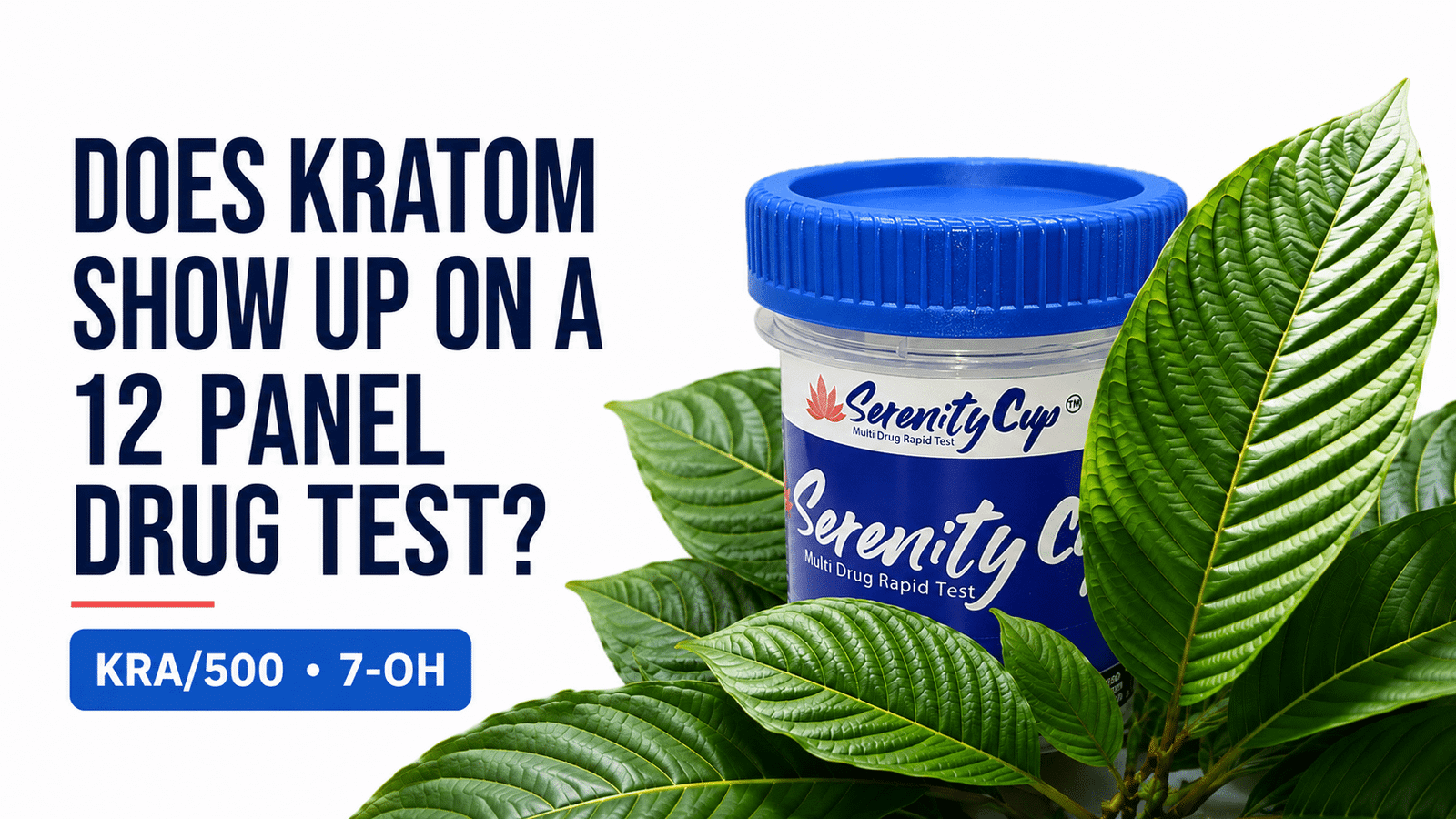

Does kratom show up on a 12 panel drug test? It can, but only when the specific test configuration includes a dedicated KRA panel. The words “12 panel” describe the number of test panels in the device; they do not guarantee that kratom, 7-OH or any other particular analyte is included.
A standard 12 panel urine drug test may screen for commonly tested drug classes such as amphetamine, methamphetamine, cocaine, marijuana, opiates, benzodiazepines, oxycodone and PCP. A specialized 12 panel drug test with kratom replaces one or more of those panels with a KRA assay.
Kratom testing can also involve mitragynine and 7-hydroxymitragynine, commonly abbreviated as 7-OH. Because the target analyte and cross-reactivity can differ between products, buyers should always review the exact manufacturer’s insert. For a detailed explanation of the compound and current testing considerations, read our guide explaining what is 7-OH and how it relates to kratom drug testing.
The Short Answer: Check for a KRA Panel
Kratom does not automatically show up on every 12 panel drug test. The device must list KRA among its included panels. If the product label, configuration table or package insert does not list KRA, it should not be presented as a kratom drug test.
This distinction is important because the term “12 panel” is not one universal drug list. Two 12 panel cups can screen for different combinations. One cup may include PCP and TCA, while another may include KRA, fentanyl, EtG or synthetic cannabinoids.
When a buyer asks, “does kratom show up on a 12 panel drug test,” the correct answer depends on the actual panel abbreviations—not simply the number printed in the product name.
Why Every 12 Panel Drug Test Is Not the Same
Manufacturers configure multi-panel urine cups for different testing requirements. The panel count tells you how many assays are included, but it does not identify those assays. This is why a product-specific panel table is more useful than a general description of a “standard” 12 panel test.
A conventional configuration may include PCP, TCA or barbiturates. A specialty configuration may replace those panels with KRA, EtG, fentanyl or K2. Both products can correctly be described as 12 panel cups, even though they screen for different substances.
Before purchasing a kratom drug test cup, verify the following information:
- KRA is listed in the panel configuration.
- The cutoff is shown on the product page or package insert.
- The manufacturer identifies the calibrator and applicable cross-reactivity.
- The intended-use designation matches your testing program.
- The collection volume, result window and storage requirements are suitable for your workflow.
Kratom, 7-OH and 7-Hydroxymitragynine
Kratom is derived from the plant Mitragyna speciosa. Two compounds commonly discussed in connection with kratom are mitragynine and 7-hydroxymitragynine. The latter compound is commonly shortened to 7-OH.
These terms should not be treated as interchangeable product specifications. A test labeled KRA/500 indicates a KRA assay with a stated cutoff of 500 ng/mL, but the abbreviation alone does not establish which compound was used as the calibrator. The product insert must be checked before stating whether a particular cup is calibrated to mitragynine, 7-OH or another designated analyte.
For example, the specifications shown for our dedicated KRA/500 kratom urine drug test strip identify 7-OH as the calibrator at 500 ng/mL and list mitragynine reactivity at a different concentration. Those specifications apply to that particular strip. They should not automatically be transferred to every cup or cartridge that carries a KRA/500 abbreviation.
This product-level distinction helps prevent inaccurate claims. It also explains why a kratom urine test must be selected by its documented assay specifications instead of by the panel count alone.
Which 12 Panel Drug Test Includes KRA/500?
The Serenity Kratom Drug Test Cup is a 120 mL multi-panel urine cup that includes a KRA/500 panel. Its live product configuration also includes K2, EtG and fentanyl alongside eight additional panels.
| Drug or analyte | Abbreviation | Cutoff |
|---|---|---|
| Amphetamine | AMP | 1,000 ng/mL |
| Buprenorphine | BUP | 10 ng/mL |
| Benzodiazepines | BZO | 300 ng/mL |
| Cocaine | COC | 300 ng/mL |
| Ethyl glucuronide | ETG | 300 ng/mL |
| Fentanyl | FEN | 20 ng/mL |
| Synthetic cannabinoids | K2 | 50 ng/mL |
| Kratom | KRA | 500 ng/mL |
| Methamphetamine | MET | 1,000 ng/mL |
| Opiates | OPI | 300 ng/mL |
| Oxycodone | OXY | 100 ng/mL |
| Marijuana metabolite | THC | 50 ng/mL |
The cup also has a built-in temperature strip, and results are generally interpreted at approximately five minutes according to the product instructions. The product is designated Forensic Use Only and is not CLIA waived.
Always review the instructions included with the current lot. The package insert controls when there is any difference between general website information and the instructions supplied with the device.
Standard 12 Panel Test vs 12 Panel Drug Test With Kratom
| Feature | Standard 12 panel configuration | 12 panel drug test with kratom |
|---|---|---|
| KRA panel | Not necessarily included | Specifically listed |
| 7-OH or mitragynine information | Usually not applicable | Must be verified in the exact insert |
| Panel selection | May prioritize PCP, TCA or other common panels | Uses KRA as one of the 12 panels |
| Best use | Programs that do not require kratom screening | Programs with a documented need for a KRA screen |
The specialty cup does not contain an extra thirteenth test simply because it includes KRA. KRA occupies one of the 12 available panel positions. Buyers should compare the full panel list to determine which other drug class has been replaced.
If kratom is not part of the testing requirement, review the broader selection of 12 panel drug test cups. If kratom is specifically required, select a configuration that clearly lists KRA.
Can OPI, THC, PCP or K2 Panels Detect Kratom?
A panel designed for opiates, marijuana, PCP or synthetic cannabinoids should not be treated as a substitute for a dedicated KRA assay. Kratom compounds are chemically different from the target analytes used for those panels.
A kratom drug test should therefore include a documented KRA assay. The absence of KRA from the configuration means the device was not specifically designed to screen for kratom-related analytes.
Cross-reactivity can be product-specific. A result on one panel cannot definitively identify the substance responsible for that result. Unexpected or preliminary non-negative results should be handled according to the testing program’s confirmation procedure.
Does a KRA/500 Panel Always Mean a 7-OH Test?
No. KRA/500 indicates the displayed panel abbreviation and cutoff, but it does not provide the complete analytical specification by itself. A buyer must inspect the manufacturer’s documentation to determine whether the assay is calibrated to 7-hydroxymitragynine, mitragynine or another stated compound.
This is especially important when comparing a cup, strip and cartridge. Products can share a KRA/500 label while using different antibodies, calibrators or cross-reactivity specifications.
Our existing guide to 7-OH, kratom and drug testing provides additional background about 7-hydroxymitragynine and current regulatory developments. That guide owns the broad 7-OH informational topic, while this page answers the narrower question about kratom and 12 panel tests.
Does Federal Workplace Drug Testing Include Kratom or 7-OH?
Current authorized federal workplace drug-testing panels do not list kratom, mitragynine or 7-OH as standard target analytes. A test being described as a 12 panel drug test does not mean that it follows a federal panel or that it includes kratom.
Organizations operating regulated testing programs should follow the rules that apply to their program and jurisdiction. A Forensic Use Only KRA cup should not be presented as a federally mandated workplace test, a CLIA-waived clinical diagnostic device or a general home-use product.
For current federal panel information, consult the applicable HHS Mandatory Guidelines and authorized testing panels.
How a Kratom Urine Test Result Works
A rapid kratom urine test is a qualitative screening test. It indicates whether the target response is below or at or above the device’s cutoff under the conditions described in its instructions. It does not provide a precise concentration.
Negative result
A negative result generally means the applicable target response was below the cutoff at the time the urine specimen was tested. It does not prove that kratom or 7-OH was never used.
Preliminary non-negative result
A preliminary non-negative result means the screening response met the device’s non-negative criteria. It should not automatically be reported as definitive identification of kratom, mitragynine or 7-hydroxymitragynine.
When policy, legal context or program requirements call for confirmation, the specimen should be sent to an appropriately qualified laboratory.
Invalid result
An invalid result occurs when the control indicator does not appear or another validity requirement is not satisfied. Do not interpret an invalid device as positive or negative. Repeat the test with a new device and follow the manufacturer’s instructions.
Can a Rapid KRA Test Identify the Exact Kratom Product?
No. A rapid KRA screen cannot establish whether a response came from kratom leaf, an extract, a concentrated 7-OH product or another preparation. It also cannot determine dose, timing, frequency of use or impairment.
The FDA has warned consumers about concentrated or enhanced products containing 7-OH. That issue should remain separate from the interpretation of a rapid screening device. A preliminary screen is not a complete chemical analysis of the consumed product.
Additional information is available in the FDA consumer update about products containing 7-OH.
How Long Can Kratom or 7-OH Be Detected in Urine?
There is no single detection period that applies to every person, specimen and KRA device. The result can be affected by the analyte targeted by the assay, device cutoff, product composition, amount and pattern of use, elapsed time, individual metabolism and urine concentration.
A cutoff also changes the practical detection window. A more analytically sensitive method may detect a target at concentrations below the threshold used by a rapid cup. This is one reason rapid screening results and laboratory findings should not be treated as identical measurements.
Use detection-window information only as a general planning reference. Do not use it to promise that a particular individual will test negative or non-negative at a particular time.
Choosing the Right Kratom Drug Test Format
| Testing need | Suggested format | Important check |
|---|---|---|
| Kratom plus multiple other panels in one collection | 12 panel KRA drug test cup | Verify the complete 12-panel configuration |
| A dedicated KRA screen without a multi-panel cup | KRA/500 kratom test strip | Verify calibrator, cutoff and reading time |
| A different multi-panel combination | Compare 12 panel cups | Do not assume every configuration includes KRA |
A kratom drug test cup is useful when collection and multi-panel screening need to occur in one device. A dedicated strip may be more appropriate when only the KRA assay is required. The correct choice depends on the documented panel requirement, intended use and product specifications.
Recommended Selection Process
- Write down every required drug or analyte before selecting the product.
- Confirm whether KRA is specifically required.
- Compare the complete panel list rather than relying on “12 panel” alone.
- Review the stated cutoff for each panel.
- Check the package insert for the KRA calibrator and cross-reactivity.
- Confirm the intended-use designation.
- Establish a procedure for invalid and preliminary non-negative results.
This process helps prevent the purchase of a standard 12 panel configuration when the actual requirement is a 12 panel drug test with kratom.
Frequently Asked Questions
Does kratom show up on a 12 panel drug test?
Kratom can show up only when the specific 12 panel configuration includes a dedicated KRA assay. A test that does not list KRA should not be expected to screen specifically for kratom-related analytes.
Does 7-OH show up on a 12 panel drug test?
Only a product with an appropriate documented assay may screen for 7-OH. The presence of KRA/500 on a device is not enough to identify the calibrator. Check the exact manufacturer’s insert for 7-hydroxymitragynine specifications.
Is KRA the same as 7-OH?
No. KRA is a panel abbreviation, while 7-OH is the shortened name for 7-hydroxymitragynine. Product documentation must identify the assay’s calibrator and relevant cross-reactivity.
What does KRA/500 mean on a drug test?
KRA/500 identifies a KRA screening panel with a stated cutoff of 500 ng/mL. It does not, by itself, provide the complete analyte and cross-reactivity specification.
Can an opiate panel detect kratom?
An opiate panel is not a substitute for a dedicated kratom drug test. Kratom screening requires a device that specifically lists KRA in its configuration.
Does federal workplace testing include kratom or 7-OH?
Current authorized federal workplace testing panels do not list kratom, mitragynine or 7-OH as standard target analytes.
Can a rapid test distinguish kratom leaf from a concentrated 7-OH product?
No. A qualitative rapid screen cannot identify the exact consumed product, determine the dose or establish impairment.
Is a preliminary non-negative KRA result final?
No. A rapid-screen result is preliminary. When confirmation is required by policy or context, the specimen should be evaluated by an appropriately qualified laboratory.
Choose a 12 Panel Test With the Correct Configuration
The answer to “does kratom show up on a 12 panel drug test” is determined by the panel list. Choose a device that explicitly includes KRA, verify the cutoff and review the manufacturer’s insert before use.
For a multi-panel option that includes KRA/500, review the Serenity 12 Panel Kratom Drug Test Cup. If only a dedicated KRA assay is required, compare the specifications of the KRA/500 kratom urine drug test strip.