

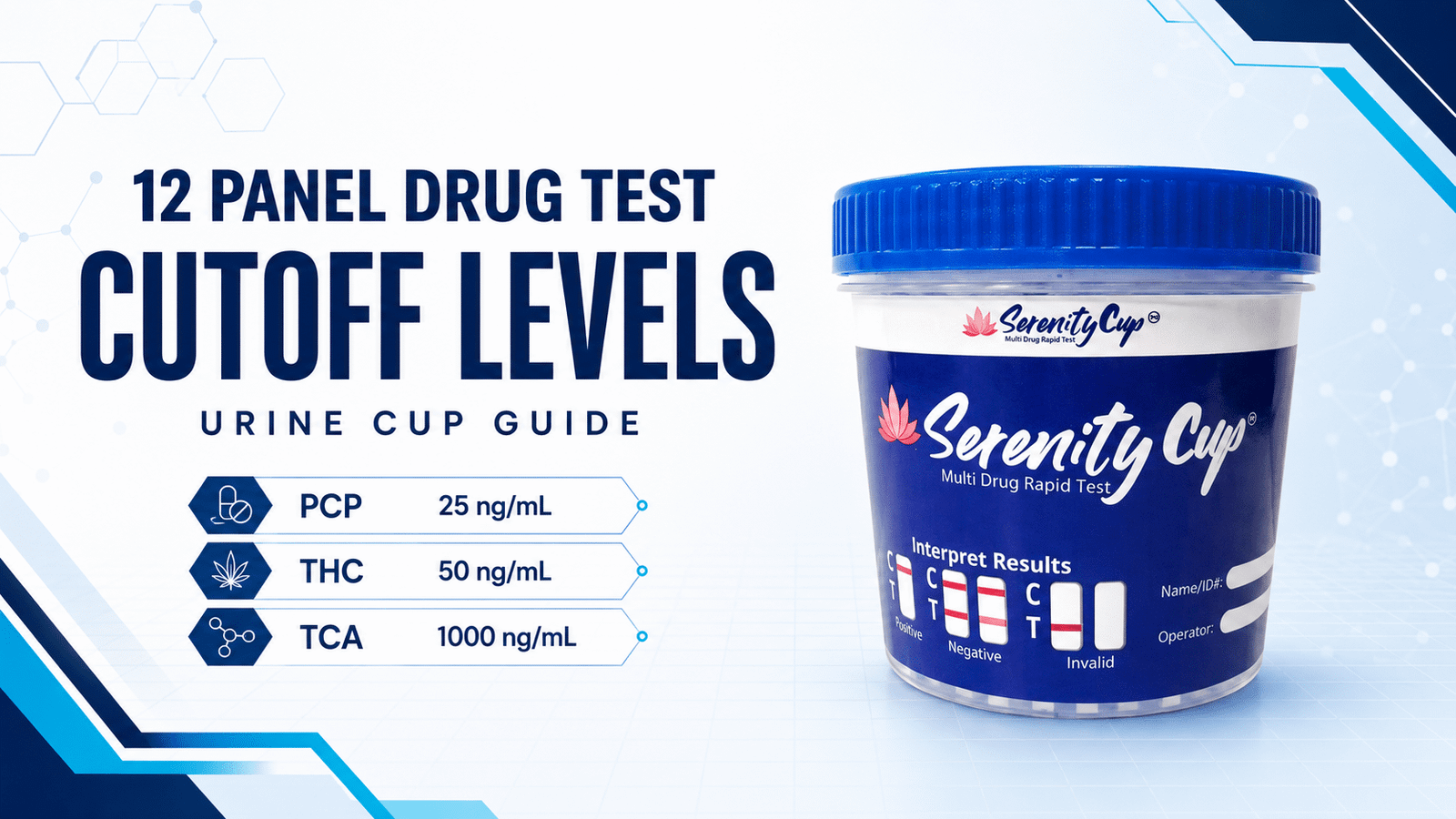

12 panel drug test cutoff levels
Understanding 12 panel drug test cutoff levels is essential when selecting a urine drug screening cup for a workplace, treatment program, correctional facility, rehabilitation center, clinical setting or other professional testing program. The cutoff level determines the concentration at which a screening device reports a drug or metabolite as a preliminary non-negative result.
However, not every 12 panel drug test cup screens for the same substances. Two products may both be described as 12 panel cups while using different configurations for PCP, TCA, EtG, fentanyl, synthetic cannabinoids, kratom or specimen-validity checks. Buyers should therefore compare the complete panel configuration and cutoff table instead of ordering by panel count alone.
This guide explains how urine drug screening cutoffs work, compares common 12 panel configurations and helps you select the appropriate product. You can also compare available 12 panel drug test cups before placing an order.
How Drug Test Screening Cutoffs Work
A drug test cutoff is the concentration used by the screening assay to separate a negative screening result from a preliminary non-negative result. Urine drug test cutoff levels are commonly expressed in nanograms per milliliter, abbreviated as ng/mL.
For example, a PCP screening cutoff of 25 ng/mL means the test is designed to produce a preliminary non-negative result when the assay detects PCP at or above its specified screening threshold. A concentration below that threshold generally produces a negative screening result.
The screening cutoff should not be confused with the smallest amount a laboratory instrument can detect. It is the decision point used by that particular test. Different drug classes and specialty assays can therefore have very different numerical cutoffs.
| Screening Outcome | General Meaning | Recommended Action |
|---|---|---|
| Negative | The target was not detected at or above the screening cutoff. | Document the result according to the applicable testing procedure. |
| Preliminary non-negative | The screening response reached the decision threshold for the target panel. | Obtain laboratory confirmation when required by policy, regulation or the intended use. |
| Invalid | The control indicator did not appear correctly or the test did not run as expected. | Do not report the result. Review the instructions and repeat the test with a new device. |
A negative result does not necessarily mean that a substance was never used. The concentration may be below the test cutoff, the specimen may have been collected outside the useful detection period or the substance may not be included in the cup’s panel configuration.
What ng/mL Means on a Drug Test Cup
The abbreviation ng/mL means nanograms of the target drug or metabolite per milliliter of urine. Because each test strip uses antibodies designed for a particular drug class or metabolite, numerical values should only be interpreted within the context of that specific assay.
A cutoff of 25 ng/mL for PCP should not be compared directly with a cutoff of 1,000 ng/mL for TCA. The difference does not automatically mean that one test is more sensitive or more accurate. These panels detect different targets and use different assay designs.
Common 12 panel urine drug test cutoff levels
The following table shows the configuration used by the standard 90 mL CLIA-waived 12 panel drug test cup. This configuration includes PCP and does not include TCA, EtG, fentanyl, K2 or adulteration checks.
| Drug or Drug Class | Abbreviation | Cutoff Level |
|---|---|---|
| Amphetamine | AMP | 1,000 ng/mL |
| Barbiturates | BAR | 300 ng/mL |
| Buprenorphine | BUP | 10 ng/mL |
| Benzodiazepines | BZO | 300 ng/mL |
| Cocaine | COC | 300 ng/mL |
| Ecstasy | MDMA | 500 ng/mL |
| Methamphetamine | MET | 1,000 ng/mL |
| Methadone | MTD | 300 ng/mL |
| Opiates | OPI | 300 ng/mL |
| Oxycodone | OXY | 100 ng/mL |
| Phencyclidine | PCP | 25 ng/mL |
| Marijuana | THC | 50 ng/mL |
This configuration is suitable when a testing program needs a broad traditional drug panel that includes PCP. Before ordering, verify the exact abbreviation and cutoff printed on the product label or documentation, especially when replacing a cup from another manufacturer.
Why 12 Panel Cup Configurations Can Be Different
The term “12 panel” describes the number of drug assays included in the cup, but it does not create a universal list of twelve substances. Manufacturers can replace one or more traditional panels with specialty targets designed for a particular testing program.
For example, one 12 panel cup may include PCP, while another replaces PCP with TCA. Other configurations may add EtG, fentanyl, K2 or kratom while removing several traditional panels. This is why buyers should review the full drug abbreviation and cutoff table for every product.
| 12 Panel Configuration | Specialty Target or Feature | Listed Cutoff | Product |
|---|---|---|---|
| Standard 12 Panel Cup | PCP | 25 ng/mL | View Standard 90 mL PCP Cup |
| 12 Panel TCA Cup | Tricyclic antidepressants | 1,000 ng/mL | View TCA 12 Panel Cup |
| 12 Panel K2 Cup – 120 mL | Synthetic cannabinoids | 50 ng/mL | View 120 mL K2 Cup |
| 12 Panel EtG and Fentanyl Cup | EtG and fentanyl | ETG 300 ng/mL; FEN 20 ng/mL | View EtG and Fentanyl Cup |
| Serenity Kratom Configuration | Kratom, K2, EtG and fentanyl | KRA 500; K2 50; ETG 300; FEN 20 ng/mL | View Kratom 12 Panel Cup |
| TCA Cup with ADLTX | TCA plus specimen-validity checks | TCA 1,000 ng/mL | View TCA and ADLTX Cup |
PCP and TCA Configurations
PCP and TCA are not interchangeable abbreviations. PCP refers to phencyclidine, while TCA refers to tricyclic antidepressants. A buyer who needs TCA screening should not assume that a standard PCP-based 12 panel urine cup includes it.
The 12 panel TCA test cup includes a TCA assay at 1,000 ng/mL. The standard 90 mL configuration instead includes PCP at 25 ng/mL. Checking this difference before ordering helps prevent purchasing a cup that does not screen for the required target.
Buyers comparing cup formats can also review the Serenity 12 panel PCP drug test kit, which includes PCP screening at a 25 ng/mL cutoff. Compare the complete configuration and product details before ordering.
EtG and Fentanyl Configurations
Testing programs that require alcohol-metabolite and fentanyl screening can choose a specialized 12 panel cup with EtG and fentanyl. Its specialty cutoffs are 300 ng/mL for EtG and 20 ng/mL for fentanyl drug test cutoff.
EtG is a metabolite associated with ethanol exposure. It is different from a test designed to measure current alcohol concentration or impairment. Fentanyl also requires its own assay and should not be assumed to be included simply because a cup contains an opiates panel.
K2 and Kratom Configurations
Standard THC panels are not a substitute for a K2 assay. K2 testing targets selected synthetic cannabinoid metabolites and must be specifically listed in the product configuration. The 90 mL K2 cup includes a K2 drug test cutoff at 50 ng/mL.
Kratom also requires a dedicated assay. The Serenity specialty configuration includes a kratom urine test cutoff at 500 ng/mL together with K2, EtG and fentanyl. Specialty products should be selected based on the exact target list and their stated intended-use classification.
Drug Panels and Adulteration Checks
Adulteration checks are used to evaluate selected specimen characteristics. The 12 panel TCA cup with ADLTX includes checks for pH, specific gravity and creatinine.
These specimen-validity indicators are not additional drug panels and should not be presented as if they have standard drug screening cutoffs in ng/mL. They provide supplemental information that can help identify certain specimen conditions, but the results must still be interpreted according to the product instructions and testing policy.
Screening Cutoff vs Drug Detection Window
A screening cutoff and a drug detection window describe two different parts of urine testing. The cutoff is the assay’s decision threshold. The detection window is the period during which a drug or metabolite may remain detectable in the specimen.
Detection time can vary based on the substance, pattern of use, metabolism, specimen concentration, hydration and other individual or testing factors. A cup’s cutoff level alone cannot determine exactly when a substance was used.
A result also cannot establish the amount consumed, frequency of use or whether a person was impaired at the time of collection. For additional context, review our guide to urine drug test detection windows.
| Testing Term | What It Describes | What It Does Not Establish |
|---|---|---|
| Screening cutoff | The concentration used to classify the initial screening response. | The exact time or amount of substance use. |
| Detection window | The general period during which a target may remain detectable. | A guaranteed detection period for every individual. |
| Preliminary non-negative result | A screening response at or above the assay’s decision point. | A laboratory-confirmed positive result. |
| Negative result | The target was not detected at or above the specified cutoff. | Proof that a substance was never used. |
Does a Lower Cutoff Mean a Better Drug Test?
A lower numerical cutoff does not automatically make one drug test better than another. Cutoffs are specific to the drug class, metabolite, antibody system and intended use of the assay. Comparing the number alone can therefore be misleading.
The better product is the one that matches the substances your program needs to screen, uses appropriate cutoff levels for the intended application and carries the required documentation or regulatory classification.
For purchasing decisions, compare the following:
- The complete list of drug abbreviations included in the cup
- The screening cutoff for every drug or metabolite
- Whether PCP, TCA, EtG, fentanyl, K2 or kratom is required
- Whether specimen-validity checks are needed
- The cup size and specimen volume requirements
- The product’s intended-use and CLIA status
- Storage conditions and expiration information
- The manufacturer’s instructions and result-reading window
Never assume that similarly named products have identical cutoff levels. Product configurations can change by model, manufacturer and intended use, so verify the current product documentation before purchasing in quantity.
Screening Results and Laboratory Confirmation
Rapid urine cups are qualitative screening devices. They provide an initial result for each included panel but do not replace laboratory confirmation when a definitive result is required.
A preliminary non-negative result should not be reported as a confirmed positive solely on the basis of the rapid cup. Confirmation testing can use a more specific analytical method and should follow the organization’s applicable policy, procedure and regulatory requirements.
According to the FDA’s general guidance on drugs-of-abuse screening tests, an initial positive screening result should receive additional laboratory testing. The product instructions remain the primary reference for operating and interpreting a specific cup.
How to Read the Test Lines
On many competitive immunoassay cups, a visible control line and test line indicate a negative screening result for that panel. A control line without a visible test line indicates a preliminary non-negative result. A faint test line is generally interpreted as negative when it appears within the specified reading time, but users must follow the instructions supplied with the exact device.
If the control line does not appear, the panel is invalid. Do not interpret an invalid panel as either negative or preliminary non-negative. For illustrated instructions, see how to read a drug test cup.
How to Choose a 12 Panel Cup by Cutoff Level
Start by making a list of the substances your testing program needs. Then compare that list against the abbreviations and cutoff levels shown on each product page.
- Choose the standard 90 mL 12 panel cup when your required configuration includes PCP drug test cutoff at 25 ng/mL.
- Choose the 12 panel TCA cup when tricyclic antidepressant screening is required instead of PCP. With TCA drug test cutoff at 1000 ng/ml
- Choose the EtG and fentanyl configuration when both alcohol-metabolite and fentanyl screening are priorities. With EtG drug test cutoff at 300 ng/ml
- Choose the 120 mL K2 urine drug test cup when the program requires a dedicated synthetic cannabinoid assay. For a compact format, compare the 90 mL K2 test cup.
- Choose the Serenity kratom configuration when KRA, K2, EtG and fentanyl are required in one cup.
- Choose the TCA cup with ADLTX when the program also needs pH, specific gravity and creatinine checks.
Once you identify the required configuration, verify its intended-use statement, cutoff table, cup size and ordering options directly on the product page. This process is more reliable than selecting a cup only because its title includes “12 panel.”
Browse the complete 12 panel urine drug test cup collection to compare standard, TCA, EtG, fentanyl, K2, kratom and adulteration-check configurations.
Frequently Asked Questions
What are the cutoff levels for a 12 panel drug test?
Cutoff levels depend on the exact cup configuration. The standard PCP-based 12 panel cup listed above uses AMP 1,000, BAR 300, BUP 10, BZO 300, COC 300, MDMA 500, MET 1,000, MTD 300, OPI 300, OXY 100, PCP 25 and THC 50 ng/mL.
Do all 12 panel drug tests use the same cutoff levels?
No. A 12 panel designation describes the number of assays, not a universal drug list. One cup may include PCP, while another includes TCA, EtG, fentanyl, K2 or kratom. Always verify the individual product table.
What does ng/mL mean on a drug test?
Ng/mL means nanograms per milliliter. It is the measurement commonly used to express the concentration threshold for a drug or metabolite in a urine screening test.
Is a result above the cutoff a confirmed positive?
No. A rapid cup provides a preliminary screening result. A preliminary non-negative result should receive laboratory confirmation when a definitive result is required.
Does a negative result mean no drug is present?
Not necessarily. It means the test did not detect the target at or above its specified screening cutoff. The substance may be absent, below the cutoff, outside the useful detection period or not included in the panel.
Does every 12 panel cup include PCP?
No. Some 12 panel configurations include PCP at 25 ng/mL, while others replace PCP with TCA or another specialty target. Check the product’s abbreviation list before ordering.
Are EtG and fentanyl included in a standard 12 panel cup?
Not automatically. EtG and fentanyl must be specifically listed in the product configuration. The specialty 90 mL cup linked above includes EtG at 300 ng/mL and fentanyl at 20 ng/mL.
Do adulteration checks count as drug panels?
No. Checks such as pH, specific gravity and creatinine evaluate selected specimen characteristics. They are supplemental features and are not additional drug assays.
IN THIS ARTICLE