

Adulterants for Drug Test Programs: Specimen Validity Guide

Organizations researching adulterants for drug test programs are usually looking for a reliable way to evaluate whether a urine specimen has unusual characteristics that could affect screening. Specimen-validity indicators can provide additional information about the sample, but they do not independently prove that a donor intentionally altered it.
Drug test cups equipped with ADLTX indicators commonly evaluate pH, specific gravity and creatinine. These indicators are separate from the drug-screening panels and should be interpreted using the current manufacturer instructions and color-comparison chart.
If your program needs a 12-panel configuration with integrated specimen-validity indicators, review the 12 Panel Drug Test Cup with Adulterants, TCA and ADLTX. This exact configuration includes TCA at a 1,000 ng/mL cutoff and does not contain PCP.
What Specimen Validity Indicators Evaluate
In drug testing, specimen validity refers to characteristics that help determine whether a urine sample is consistent with an acceptable specimen. Dilution, substitution, improper handling and the addition of certain substances can change those characteristics and potentially interfere with the screening process.
An adulterant drug test indicator does not identify every possible substance or method that could affect a specimen. Instead, integrated ADLTX pads provide preliminary information about selected characteristics.
| Indicator | What It Evaluates | What an Unusual Reading May Suggest | Important Limitation |
|---|---|---|---|
| pH | Acidity or alkalinity of the urine specimen | A specimen outside the manufacturer’s expected reference range | Does not identify a specific substance or prove intentional tampering |
| Specific gravity | Urine concentration | An unusually dilute or concentrated specimen | Must be interpreted with the supplied chart and testing procedure |
| Creatinine | A urine characteristic used when evaluating specimen concentration | An unusually dilute specimen or possible substitution | An indicator-pad result is not equivalent to laboratory specimen-validity testing |
Under U.S. Department of Transportation laboratory rules, laboratories measure creatinine and pH and determine specific gravity under defined circumstances. Integrated cup indicators are preliminary screening tools and should not be presented as replacements for laboratory specimen-validity testing.
How pH, Specific Gravity and Creatinine Work Together
pH
The pH indicator evaluates the acidity or alkalinity of the urine specimen. The pad should be compared with the reference chart supplied with the exact product. Avoid applying a reference range from another device because pad chemistry, timing and color interpretation may differ.
Specific Gravity
Specific gravity provides information about urine concentration. An unusual result can be associated with dilution, substitution or another change in specimen composition. It does not explain why the result occurred and should be evaluated together with the other available information.
Creatinine
The creatinine indicator provides another measure related to specimen concentration. A result outside the product’s reference range may support the need for additional review, recollection or laboratory evaluation under the organization’s established procedure.
The three indicators are most useful when considered together. One unusual color-pad result should not automatically be described as proof that the specimen was adulterated.
Temperature Screening and ADLTX Serve Different Purposes
A built-in temperature strip and ADLTX pads perform different functions. The temperature strip is checked after collection within the period specified by the applicable collection procedure. It helps determine whether the specimen temperature is consistent with a recently collected sample.
The ADLTX pads evaluate pH, specific gravity and creatinine. The temperature strip is therefore not one of the three ADLTX indicators and does not increase the number of drug panels or specimen-validity pads.
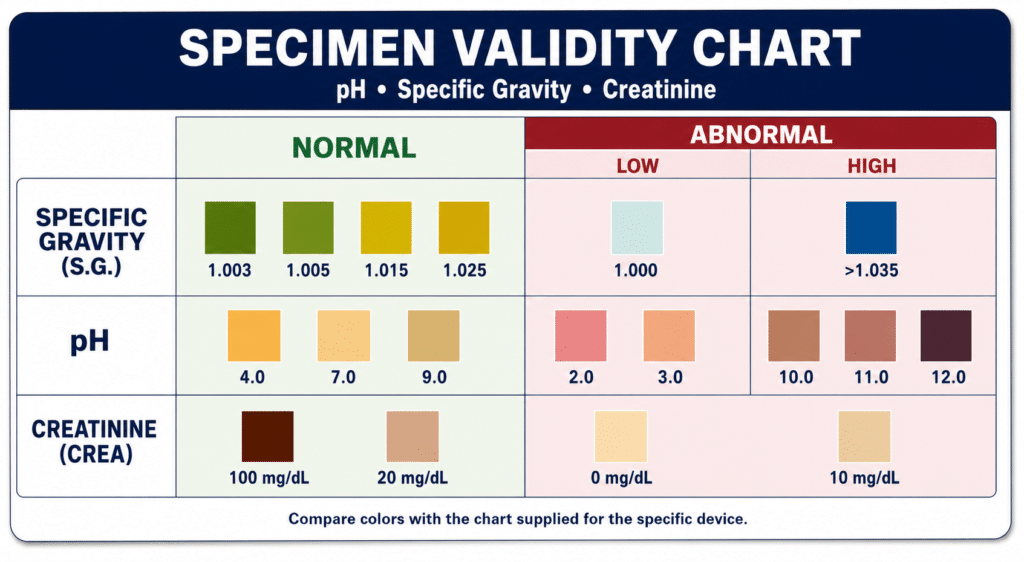
How to Read ADLTX Indicator Pads
- Verify the product. Check the expiration date, sealed packaging and exact panel configuration before collection.
- Collect the specimen. Follow the collection procedure and secure the cup lid completely.
- Check the temperature. Read the temperature strip within the period specified by the collection procedure.
- Allow the indicators to develop. Follow the timing in the current product insert.
- Compare each pad with the correct chart. Evaluate pH, specific gravity and creatinine against the chart supplied with that product.
- Document unexpected results. Follow the organization’s policy for review, recollection or additional testing.
ADLTX pads are read by comparing colors. They are not interpreted through control and test lines. The drug-screening panels use a different result format. See our guide explaining how to read a drug test cup for control-line, test-line and invalid-result examples.
Can an Unexpected ADLTX Result Prove Tampering?
No. An unexpected specimen-validity indicator does not independently prove that a donor intentionally changed the sample. It shows that one or more specimen characteristics may fall outside the reference range supplied by the manufacturer.
Testing programs should avoid making a final conclusion from one color pad alone. Depending on the applicable policy, an unexpected result may require documentation, recollection, review by an appropriate professional or laboratory specimen-validity testing.
Organizations should also avoid calling an unusual ADLTX result a confirmed positive drug test. Drug-panel results and specimen-validity observations answer different questions and require separate interpretation.
Choose a 12 Panel TCA Cup with ADLTX
The 12 Panel Drug Test Cup with Adulterants combines urine collection, 12 preliminary drug-screening panels, three specimen-validity indicators and a built-in temperature strip in one cup.
- Includes TCA at a 1,000 ng/mL cutoff
- Tests for 12 drugs or drug classes
- Includes pH, specific gravity and creatinine indicators
- Includes a built-in urine temperature strip
- Supports integrated collection and preliminary screening
- Available with quantity-based pricing
| Drug or Drug Class | Abbreviation | Cutoff Level |
|---|---|---|
| Amphetamine | AMP | 1,000 ng/mL |
| Barbiturates | BAR | 300 ng/mL |
| Buprenorphine | BUP | 10 ng/mL |
| Benzodiazepines | BZO | 300 ng/mL |
| Cocaine metabolite | COC | 300 ng/mL |
| MDMA/Ecstasy | MDMA | 500 ng/mL |
| Methamphetamine | MET | 1,000 ng/mL |
| Methadone | MTD | 300 ng/mL |
| Opiates/Morphine | OPI | 300 ng/mL |
| Oxycodone | OXY | 100 ng/mL |
| Tricyclic antidepressants | TCA | 1,000 ng/mL |
| Marijuana metabolite | THC | 50 ng/mL |
The ADLTX indicators do not count as additional drug panels. This remains a 12-panel drug test cup.
Programs that need the same general TCA panel configuration without integrated ADLTX indicators can compare the 12 Panel TCA Test Cup without ADLTX. Additional configurations are available in the 12 panel drug test cup collection.
For a Serenity 120 mL configuration combining specialty drug screening with pH, specific gravity and creatinine indicators, review our 18 panel drug screen with ADLTX.
For eligible forensic programs that also require gabapentin screening, the 18 panel drug screen cup with GAB and ADLTX combines 18 drug screening panels with creatinine, specific gravity and pH specimen checks.
Before ordering, verify the current product insert, drug panels, cutoff levels, package quantity and regulatory status required by your testing program.
Frequently Asked Questions
What are adulterants for drug test?
In drug testing, adulteration refers to changes that may affect the composition or testing characteristics of a specimen. This can include adding certain substances, dilution or substitution. Specimen-validity indicators can identify unusual characteristics but do not detect every possible form of specimen alteration.
What does ADLTX mean on this drug test cup?
On this product, ADLTX identifies three integrated specimen-validity indicators: pH, specific gravity and creatinine. They are separate from the 12 drug-screening panels.
What do pH, specific gravity and creatinine measure?
pH evaluates acidity or alkalinity, specific gravity provides information about urine concentration, and creatinine provides additional information used when evaluating specimen concentration and validity.
Do the three ADLTX indicators count as drug panels?
No. The product contains 12 drug-screening panels. Its pH, specific gravity and creatinine indicators evaluate specimen characteristics and do not increase the drug-panel count.
Does an unusual indicator prove that the specimen was adulterated?
No. An unusual indicator result does not independently prove intentional tampering. It should be interpreted using the supplied chart and the organization’s established testing procedure.
Is the temperature strip an ADLTX indicator?
No. The temperature strip evaluates specimen temperature after collection. The three ADLTX indicators evaluate pH, specific gravity and creatinine.
Does the featured 12 panel cup include PCP?
No. This exact configuration includes TCA at a 1,000 ng/mL cutoff instead of PCP.
How should an unexpected specimen-validity result be handled?
Follow the applicable testing policy and current product instructions. Depending on the program, the next step may include documentation, recollection, professional review or laboratory specimen-validity testing.
IN THIS ARTICLE