

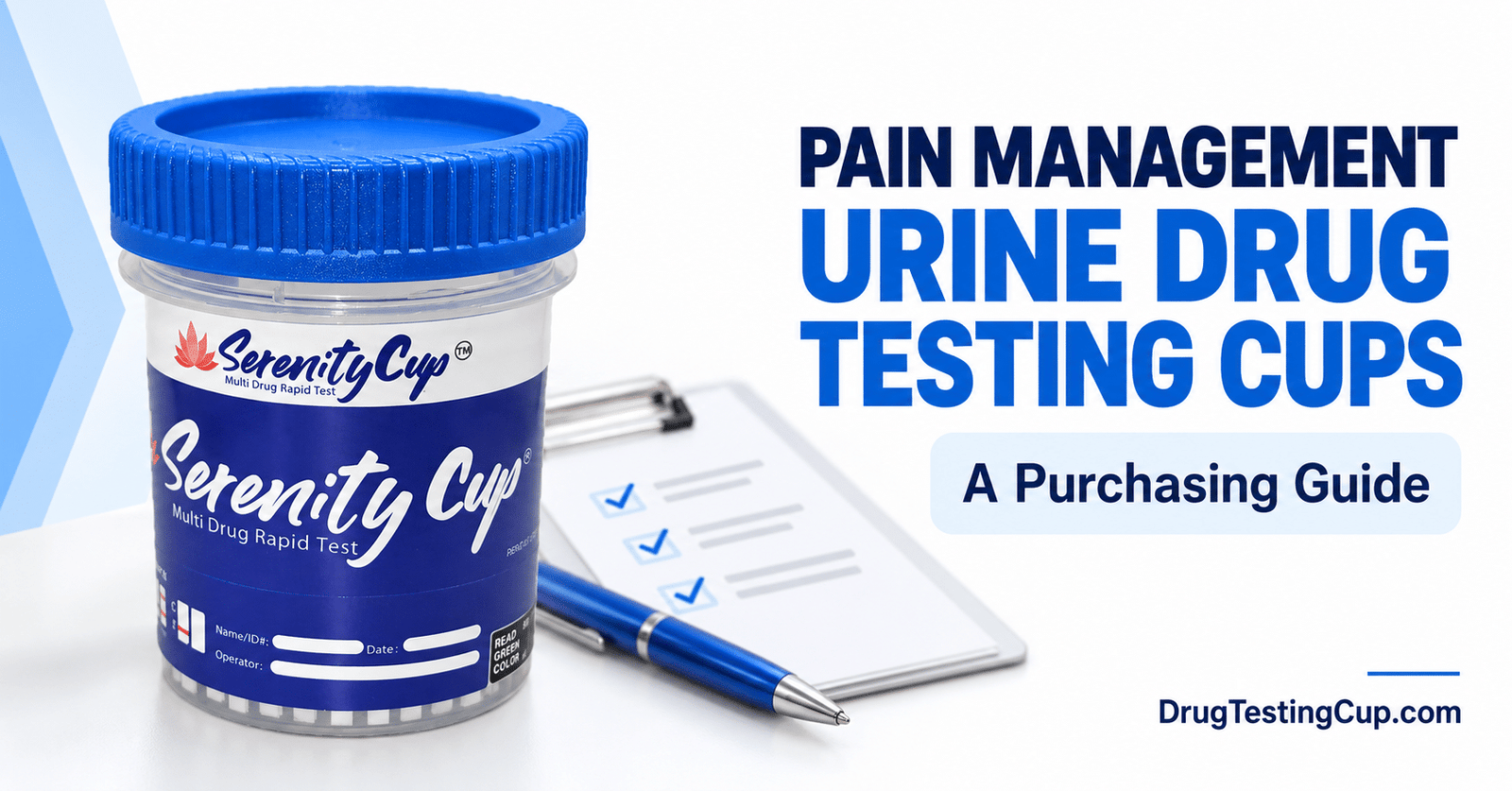

Pain management urine drug testing cups should be chosen around the clinic’s approved testing needs, the medications or substances its clinicians want to evaluate, and the intended use of the exact device. The purchasing process should connect those clinical requirements with documented product specifications. Choosing the right pain management urine drug testing cups is essential for effective patient care.
A cup’s panel count is only part of that comparison. Clinics also need to review assay coverage, cutoff levels, collection instructions and the laboratory services available when a preliminary screen does not answer the clinical question.
When selecting pain management urine drug testing cups, it is important to consider both the panel count and the specific substances that will be tested.
This guide is for practice managers and purchasing staff who need to organize that review. It explains how to compare urine drug testing cups for pain clinics, prepare a useful supplier request and maintain consistent supplies without turning an inventory decision into a clinical protocol.
This guide includes insights on pain management urine drug testing cups, focusing on ensuring compliance with clinical needs.
Begin with the clinical question
Ask the clinical lead to identify what information the approved testing process is intended to provide. The request might concern a specified medication, a drug class or another substance relevant to an individual patient’s care.
Understanding the purpose of pain management urine drug testing cups will help in selecting the most suitable options for each patient.
CDC advises clinicians prescribing opioids for subacute or chronic pain to consider the benefits and risks of toxicology testing. Its guidance supports individualized care rather than a single testing schedule or panel for every patient. CDC recommendations and guiding principles
Clinicians must familiarize themselves with the various pain management urine drug testing cups available to ensure effective screening.
For purchasing, this means the clinic should approve the testing specification before selecting a product. Staff should know which requirements are essential and which options remain under clinical review.
Choosing appropriate pain management urine drug testing cups is critical in supporting patient safety and treatment accuracy.
Do not use a supplier’s largest available panel as the starting point for the clinic’s protocol. Start with the approved need, then determine which documented device or laboratory arrangement can support it.
Create a medication-to-assay review record
Medication names and assay names do not always describe the same thing. A useful purchasing record should connect the clinician’s requested target with the exact test information supplied by the manufacturer or laboratory.
A thorough understanding of pain management urine drug testing cups enables better alignment with patient care protocols.
An opiate immunoassay does not provide universal coverage of all opioids. Chemically different substances such as fentanyl may require a separate assay. Confirm the specific target rather than treating an OPI label as a complete opioid screen. ARUP drug-testing guidance
Use a review table that can be approved by the clinical lead:
| Review field | Information to record |
|---|---|
| Requested medication or substance | The exact target identified by the clinician |
| Assay or laboratory test | The corresponding manufacturer assay or laboratory order |
| Intended use | Documentation supporting the proposed clinical use |
| Cutoff and units | The specified threshold for that exact assay |
| Important limitations | Relevant information from the supplied instructions |
| Follow-up route | The laboratory or clinician responsible for additional evaluation |
Keep the completed record with the approved SKU or laboratory code. It should remain available when the clinic reorders or considers a substitute.
Verify clinical labeling before comparing commercial offers
Request the current instructions for the exact product, along with the applicable regulatory documentation. A general brand brochure is useful for orientation but does not establish the status of every configuration.
The FDA’s discussion of drugs-of-abuse tests distinguishes among intended uses and the information reviewed for applicable devices. Clinical purchasing should therefore be based on the exact product’s documentation rather than a website-wide claim. FDA information on drugs-of-abuse tests
Incorporating pain management urine drug testing cups into clinical practice can enhance the monitoring of patient medication adherence.
Where a CLIA-waived device is required, verify that status for the selected test and the conditions under which it is used. The CLIA-waived drug test cups category can help identify options for further review.
Record which documents were reviewed and who approved the selection. This gives the receiving and clinical teams a common reference if later shipments use different packaging or instructions.
Compare 10 panel and 12 panel cups against the approved need
A clinic may begin its catalog review with 10 panel cups or 12 panel drug test cups. The useful comparison is the actual assay list and intended use of each candidate.
Do not assume that a 12 panel device is the clinic’s current 10 panel device with two additional substances. The combinations may differ in other ways, including the drug classes selected or their screening cutoffs.
Place the candidate products beside the approved specification. Identify every match, omission and difference that requires review. Ask the clinical lead to resolve those differences before the purchasing team compares prices.
A comprehensive review of pain management urine drug testing cups will aid in identifying their benefits and limitations.
If the clinical question requires information that a cup cannot provide, record the laboratory alternative. That prevents a product substitution from being mistaken for a solution to a testing-method limitation.
Review expanded panels with the same clinical-use standard
An expanded panel can attract attention because it lists more specialty substances. That does not establish that the device is appropriate for pain-management care.
The 18 panel drug test cups discussed here are Forensic Use Only configurations. They should not be promoted as routine clinical testing options for pain clinics.
If a clinician requests a specialty target shown on a forensic cup, ask for a clinically appropriate option or coordinate a suitable laboratory test. The presence of that target on a product label does not transfer the product into a different intended-use category.
Keep the Forensic Use Only guidance available to staff who compare catalog products. It can help explain why an expanded configuration still needs a separate suitability review.
It is advisable to keep updated on the latest pain management urine drug testing cups to stay compliant with industry standards.
Understand what cutoff information can and cannot tell you
The cutoff belongs in the approved specification because it helps define the assay being ordered. Record both the number and the unit for every required target.
A screening threshold is not an exact measurement of medication dose. Urine findings require interpretation in context, and an unexpected screening result may warrant confirmation when it could affect patient care. ARUP guidance on interpreting and confirming drug screens
Ensuring proper use of pain management urine drug testing cups can significantly impact patient outcomes.
For procurement, the immediate task is to avoid unnoticed changes. If a replacement product uses a different cutoff, identify that difference and send it for clinical review.
Do not convert a cutoff table into a promised detection period. Avoid adding fixed “detects for this many days” statements to staff purchasing sheets unless the clinical team has approved appropriately qualified information for the specific method.
Arrange laboratory follow-up before introducing the cup
The clinic should know which laboratory can evaluate a result that needs additional investigation. Confirm the relevant order codes, collection materials and contact details before the new device is placed into routine use.
Ask the laboratory what specimen and transport requirements apply to the requested testing. Do not assume that a specimen collected in any screening cup is automatically suitable for every follow-up method.
Discuss with laboratory staff the specifics of pain management urine drug testing cups to ensure that all testing methods align.
Identify who authorizes additional testing and how results return to the responsible clinician. Administrative staff should have a clear handoff process without being expected to interpret the findings.
Keep laboratory information with the approved clinical workflow, rather than only in the purchasing team’s supplier contacts. Staff working during an absence or at another location should be able to find the correct procedure.
Evaluate the collection process in the actual clinic
A purchasing review should consider how the device will be handled at the collection location. Look at the available space, specimen identification process, reading area and storage arrangement.
Confirm that staff can access the current instructions and use the required timing procedure. A familiar cup design should not lead the team to assume that every new product has the same steps or reading window.
Use the drug test cup reading guide as supporting education, with the manufacturer’s instructions controlling the actual procedure.
Training staff on the correct use of pain management urine drug testing cups is essential for maintaining testing integrity.
Ask staff to report operational questions during the introduction period. Confusing labels, missing accessories or unclear storage instructions should be resolved before they become recurring issues across the practice.
Document quality and specimen-check requirements separately
If the clinic requires additional specimen checks, list the exact parameters in the purchasing specification. A general description such as “adulteration testing” is not enough to identify what is included.
Keep specimen checks separate from the drug-assay count. Also distinguish any included temperature feature from chemical checks such as pH, specific gravity or creatinine.
The clinic’s approved procedure should explain how staff document and refer an unexpected finding. Product features should not be described as guaranteeing specimen authenticity.
For quality-control materials or additional verification requirements, follow the device instructions and the testing site’s applicable procedures. Ask the supplier what is included with the product and what must be obtained separately.
Forecast purchasing from actual clinical use
Evaluating the demand for pain management urine drug testing cups will help streamline inventory management.
Use consumption records from the clinic’s approved testing process to estimate demand. Include expected operational changes, such as opening a new location, only after the relevant service plans are confirmed.
Keep separate counts for different SKUs. A total of “drug test cups” can conceal that the clinic has plenty of one configuration and very few of another.
Build the order around expected consumption, current stock, delivery timing and the expiration dates available from the supplier. An operational reserve can help manage supply interruptions, but its size should be a practice decision.
Review whether a larger shipment is practical for the clinic’s storage space and consumption rate. Bulk purchasing should support continuity without creating avoidable expired inventory.
Review the full cost of pain management urine drug testing cups
Understanding the full cost associated with pain management urine drug testing cups ensures informed purchasing decisions.
The listed cup price is one component of the purchasing decision. Also compare shipping, required accessories, staff preparation and the laboratory services needed for the approved workflow.
Keep clinical suitability separate from commercial scoring. A device that does not meet the approved specification should not receive preference merely because it is inexpensive.
Ask suppliers to identify package quantities and whether the quote covers cups, accessories or both. For multiple locations, request the allocation and delivery details in writing.
The wholesale drug test cup buying guide can help structure the commercial comparison. Use it alongside the clinical specification so the selected offer remains connected to the practice’s actual requirements.
Control substitutions and recurring orders
Tracking pain management urine drug testing cups as part of the procurement process can enhance operational efficiency.
Once a device is approved, use its exact SKU on repeat orders. Retain the configuration and documentation reviewed by the clinical team.
Require review when an alternative differs in target coverage, cutoff, intended use or procedure. A purchasing system should not silently replace an approved item with another product sharing the same panel count.
At receipt, compare the shipment with the purchase order and review the relevant lot and expiration information. Make the current instructions available before the stock is distributed.
For practices with several locations, assign one contact to coordinate product changes. That helps keep local instructions and central purchasing records consistent.
Prepare a useful supplier request
Send the approved clinical-use requirement, target list, cutoffs, expected quantity and delivery details. Include the current SKU for a reorder and identify any documentation or accessories required.
Name the clinical contact who can resolve assay questions and the purchasing contact who can coordinate pricing and delivery.
Clearly defining the specifications for pain management urine drug testing cups will facilitate smooth supplier interactions.
Contact DrugTestingCup.com about pain-management testing supplies with that specification. The discussion can then focus on documented options and the practical supply needs of the clinic’s approved testing process.
Frequently Asked Questions
How should a pain clinic select urine drug testing cups?
The clinical lead should define the testing need, then review the exact device’s intended use, assay coverage, cutoffs and laboratory follow-up requirements. Purchasing should follow that approved specification.
Does an opiate assay screen for every opioid?
No. An OPI assay does not provide universal coverage of all opioids. Confirm the appropriate assay or laboratory method for each requested target.
Are the current Forensic Use Only 18 panel cups routine clinical options?
They should not be selected or promoted as routine clinical pain-management tests. Obtain an appropriately labeled clinical option or a suitable laboratory service.
It is crucial to have reliable options for pain management urine drug testing cups to ensure patient needs are met.
What information should accompany a bulk quote request?
Include the approved clinical-use requirement, target and cutoff list, quantity, delivery details, current SKU if available and contacts for clinical and purchasing questions.
Providing comprehensive information in bulk quote requests for pain management urine drug testing cups will improve response accuracy.