

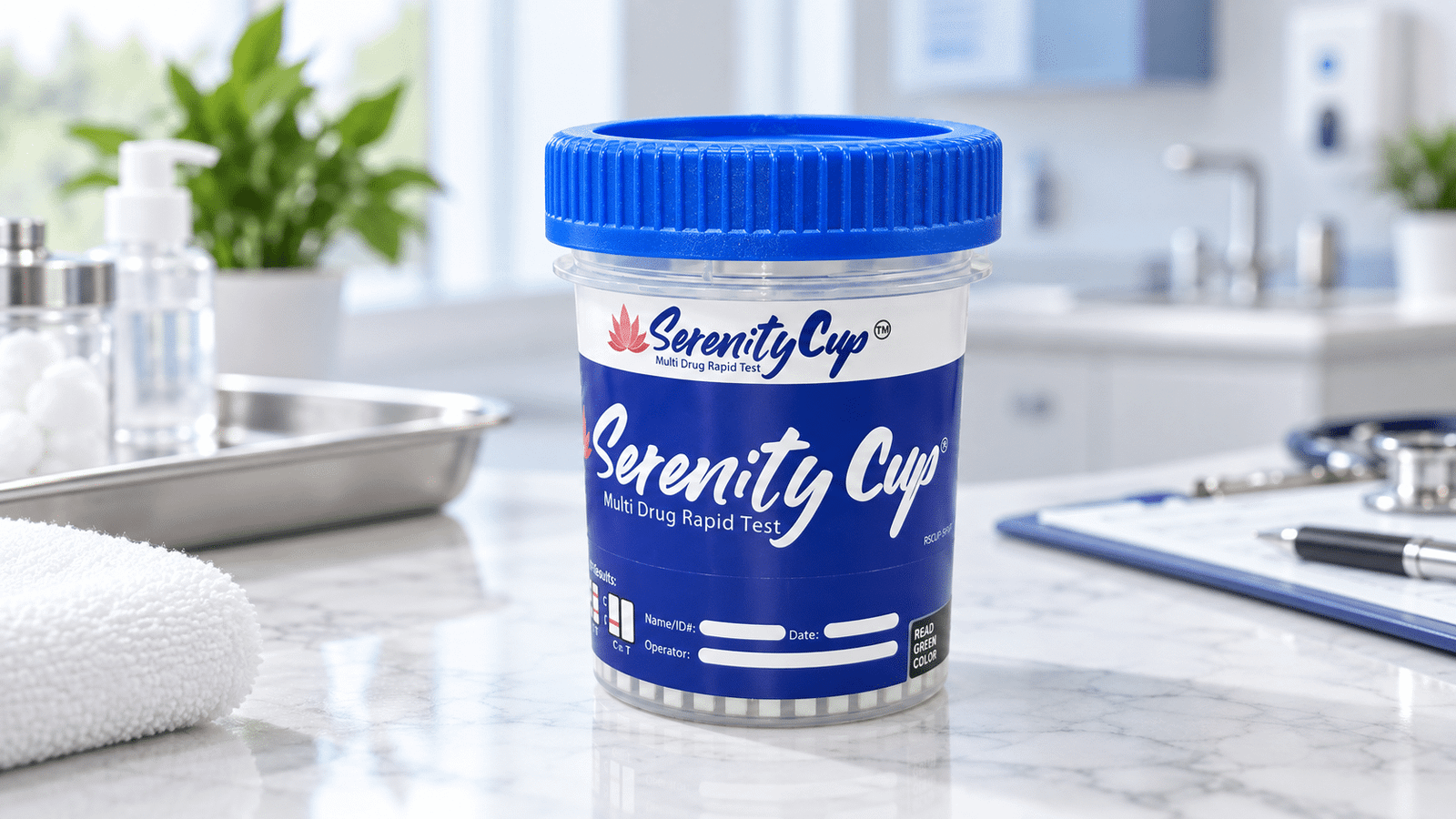

What is a 5 panel drug test? A 5 panel drug test is a screening test designed to check one specimen for five selected drugs or drug classes, including what is a 5 panel drug test for amphetamines, cocaine, opiates, phencyclidine (PCP), and marijuana metabolites. However, not every 5 panel drug test uses exactly the same combination.
The term “5 panel” describes the number of drug assays or drug categories being screened. It does not guarantee a universal list of five substances. Depending on the product and testing program, one configuration may include PCP and THC, while another may replace PCP with methamphetamine or replace THC with oxycodone.
That distinction matters when choosing a test. Employers, treatment programs, clinics, staffing agencies, occupational health providers, and professional testing services should review the exact drug abbreviations and cutoff levels on the product rather than relying only on the panel count.
For available configurations, compare our 5 panel drug test cups.
Understanding what is a 5 panel drug test is essential for anyone involved in drug screening.
What Does a 5 Panel Drug Test Test For?
A commonly recognized five-category drug testing model includes amphetamines, cocaine, opioids, phencyclidine, and marijuana. These are also the five broad drug categories used in federal workplace drug testing programs and DOT-regulated drug testing.
The question of what is a 5 panel drug test can lead to more inquiries about its components and effectiveness.
However, that does not mean every commercial rapid 5 panel urine test uses the same analytes, cutoff concentrations, or regulatory procedures.
For clarity, what is a 5 panel drug test typically screens for, and what makes it a choice among employers?
| Common Drug Category | Common Abbreviation | What the Panel Screens For |
|---|---|---|
| Amphetamines | AMP | Amphetamine-class drugs or metabolites according to the specific assay |
| Cocaine | COC | Typically a cocaine metabolite such as benzoylecgonine |
| Opiates / Opioids | OPI / MOR | Selected opiate or opioid compounds depending on the assay and cutoff |
| Phencyclidine | PCP | Phencyclidine |
| Marijuana | THC | Marijuana metabolite screening, commonly based on THC metabolite detection |
This AMP, COC, OPI, PCP, and THC combination is one common five-panel configuration, but buyers should not assume that every product marketed as a five-panel drug test contains these exact assays.
When discussing what is a 5 panel drug test, it’s important to emphasize that configurations can vary by provider.
Are All 5 Panel Drug Tests the Same?
No. This is one of the most important things to understand when comparing drug-testing products.
Two products can both be described as a 5 panel drug test while testing for different substances.
For example, DrugTestingCup.com currently carries several five-panel configurations:
| Configuration | Drug Panels | Key Difference |
|---|---|---|
| Standard 5 Panel | AMP, COC, OPI, PCP, THC | Traditional PCP and THC configuration |
| MET Configuration | AMP, COC, MET, OPI, THC | Methamphetamine replaces PCP |
| MAMP + Specimen Validity | AMP, COC, MAMP, OPI, THC | Includes pH, SG, and CR indicators |
| No THC Configuration | AMP, COC, MET, OPI, OXY | Oxycodone replaces THC |
| PCP + Specimen Validity | AMP, COC, OPI, PCP, THC | Includes pH, SG, and CR indicators |
| BZO Configuration | BZO, COC, MET, OPI, THC | Benzodiazepines included instead of AMP or PCP |
This is why purchasing by panel count alone can lead to the wrong test. Always verify the complete drug configuration before ordering.
What Is on a Standard 5 Panel Drug Test?
To clarify, what is a 5 panel drug test that is considered standard includes specific drugs.
When people search for a “standard 5 panel drug test,” they commonly mean a test that screens for:
AMP + COC + OPI + PCP + THC
One of the 5 panel drug test cups available from DrugTestingCup.com uses the following rapid urine screening configuration:
| Drug | Abbreviation | Product Cutoff |
|---|---|---|
| Amphetamine | AMP | 1000 ng/mL |
| Cocaine Metabolite | COC | 300 ng/mL |
| Opiates | OPI | 300 ng/mL |
| Phencyclidine | PCP | 25 ng/mL |
| Marijuana Metabolite | THC | 50 ng/mL |
These are product-specific rapid screening cutoffs. They should not be assumed to be identical to federal laboratory testing cutoffs or to the cutoffs used by every five-panel product.
What Are 5 Panel Drug Test Cutoff Levels?
A drug test cutoff level is the concentration used by an assay when classifying a screening result. Cutoff concentrations are usually expressed in nanograms per milliliter, or ng/mL.
A cutoff should not be interpreted as the amount of a drug a person consumed. It also does not indicate how long ago the substance was used.
If the targeted drug or metabolite is present below the test’s screening threshold, the screening result may be negative. If the assay responds at or above its threshold, the result may be considered presumptive non-negative and may require additional evaluation or laboratory confirmation depending on the testing program.
Different products can use different cutoff concentrations for the same general drug category. This is another reason to check the exact specifications before selecting a test.
For more information, see our complete drug test cutoff levels guide.
Does a 5 Panel Drug Test Use the Same Cutoffs as DOT Testing?
No—not automatically.
The U.S. Department of Transportation regulates DOT drug testing under 49 CFR Part 40. DOT testing uses specific laboratory procedures, approved specimen collection processes, defined initial and confirmatory cutoff concentrations, and Medical Review Officer procedures.
A rapid point-of-collection drug test cup should therefore not be described as a DOT drug test simply because it screens for five similar drug categories.
For example, current DOT urine laboratory rules specify their own initial cutoff concentrations for marijuana metabolite, cocaine metabolite, opioids, PCP, and amphetamines. Those laboratory requirements may differ from the cutoffs printed on a particular rapid screening cup.
Employers conducting both DOT and non-DOT testing should keep the programs separate and follow the applicable federal procedures for DOT-regulated employees.
Official DOT requirements are available through the U.S. Department of Transportation Part 40 regulations.
How Does a 5 Panel Urine Drug Test Work?
Many rapid 5 panel urine tests use competitive immunoassay technology. The cup contains individual test strips or assay areas designed to react to specific drugs or metabolites.
After a urine specimen is collected, the screening reaction develops for the amount of time specified by the manufacturer. Each panel normally includes a control line and a test line.
Although the exact instructions supplied with the product should always control, results are generally interpreted as follows:
- Negative preliminary result: the control line and test line appear for the applicable panel.
- Presumptive non-negative result: the control line appears but the corresponding test line does not.
- Invalid result: the required control line does not appear.
A faint test line can still represent a negative preliminary result when it appears within the manufacturer’s specified interpretation window.
For a visual explanation, see how to read a drug test cup.
 How Long Does a 5 Panel Drug Test Take?
 How Long Does a 5 Panel Drug Test Take?
Many rapid urine test cups are designed to provide preliminary results within approximately five minutes. The exact development and interpretation time depends on the specific test, so users should always follow the manufacturer instructions included with the product.
Results should not be interpreted too early or after the specified reading window because doing so may lead to an incorrect interpretation.
What Does a Negative 5 Panel Drug Test Mean?
A negative screening result generally means the targeted drug or metabolite was not detected at or above the screening cutoff used by that assay.
It does not necessarily mean that absolutely no amount of the drug or metabolite is present in the specimen.
For example, a THC test with a 50 ng/mL screening cutoff is designed to classify the result according to that threshold. A concentration below the screening cutoff may produce a negative preliminary result.
What Does a Positive 5 Panel Drug Test Mean?
For a rapid screening cup, the more precise term is usually presumptive positive or presumptive non-negative.
A rapid drug test is a screening tool. Depending on the testing program, a presumptive non-negative result may need to be confirmed using a more specific laboratory analytical method.
The nuances of what is a 5 panel drug test can change based on the testing environment.
A screening result by itself generally does not establish exactly when a substance was used, how much was consumed, whether the donor is currently impaired, or whether a medication was taken under a valid prescription.
When testing has employment, clinical, legal, or other significant consequences, organizations should follow their established procedures for confirmation and professional review.
How Long Can Drugs Be Detected on a 5 Panel Test?
There is no single detection window for a five-panel drug test because each drug or metabolite can remain detectable for a different period.
Urine detection time can also vary based on frequency of use, dose, metabolism, hydration, body composition, specimen concentration, and other individual factors.
Cutoff level and detection window should not be treated as the same measurement. The cutoff is an assay threshold; the detection window is an estimate of how long a substance or metabolite may remain detectable.
For more information by drug category, review our urine drug test detection windows.
What Is a 5 Panel Drug Test for Employment?
A 5 panel drug test for employment is a five-drug screening panel selected by an employer as part of its workplace drug-testing program.
Five-panel urine testing has historically been associated with workplace screening because it covers several broad drug categories without the cost or complexity of a larger multi-panel test.
Potential non-DOT workplace uses can include pre-employment testing, random testing, reasonable-suspicion testing, post-incident screening, return-to-work programs, and other employer-defined testing situations.
However, employers should not assume that one panel is appropriate for every workplace. Testing requirements can vary according to industry, jurisdiction, contractual obligations, federal regulations, state law, and company policy.
Organizations should establish their testing policy before choosing the drug panel.
Is a 5 Panel Drug Test a DOT Test?
No. A commercially available rapid five-panel urine cup is not automatically a DOT drug test.
DOT-regulated testing requires specific procedures under 49 CFR Part 40, including approved specimen collection procedures, laboratory testing, confirmation, reporting, and Medical Review Officer processes.
For employers, knowing what is a 5 panel drug test means understanding its legal implications.
Although DOT testing covers five broad drug categories—marijuana, cocaine, amphetamines, opioids, and PCP—that similarity does not make an instant five-panel cup acceptable for DOT-regulated testing.
This distinction is particularly important for transportation employers that maintain both DOT and non-DOT testing programs.
What Is a 5 Panel Drug Test Without THC?
A five-panel test does not have to contain marijuana screening.
For example, a 5 panel drug test without THC may replace the THC assay with another drug such as oxycodone.
One available no-THC configuration screens:
AMP + COC + MET + OPI + OXY
This type of configuration may be considered by organizations whose written testing policy intentionally excludes marijuana while continuing to screen for other selected drugs.
Whether THC should be included or excluded is a policy and compliance decision, not something determined by the term “five panel.”
What Is a 5 Panel Drug Test with Specimen Validity Testing?
Some five-panel urine cups include additional specimen-validity indicators such as pH, specific gravity, and creatinine.
These indicators are commonly abbreviated as:
pH + SG + CR
They are not additional drug panels.
Instead, they provide information about characteristics of the urine specimen that may help identify unusually dilute or otherwise atypical samples when interpreted according to the manufacturer’s instructions.
For example, the 5 panel drug test cup with MAMP includes five drug-screening assays together with pH, SG, and CR specimen-validity indicators.
In summary, what is a 5 panel drug test can significantly influence hiring policies.
Another 5 panel urine drug test with PCP uses a PCP-and-THC configuration together with the same three specimen-validity indicators.
5 Panel vs Larger Multi-Panel Drug Tests
A five-panel drug test provides a narrower screening profile than expanded tests such as 10-, 12-, 14-, 18-, or 20-panel cups.
A larger panel may include additional assays for substances such as benzodiazepines, buprenorphine, oxycodone, methadone, fentanyl, EtG alcohol metabolite, synthetic cannabinoids, kratom, ketamine, tramadol, or other analytes depending on the specific product.
More panels are not automatically better. The appropriate test is the one that matches the testing program’s actual requirements.
Browse our complete selection of multi-panel urine drug test cups to compare different panel counts and configurations.
How to Choose the Right 5 Panel Drug Test
Before ordering a five-panel test, verify the exact drug combination, cutoff concentrations, regulatory designation, urine cup capacity, specimen-validity features, result time, and intended testing environment.
When comparing products, consider what is a 5 panel drug test that matches your requirements.
For example, an organization that needs PCP and THC may choose a different configuration from one that needs methamphetamine or oxycodone. A program concerned with specimen validity may prefer a cup that includes pH, SG, and CR indicators.
The product name alone is not enough. The analyte table should be treated as the primary specification.
Where Can You Buy 5 Panel Drug Test Cups in Bulk?
DrugTestingCup.com supplies 5 panel drug test cups in multiple configurations for professional and high-volume buyers.
Available options include 90ml economy cups, 120ml cups, CLIA-waived configurations, no-THC tests, methamphetamine-focused panels, PCP configurations, and products with specimen-validity indicators.
Quantity pricing is available for employers, clinics, staffing agencies, treatment programs, sober-living organizations, occupational-health providers, testing companies, institutional purchasers, and other professional buyers.
Qualifying orders of 100 or more cups receive free shipping, and qualifying in-stock orders placed before the published 3:00 PM EST cutoff can receive same-day shipping.
Frequently Asked Questions About 5 Panel Drug Tests
Finally, understanding what is a 5 panel drug test can lead to informed decisions in your organization.
What is a 5 panel drug test?
A 5 panel drug test screens one specimen for five selected drugs or drug classes. The exact five analytes depend on the product and testing program.
Essentially, what is a 5 panel drug test involves screening for a mix of substances.
What drugs are on a standard 5 panel drug test?
A commonly recognized five-panel configuration includes amphetamines, cocaine, opiates or opioids, PCP, and marijuana. Commercial rapid tests may use different combinations.
In summary, what is a 5 panel drug test can vary and requires careful consideration.
Are all 5 panel drug tests the same?
No. Five-panel tests can differ by drug combination, cutoff concentrations, specimen type, regulatory designation, and specimen-validity features.
Ultimately, the question of what is a 5 panel drug test is central to effective drug screening.
Does a 5 panel drug test test for THC?
Many five-panel configurations include THC, but not all do. No-THC five-panel tests are also available.
Does a 5 panel drug test test for methamphetamine?
Some configurations include a dedicated MET or MAMP panel, while others use PCP instead. Check the exact analyte list for the product.
What is the cutoff level on a 5 panel drug test?
There is no single cutoff for an entire five-panel test. Each assay has its own cutoff, and cutoff concentrations can differ between products and testing programs.
How long does a 5 panel drug test take?
Many rapid urine cups provide preliminary results in approximately five minutes, but the exact interpretation time must follow the manufacturer instructions.
Understanding what is a 5 panel drug test also involves knowing the interpretation of results.
What does a faint line mean on a 5 panel drug test?
A faint test line can still represent a negative preliminary result when the control line is present and the test is read within the manufacturer’s specified interpretation window.
Is a 5 panel drug test a DOT test?
No. A rapid point-of-collection five-panel cup is not automatically a DOT test. DOT-regulated testing must follow the laboratory and procedural requirements of 49 CFR Part 40.
Can a 5 panel drug test be used for employment screening?
Five-panel tests are commonly used in non-DOT workplace screening programs. Employers should choose the panel according to their written policy and applicable legal requirements.
As we conclude, what is a 5 panel drug test is a critical question in workplace settings.
Can a 5 panel drug test include specimen-validity checks?
Yes. Selected products include pH, specific gravity, and creatinine indicators in addition to the five drug-screening assays.
Can I buy 5 panel drug test cups in bulk?
Yes. DrugTestingCup.com offers multiple five-panel configurations with quantity pricing for professional and high-volume purchasers.
Ultimately, knowing what is a 5 panel drug test can prevent costly mistakes.
Therefore, when looking for drug tests, remember what is a 5 panel drug test to make an informed choice.