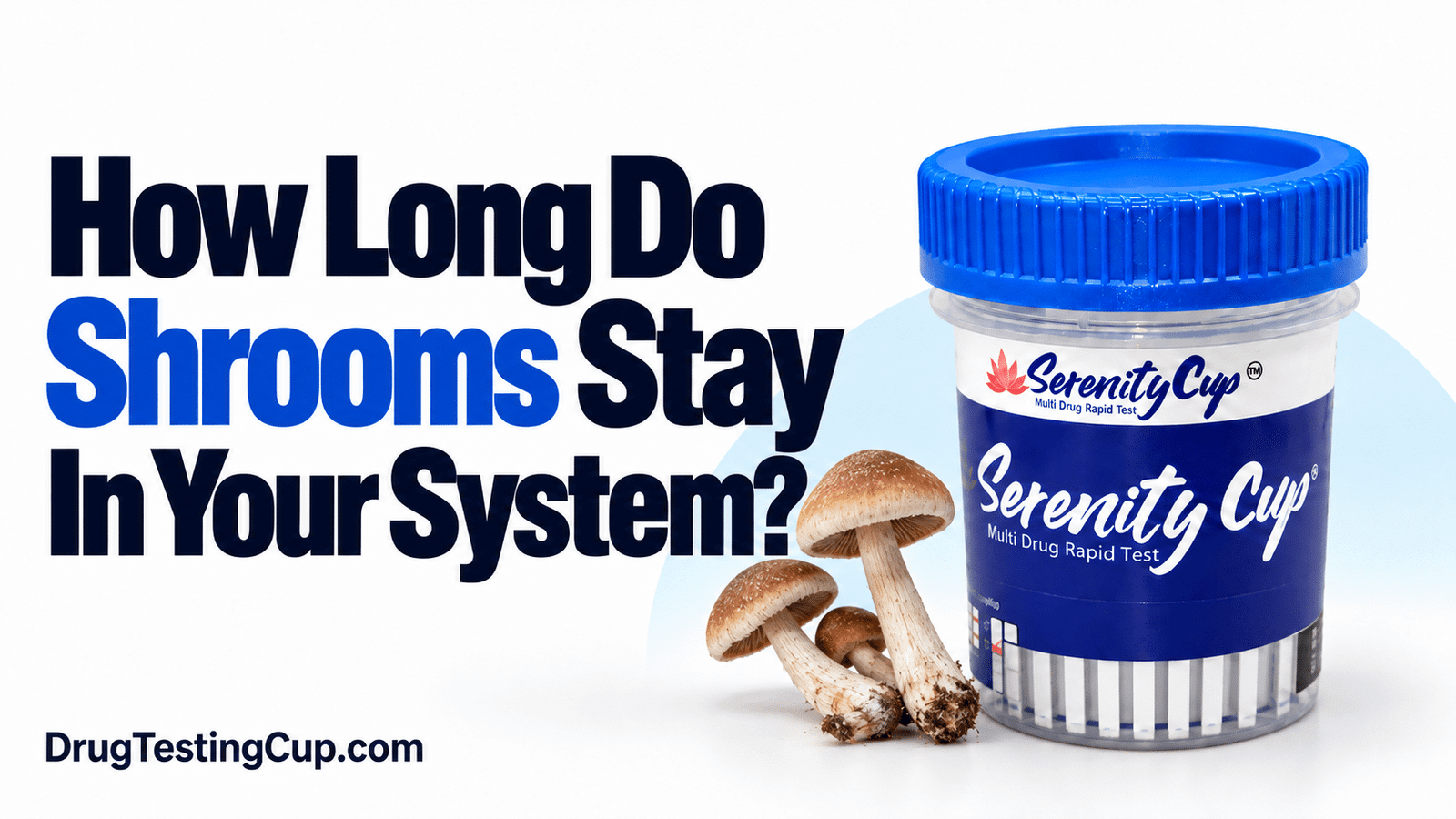

How long do shrooms stay in your system? Psilocybin is converted to psilocin and eliminated relatively quickly, so the urine detection window is short, often cited as about 1–3 days. Published human data are limited, though, and detection depends on the dose, frequency of use and the test used.
The more important point for most people is that shrooms do not show up on a standard drug test. Basic 5-panel and 10-panel tests do not screen for psilocybin or psilocin. Mushrooms are detected only when a test includes a psilocybin panel, often labeled PSY, or when a laboratory runs a specific test.
This guide explains what psilocybin is, how long shrooms may stay in your system, which drug tests detect mushrooms and how to read a psilocybin test result.
What Are Shrooms?
“Shrooms” or “magic mushrooms” are mushrooms that contain psilocybin. According to the DEA psilocybin fact sheet, psilocybin is metabolized in the body to the active drug psilocin, which is also present in many of the same mushrooms. The National Institute on Drug Abuse describes effects that can include changes in perception, a distorted sense of time and space, intense emotions, a faster heartbeat and nausea.
Psilocybin is listed as a Schedule I controlled substance under federal law in 21 CFR §1308.11. Some states have changed their own laws on psilocybin, but those changes do not alter federal scheduling or an employer’s or program’s testing policy.
How Long Do Shrooms Stay in Your System?
Psilocybin does not stay in the body for long. After ingestion it is converted to psilocin, and psilocin and its metabolites are excreted relatively quickly. Unlike THC, which can accumulate in fat with frequent use, psilocybin is not known for long detection windows.
There is no authoritative, widely accepted detection table for psilocybin the way there is for common drugs. Psilocybin does not appear in ARUP Consult’s urine detection window table, and published human data are limited. The short window often cited for urine is about 1–3 days, with most detection likely within the first day after use.
Detection depends on:
- Dose – mushrooms vary widely in psilocybin content, so the same amount of dried mushroom can deliver very different doses.
- Frequency of use – repeated use over several days can extend the window.
- Timing of collection – a sample taken the same day is far more likely to be non-negative.
- Individual metabolism and hydration – these affect how concentrated psilocin is in urine.
- Test design and cutoff – what the assay targets and at what concentration.
Because of these variables, no detection window should be used to predict when a specific person will test negative.
Do Shrooms Show Up on a Drug Test?
Not on a standard drug test. Standard panels focus on THC, cocaine, amphetamines, opiates and PCP. Psilocybin and psilocin are not part of those panels, and they are not on the federally regulated DOT drug list in 49 CFR §40.85.
Mushrooms show up only when:
- The cup or dip card includes a PSY (psilocybin) panel.
- A single-panel psilocybin test is used.
- A laboratory runs a specific test for psilocin.
Psilocybin panels are most common on expanded cups designed for treatment programs, courts and corrections, where hallucinogen use is a concern.
Do Mushrooms Show Up on a Urine Drug Test?
Urine is the most practical specimen for psilocybin screening, but only with a test that includes a psilocybin panel. A urine sample tested on a standard 5- or 10-panel cup will not show mushrooms, no matter how recently they were used.
If a program wants to screen for mushrooms, the panel list is what matters. Check for PSY or psilocybin on the product page or package insert. Our drug test abbreviations chart explains how to read panel codes.
Psilocybin Testing Products
| Format | Best fit | Product |
|---|---|---|
| Psilocybin dip card (PSY/500) | Mushroom-only screening | Psilocybin dip card |
| Psilocybin test (500 ng/mL) | Single-panel psilocybin screening | Psilocybin drug test |
| 21 panel cup with PSY | Psilocybin plus xylazine, fentanyl, alcohol and standard drugs | 21 panel drug screen cup |
| 28 panel cup with PSY | The broadest screening, including nitazenes and medetomidine | 28 panel drug test cup |
Programs that test only occasionally for mushrooms usually choose a single-panel test. Programs that need broad coverage of emerging and specialty substances typically choose an expanded cup with PSY.
Why Psilocybin Testing Is Less Common
Several factors explain why most drug tests leave psilocybin out. Its short detection window means a scheduled test is unlikely to catch use from several days earlier. Mushroom use is generally less frequent than use of substances such as THC, opioids or stimulants, so many programs focus their testing budget elsewhere. And federally regulated workplace testing does not require it.
That does not mean psilocybin testing has no value. In supervision and treatment settings where all controlled substances are prohibited, or where there is a specific reason to suspect mushroom use, adding a PSY panel closes a gap that standard panels leave open. The key is to test soon after suspected use and to choose a configuration that matches the program’s written policy.
Who Tests for Psilocybin?
Psilocybin testing is less common than standard drug screening, but it is used by:
- Treatment programs – to understand all substances a patient may be using.
- Drug courts, probation and parole – where supervision conditions prohibit all controlled substances.
- Correctional facilities – where broad screening is part of security.
- Some employers – for safety-sensitive roles outside DOT programs.
Psilocybin vs Other Hallucinogens on a Drug Test
Each hallucinogen or dissociative drug needs its own panel. A psilocybin panel does not detect the others, and their panels do not detect psilocybin:
| Substance | Panel code | On a standard 5-panel? |
|---|---|---|
| Psilocybin (mushrooms) | PSY | No |
| MDMA (ecstasy) | MDMA | No |
| Ketamine | KET | No |
| Phencyclidine | PCP | Yes |
| LSD | LSD | No |
If your program is concerned about hallucinogens in general, choose a configuration that lists each substance you need. An expanded cup that includes PSY, KET and MDMA covers more ground than adding single-panel tests one at a time.
How to Choose a Psilocybin Test
Use these questions to pick the right format:
- How often do you need to test for mushrooms? Occasional, reason-based testing fits a single-panel PSY test. Routine screening fits an expanded cup.
- What else do you need to detect? If you also monitor fentanyl, xylazine or alcohol, a 21- or 28-panel cup avoids running several tests.
- How quickly is the specimen collected? Because the window is short, testing soon after suspected use gives the best chance of detection.
- Do you need laboratory confirmation? Arrange a confirmation pathway before you begin testing, so non-negative screens can be confirmed when results matter.
Keep the same product and cutoff over time, and record the lot number, cutoff and reading time with each result. For bulk pricing on psilocybin tests and expanded cups, request a quote.
How to Read a Psilocybin Test
Psilocybin rapid tests use the same line logic as other drug panels:
- Negative: both the control line (C) and the PSY test line (T) appear, even if T is faint.
- Preliminary non-negative: only the control line appears.
- Invalid: no control line appears.
Read the result within the time stated in the package insert. Our guide to reading a drug test cup explains faint lines and invalid results.
What a Positive Psilocybin Test Means
A preliminary non-negative PSY result suggests psilocybin or psilocin may be present above the cutoff. It does not show how much was used, exactly when it was used or whether the person is impaired. Rapid results are preliminary, and non-negative results should be confirmed by a laboratory method according to your program’s procedure, especially when the result will affect legal, employment or treatment decisions.
Frequently Asked Questions
How long do shrooms stay in your system?
Psilocybin is converted to psilocin and eliminated relatively quickly. The urine detection window is often cited as about 1–3 days, but published human data are limited and detection varies with dose, frequency of use and the test used.
Do shrooms show up on a drug test?
Not on a standard drug test. Basic 5-panel and 10-panel tests do not screen for psilocybin. Mushrooms show up only when the test includes a psilocybin (PSY) panel or a laboratory runs a specific test.
Do mushrooms show up on a urine drug test?
Only if the urine test includes a psilocybin panel. A standard urine cup will not detect mushrooms, regardless of how recently they were used.
How long do psilocybin mushrooms stay in your urine?
Detection in urine is usually short, often cited as about 1–3 days, with most detection likely within the first day. The exact window depends on dose, frequency, timing and the test’s cutoff.
Are shrooms part of a DOT drug test?
No. DOT drug testing follows the drug list in 49 CFR §40.85, which does not include psilocybin.
What does PSY mean on a drug test?
PSY is the abbreviation used for the psilocybin panel on some drug test cups and dip cards. Our psilocybin tests list a 500 ng/mL cutoff.
IN THIS ARTICLE