

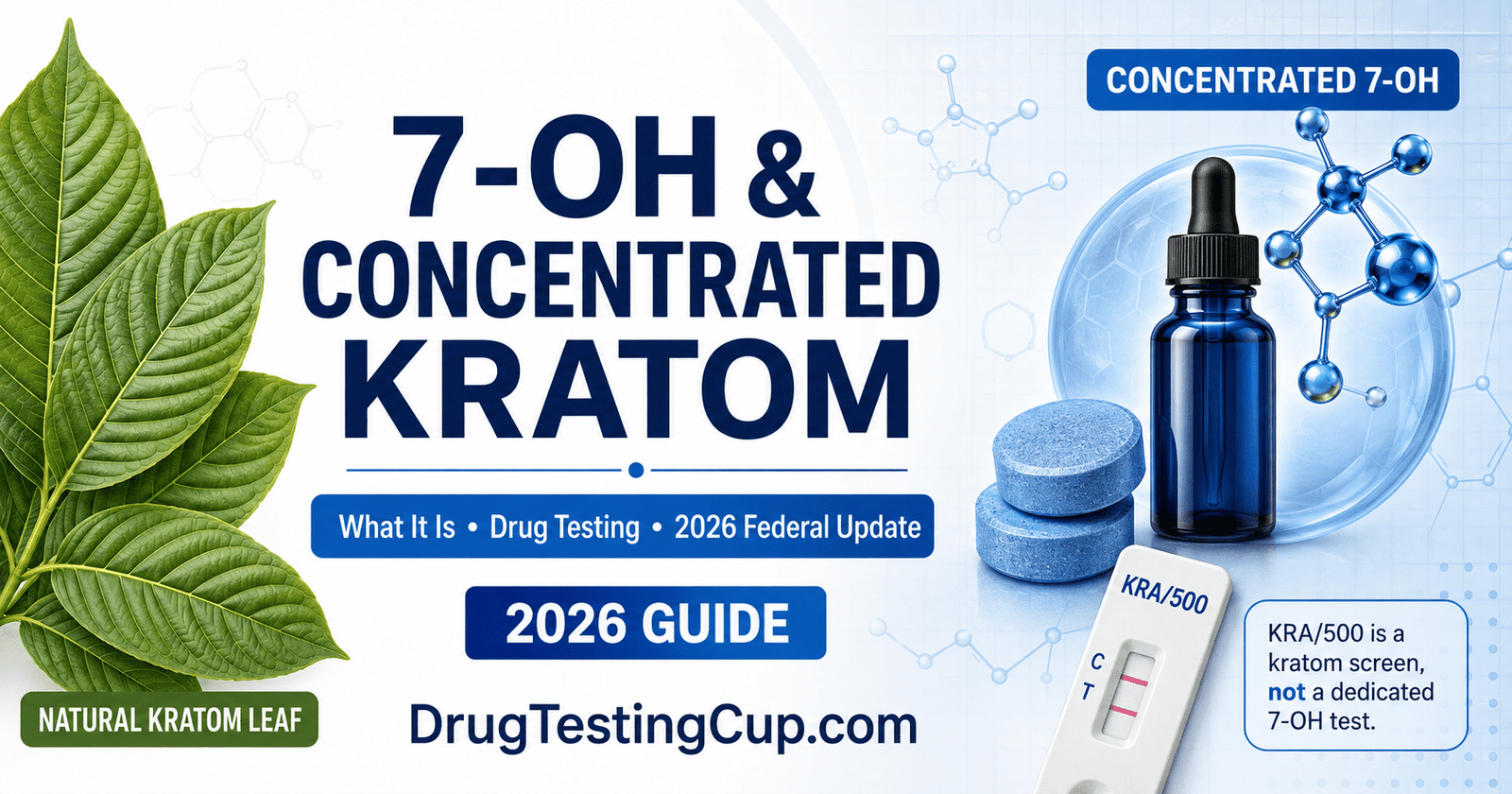

7-OH is short for 7-hydroxymitragynine, an alkaloid associated with the kratom plant, Mitragyna speciosa. It occurs naturally in trace amounts in botanical kratom, but products containing added, enhanced or concentrated 7-OH are different from traditional leaf. The FDA advises consumers to avoid these concentrated 7-OH products because they have not been proven safe or effective for any use and may cause serious harm.
Routine federal workplace drug-testing panels do not include kratom alkaloids or 7-OH. A specialized assay is required. The exact KRA-U12 kratom urine drug test strip sold by DrugTestingCup is calibrated to 7-hydroxymitragynine at 500 ng/mL and also lists positive reactivity to mitragynine at 6,000 ng/mL. It is a qualitative, preliminary test labeled Forensic Use Only.
Testing note: “KRA/500” is not a universal description of every kratom assay. Always review the current insert for the exact device being used.
7-OH at a Glance
| Question | Short answer |
| What is 7-OH? | 7-hydroxymitragynine, an opioid-active alkaloid related to kratom |
| Is it present in natural kratom? | Yes, generally in trace amounts |
| Are concentrated 7-OH products the same as natural leaf? | No. Enhanced products can contain much higher amounts and have a different risk profile |
| Is 7-OH included on the federal workplace urine panel? | No; a specialized assay is needed |
| What does this exact KRA-U12 strip target? | 7-OH at a 500 ng/mL cutoff; the insert also lists mitragynine reactivity at 6,000 ng/mL |
| Does a screening result prove impairment? | No |
| Is the result definitive? | No; a preliminary non-negative result requires appropriate laboratory confirmation |
What Is the Difference Between Kratom and 7-OH?
Kratom is the common name for Mitragyna speciosa, a plant native to Southeast Asia. Its leaves contain multiple alkaloids, with mitragynine generally described as the major alkaloid and 7-hydroxymitragynine as a minor alkaloid present at much lower natural levels.
The phrase “7-OH product” usually refers to a tablet, gummy, shot, powder, drink mix or similar processed product containing added or enhanced 7-hydroxymitragynine. FDA distinguishes these concentrated products from natural botanical leaf containing only naturally occurring trace levels of 7-OH.
| Natural botanical kratom | Concentrated or enhanced 7-OH product |
| Plant material with a mixture of naturally occurring alkaloids | Processed product formulated to contain a higher amount of 7-OH |
| 7-OH is normally present only in trace amounts | May contain added, enriched or chemically converted 7-OH |
| Not the stated target of the proposed federal threshold when below it | May fall within the proposed federal threshold depending on composition |
| Product composition can still vary | Strength, purity and labeling can vary substantially |
This distinction does not mean natural kratom is FDA approved or risk-free. FDA continues to warn consumers about risks associated with kratom and separately emphasizes the emerging danger of concentrated 7-OH products.
7-OH vs. Mitragynine
Mitragynine and 7-hydroxymitragynine are related but distinct compounds. Mitragynine is generally the predominant alkaloid in kratom leaf. 7-OH occurs at lower natural levels and is also formed as a metabolite of mitragynine in the body.
For drug testing, the difference matters because immunoassays can be calibrated to one compound while responding differently to a related compound. A product label that says only “KRA/500” does not by itself explain which compound is the calibrator or how strongly the test responds to mitragynine. The device insert provides that information.
Does a Kratom Drug Test Detect 7-OH?
It depends on the test.
Not every multi-panel cup includes a KRA assay. If you are comparing cup configurations, read does kratom show up on a 12 panel drug test to understand when a dedicated KRA panel is required.
The 2026 HHS authorized federal workplace panels list marijuana metabolite, cocaine metabolite, several opioids, PCP, fentanyl and amphetamine-group analytes. They do not list kratom, mitragynine or 7-hydroxymitragynine. Therefore, a routine federal workplace panel is not a 7-OH test.
A specialized KRA assay can target kratom-related alkaloids. However, different KRA devices may use different calibrators and cross-reactivity profiles. Buyers should verify the exact insert instead of assuming every KRA test detects 7-OH at the same level.
What the KRA-U12 Urine Strip Detects
The uploaded KRA-U12 insert identifies:
- Calibrator: 7-hydroxymitragynine
- 7-hydroxymitragynine response level: 500 ng/mL
- Mitragynine response level: 6,000 ng/mL
- Specimen: human urine
- Result: qualitative and presumptive
- Intended use: Forensic Use Only
This means the exact strip can respond directly to 7-OH at the stated cutoff. It can also respond to mitragynine, but at the higher concentration listed in the insert.
The strip cannot determine which commercial product was used, how much was consumed, when it was consumed, or whether the person is impaired. Because both 7-OH and mitragynine can produce a response at different concentrations, the screen also does not definitively identify which compound caused a preliminary non-negative result.
What Does KRA 500 Mean?
For this KRA-U12 strip, 500 ng/mL is the urine screening cutoff for the 7-hydroxymitragynine calibrator. It is not:
- the amount of 7-OH in a retail tablet or gummy;
- a measure of product potency;
- a legal threshold for possession or sale;
- proof of impairment; or
- a universal cutoff for every KRA test.
The proposed federal product thresholds discussed below measure 7-OH in botanical or processed material. Those proposed composition thresholds are entirely different from a 500 ng/mL urine immunoassay cutoff.
How to Use the KRA-U12 7-OH Urine Test Strip
Always follow the insert supplied with the current product.
- Bring the strip and urine specimen to room temperature, 15-30°C.
- Remove one strip and use it promptly. Close the canister tightly after removing a strip.
- Hold the printed end without touching the membrane.
- Dip the strip vertically into the urine for at least 10-15 seconds. Do not immerse it beyond the MAX line.
- Remove the strip and place it on a flat, non-absorbent surface.
- Read the result at 5 minutes. Do not interpret it after 10 minutes.
The insert specifies human urine only. Do not describe this strip as a test for powders, beverages, product contents or “any other liquid.”
How to Read the Result
Negative Preliminary Result
Two colored lines appear: one at the control region (C) and one at the test region (T). Any visible shade of a test line should be treated as negative when the control line is present, subject to the product insert.
Preliminary Non-Negative Result
The control line appears and no test line appears. The insert labels this pattern positive, but it remains a preliminary screening result and should be confirmed by an appropriate laboratory method.
Invalid Result
No control line appears. Discard the test, review the procedure and repeat with a new device.
Important Test Limitations
The KRA-U12 strip is a qualitative immunoassay. It does not report the concentration present in the specimen. A preliminary non-negative result does not establish intoxication, impairment, dose, frequency of use or time of use.
A negative result does not rule out exposure. The target compound may be absent, present below the assay’s response level, or outside the period in which the urine specimen contains a detectable concentration. Dilution, adulteration, contamination, storage conditions, timing and procedure can also affect results.
The manufacturer’s insert calls for a more specific analytical method to obtain a confirmed result. The confirming laboratory should select and validate an appropriate definitive method for the analytes of interest.
Screening coverage depends on the specific assay. A KRA result should not be used to draw conclusions about a different substance such as medetomidine. See our guide to medetomidine screening for another example of why emerging substances may require dedicated tests.
Who Should Use This Test?
The KRA-U12 strip is labeled Forensic Use Only. It should be used only by organizations and personnel whose program is consistent with that labeling, the current instructions and applicable requirements.
Do not market this device as a home diagnostic test, a CLIA-waived clinical test or a DOT test. It can be considered by qualified forensic programs that intentionally include kratom-related alkaloids in their testing policy. Programs needing broader screening can compare a 15-panel cup with K2, KRA and tramadol or a 28-panel drug test cup, but must verify the model-specific insert for each multi-panel device.
Health and Safety Information About Concentrated 7-OH
FDA states that products containing added or enhanced 7-OH have not been proven safe or effective for any use and advises consumers to avoid them. Reported harms associated with these products include addiction, withdrawal symptoms, seizures and other serious effects. FDA also states that no 7-OH product is FDA approved for medical use.
If someone is unresponsive or experiencing a medical emergency, call 911. FDA directs consumers with concerns about a possible adverse event to the Poison Help Line at 1-800-222-1222 and to its MedWatch reporting program.
Read the FDA consumer warning about products containing 7-OH.
2026 Federal Status of 7-OH
Status as of August 27, 2026: DEA has published a notice of intent proposing temporary Schedule I control of 7-hydroxymitragynine above a specified threshold. The proposal distinguishes qualifying botanical kratom containing trace natural 7-OH from processed, concentrated and synthetic products above the proposed threshold.
The proposed thresholds are:
- botanical Mitragyna speciosa material containing more than 0.050% 7-OH by dry weight; or
- an alternative synthetic or processed article containing more than 0.050% 7-OH by weight/weight, weight/volume or volume/volume, or more than 1.00 mg of 7-OH in the article.
HHS extended the public-comment deadline concerning the proposed threshold to September 10, 2026. At the time of this update, the 7-OH-above-threshold scheduling order described in the notice of intent had not yet been published as a final temporary order.
Separately, DEA temporarily placed mitragynine pseudoindoxyl, MGM-15 and MGM-16 in Schedule I effective August 26, 2026. That temporary order is effective through August 26, 2028 unless extended or made permanent.
Because federal and state rules can change, readers should verify the current law in the relevant jurisdiction. Review the DEA notice concerning 7-OH above a proposed threshold, the HHS comment-period extension and the temporary order for three related compounds.
Frequently Asked Questions
What is 7-OH?
7-OH is 7-hydroxymitragynine, an opioid-active alkaloid related to the kratom plant. It occurs naturally in trace amounts, while concentrated retail products can contain much higher amounts.
Does a standard drug test detect 7-OH?
Not usually. The current federal workplace testing panel does not include kratom, mitragynine or 7-OH. A specialized assay is required.
Does the KRA-U12 strip directly detect 7-OH?
Yes. Its insert identifies 7-hydroxymitragynine as the calibrator and lists a 500 ng/mL cutoff. The same insert lists mitragynine positive reactivity at 6,000 ng/mL.
Can the strip tell whether someone used natural kratom or a concentrated 7-OH product?
No. It is a qualitative preliminary urine screen and cannot identify the product, dose, source, time of use or which responsive compound produced the result.
What does a preliminary non-negative result mean?
It means the control line appeared without a test line. The result requires confirmation using an appropriate definitive laboratory method and review under the testing program’s procedures.
Does a negative result rule out 7-OH or kratom exposure?
No. A target compound may be absent, below the assay’s response level or outside the period in which it is detectable in that specimen.
Is the KRA-U12 strip for home use?
No. The insert labels it Forensic Use Only. Do not market it as a home diagnostic, CLIA-waived clinical or DOT device.
Is 7 OH federally illegal?
As of August 27, 2026, DEA had proposed temporary Schedule I control of 7-OH above a specified threshold, but the final temporary order described in that proposal had not yet been published. Laws may also vary by state. Three related compounds—mitragynine pseudoindoxyl, MGM-15 and MGM-16—were temporarily placed in Schedule I effective August 26, 2026.
Sources and Editorial Note
This article was reviewed against the KRA-U12 manufacturer insert, REV1.0, effective March 12, 2020, and current federal sources available on August 27, 2026:
- FDA: Hiding in Plain Sight—7-OH Products
- FDA: Products Containing 7-OH Can Cause Serious Harm
- 2026 HHS Federal Workplace Drug Testing Panels
- DEA Notice of Intent for 7-OH Above a Proposed Threshold
- HHS Extension of the 7-OH Threshold Comment Period
- DEA Temporary Schedule I Order for Three Related Compounds
IN THIS ARTICLE