


Blog
How to Read a Drug Test Cup: Positive, Negative & Invalid Results

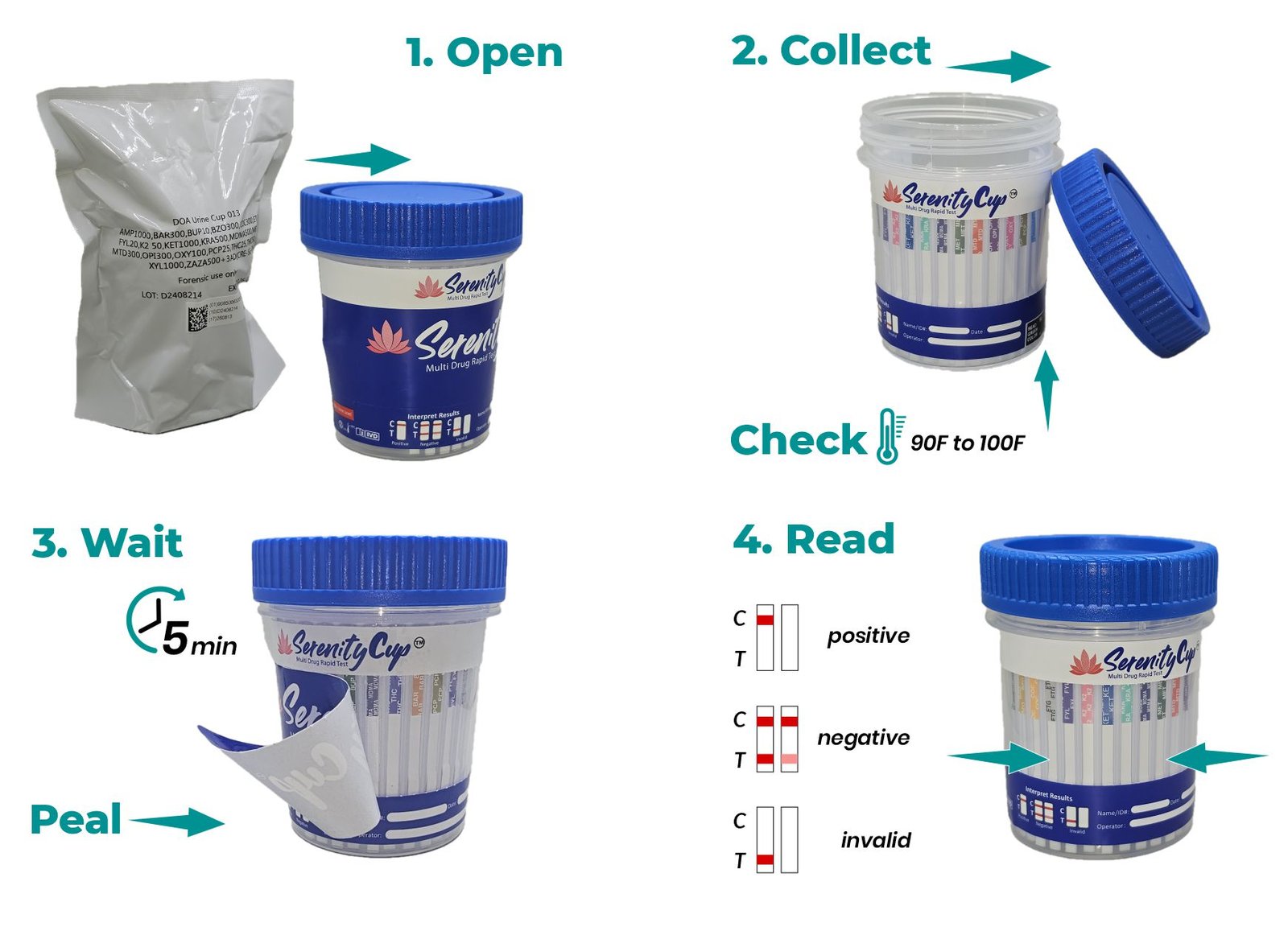
Learning how to read a drug test cup is straightforward once you understand the control line (C), test line (T), and the way competitive urine drug-testing immunoassays work.
The most important rule is:
- Two lines — C and T = Negative
- One line at C only = Presumptive Positive
- No C line = Invalid
- A faint T line generally still counts as Negative when it appears within the manufacturer’s specified reading time
FDA-reviewed documentation for urine drug screening cups explains that a drug-negative specimen produces a test line, while a specimen containing the target drug or metabolite at or above the assay cutoff may prevent the test line from appearing. The control line verifies that the test functioned properly.
For the most accurate interpretation, always follow the instructions supplied with the specific drug test cup you are using. Read times, cutoff levels, analytes and specimen requirements can vary between products.
Drug Test Cup Results at a Glance
| Result | Control Line (C) | Test Line (T) | Meaning |
|---|---|---|---|
| Negative | Visible | Visible | Drug/metabolite is below the test cutoff |
| Negative with faint line | Visible | Faint but visible | Generally interpreted as negative |
| Presumptive Positive | Visible | No line | Drug/metabolite may be at or above the cutoff |
| Invalid | No line | Visible or absent | Test cannot be interpreted; repeat with a new device |
The FDA also explains that rapid home and point-of-care drug tests provide preliminary or presumptive results. A preliminary positive result may require confirmation using a more specific laboratory method. (FDA: Drugs of Abuse Home Use Test)
A preliminary non-negative rapid drug-test result may require additional laboratory testing depending on the testing program and applicable requirements. For healthcare billing terminology related to screening and confirmation, see our guide to CPT codes for presumptive and definitive drug testing
What Do C and T Mean on a Drug Test Cup?
Most rapid urine drug test cups contain a Control region (C) and one or more Test regions (T).
C Means Control
The C line is the control line.
Its purpose is to show that:
- Enough urine reached the test membrane
- The liquid migrated through the test correctly
- The test procedure functioned as expected
A valid result should contain a visible control line.
If the control line does not appear, do not interpret the test as positive or negative.
The result is invalid.
T Means Test
The T line is the test line for a particular drug or drug metabolite.
A multi-panel drug test cup may contain separate test areas for substances such as:
- AMP – Amphetamine
- BZO – Benzodiazepines
- BUP – Buprenorphine
- COC – Cocaine metabolite
- FEN/FYL – Fentanyl
- MET/MAMP – Methamphetamine
- MTD – Methadone
- OPI/MOP – Opiates/Morphine
- OXY – Oxycodone
- PCP – Phencyclidine
- THC – Marijuana metabolite
- ETG – Ethyl glucuronide
- KRA – Kratom
- KET – Ketamine
- TRA/TML – Tramadol
Each panel must be interpreted separately.
For example, a 14-panel cup can have a negative THC result while simultaneously producing a presumptive positive result for fentanyl.
To compare available configurations, see our complete selection of Drug Test Cups.
Why Does Two Lines Mean Negative on a Drug Test?
This is one of the most confusing parts of reading a drug test cup.
Many people assume that two lines should mean positive because pregnancy tests and other rapid tests may work differently.
Urine drug tests commonly use a competitive lateral-flow immunoassay.
In this type of test, the presence of the target drug or metabolite above the cutoff can prevent the test line from forming.
In simplified terms:
Less drug/metabolite → T line can form → Negative
Enough drug/metabolite to reach the cutoff → T line may disappear → Presumptive Positive
FDA-reviewed test documentation describes this competitive mechanism: a drug-negative specimen generates a line in the test region, while a drug-positive specimen may not generate that line.
That is why drug tests can appear to work “backwards” compared with some other lateral-flow tests.
What Does a Negative Drug Test Cup Look Like?
A negative drug test result normally shows:
C line + T line
The control line confirms that the test operated correctly.
The test line indicates that the concentration of the drug or metabolite is below the cutoff level for that assay.
It does not necessarily mean there are absolutely zero molecules of the substance in the urine.
This distinction is important.
Negative Does Not Mean “No Drug Exists”
Drug tests operate using cutoff concentrations.
If a THC test has a cutoff of 50 ng/mL, for example, a result below the assay cutoff can be reported as negative even though very small amounts of metabolite may still be present.
For more information, see our complete Drug Test Cut-Off Levels guide.
A negative screening result therefore means:
The target drug or metabolite was not detected at or above the test’s screening cutoff.
It does not necessarily mean:
There is absolutely no drug or metabolite in the specimen.
What Does a Positive Drug Test Cup Look Like?
A presumptive positive result normally shows:
C line only — no T line for that drug panel
For example:
| C Line | THC T Line | Interpretation |
|---|---|---|
| Visible | Visible | Negative THC screen |
| Visible | No line | Presumptive positive THC screen |
| No line | Any result | Invalid test |
The word presumptive is important.
Rapid drug test cups are screening devices. FDA guidance states that a preliminary positive home drug-test result should be followed by a second, more specific laboratory test when confirmation is needed.
FDA-cleared urine cup documentation similarly states that these devices provide preliminary results and that a more specific chemical method can be used for confirmation.
Depending on the testing program, confirmatory methods may include technologies such as:
- GC-MS
- LC-MS/MS
A rapid cup should therefore not automatically be treated as definitive proof of drug use when confirmation is required.
What Does a Faint Line on a Drug Test Mean?
A faint T line generally means a negative result, provided the line appears within the manufacturer’s specified reading window.
The darkness of the T line should not be used to estimate how much of a drug is present.
FDA-reviewed urine cup documentation states that regardless of color intensity, a visible test line—even a faint one—is interpreted as negative for the referenced device.
Therefore:
| Test-Line Appearance | General Interpretation |
|---|---|
| Dark T line | Negative |
| Medium T line | Negative |
| Faint but visible T line | Negative |
| No T line | Presumptive positive |
The key question is whether a valid test line is visible, not how dark the line appears.
Does a Faint Line Mean a Small Amount of Drugs?
Not necessarily.
A faint line does not provide a quantitative measurement.
You should not interpret:
- Dark line = zero drugs
- Medium line = small amount
- Faint line = almost positive
Rapid cup tests are generally qualitative screening tests, not quantitative concentration measurements.
They are designed primarily to indicate whether the target analyte is above or below the assay’s cutoff.
What Is an Invalid Drug Test Result?
A drug test is generally invalid when the control line does not appear.
Possible patterns include:
| C Line | T Line | Result |
|---|---|---|
| No C | No T | Invalid |
| No C | T visible | Invalid |
| C visible | T visible | Negative |
| C visible | No T | Presumptive positive |
If there is no control line:
- Do not report the result as negative.
- Do not report it as positive.
- Review the instructions.
- Repeat the test using a new device.
An invalid result may occur because of factors such as improper testing procedure, insufficient specimen migration, a damaged device or another test-specific issue.
Always consult the product insert before repeating the procedure.
How Long Should You Wait Before Reading a Drug Test Cup?
Use the exact reading time specified by the manufacturer.
The old version of this article instructed everyone to “wait five minutes” and never read after 10 minutes. That should not be treated as a universal rule because different devices have different validated read windows.
For example, one FDA-reviewed drug screening urine cup was validated for interpretation between 3 and 8 minutes.
Other products may specify another interval.
Therefore:
Do not assume every drug test cup must be read at exactly five minutes.
Check the:
- Cup label
- Product packaging
- Package insert
- Manufacturer instructions
You can also review our general Drug Testing Instructions.
Step-by-Step: How to Read a Drug Test Cup
Step 1: Check the Test Before Collection
Before using the test:
- Confirm the expiration date
- Check that the packaging is sealed and undamaged
- Verify the correct panel configuration
- Review the cutoff levels
- Read the manufacturer’s instructions
Different drug test cups can contain completely different analytes even when they have the same number of panels.
Step 2: Collect the Urine Specimen
Collect the urine according to the instructions supplied with the test.
Many integrated cups combine the specimen container and test panels into a single device.
You can learn more about their design in our Complete Guide to Drug Testing Cups.
Step 3: Secure the Lid
Close the cup according to the manufacturer’s directions.
Some drug test cups begin testing automatically once urine enters the device.
Others may use a key, activation mechanism or another design.
Follow the instructions for that specific cup.
Step 4: Check the Temperature Strip if Applicable
Many urine collection and drug-testing cups contain a temperature strip.
For DOT-regulated urine collections, federal rules require the collector to check specimen temperature no later than four minutes after collection. The acceptable DOT range is 90–100°F (32–38°C). (49 CFR §40.65)
This DOT requirement should not automatically be applied to every non-DOT testing program, but the temperature strip can still provide useful specimen information when the test protocol requires it.
Step 5: Wait for the Specified Read Time
Start timing according to the package instructions.
Do not interpret results too early.
Do not re-read the test long after the manufacturer’s valid reading window has passed.
Step 6: Locate the Control Line
Look for C.
If the C line is absent, stop.
The result is invalid.
Step 7: Check Each Drug Panel Separately
Next, look for the T line beside each analyte abbreviation.
For example:
| Panel | C | T | Result |
|---|---|---|---|
| THC | ✓ | ✓ | Negative |
| COC | ✓ | ✓ faint | Negative |
| FEN | ✓ | No line | Presumptive positive |
| BZO | No C | — | Invalid |
A multi-panel cup can therefore contain a mixture of negative and presumptive-positive results.
How to Read a Multi-Panel Drug Test Cup
A multi-panel urine cup simply performs several individual drug screening assays at the same time.
A 12-panel drug test does not produce one universal positive or negative result.
Instead, each analyte has its own test result.
For example:
| Drug | Abbreviation | Example Result |
|---|---|---|
| Amphetamine | AMP | Negative |
| Benzodiazepines | BZO | Negative |
| Buprenorphine | BUP | Negative |
| Cocaine | COC | Presumptive positive |
| Methamphetamine | MET | Negative |
| Methadone | MTD | Negative |
| Opiates | OPI | Negative |
| Oxycodone | OXY | Negative |
| PCP | PCP | Negative |
| THC | THC | Negative |
Only the COC panel in this example would be considered presumptive positive.
This is why the individual panel abbreviations must be read carefully.
Organizations comparing panel configurations can review our 10 Panel vs 12 Panel vs 14 Panel Drug Test guide.
What Is a Drug-Test Cutoff Level?
A cutoff level is the concentration used by the test to distinguish a negative screening result from a presumptive positive result.
Cutoffs are normally expressed in:
ng/mL — nanograms per milliliter
Examples might include:
- THC/50
- COC/300
- BZO/300
- OXY/100
- FEN/20
However, cutoff levels vary between products, manufacturers and testing programs.
Do not assume that every THC, cocaine, fentanyl or opioid test uses the same cutoff.
Check the specific product instructions and review our Drug Test Cut-Off Levels guide.
Does a Positive Line Mean the Person Is Impaired?
No.
A urine drug test does not normally determine current impairment.
It detects drugs or metabolites according to the assay and its cutoff.
A presumptive positive result cannot by itself tell you:
- Exactly when a drug was used
- Exactly how much was used
- Whether the person is currently impaired
- Whether the drug was prescribed
- How frequently it was used
Urine detection windows also vary considerably between drugs.
See our Drug Detection Times guide for estimated detection periods.
Can Prescription Medication Cause a Drug Test Result?
Yes.
Some prescription medications are themselves targets of drug-testing assays, while other substances may potentially interact with particular immunoassays.
A test result should therefore be interpreted according to:
- The specific analyte
- Manufacturer cross-reactivity information
- Medication history where appropriate
- Testing program requirements
- Laboratory confirmation when necessary
A rapid cup alone should not be used to make unsupported conclusions about why a particular result occurred.
What Are Adulteration or Specimen Validity Tests?
Some expanded drug test cups contain specimen-validity or adulteration checks in addition to drug panels.
Common indicators may include:
- CRE – Creatinine
- SG – Specific Gravity
- pH – Acidity/alkalinity
- Nitrite
- Oxidants
- Other manufacturer-specific markers
These tests are not interpreted using ordinary C and T drug-test lines.
They commonly use color pads that must be compared with a reference chart.
SAMHSA explains that specimen validity testing is used to determine whether urine exhibits abnormal characteristics or evidence that may affect specimen validity. (SAMHSA Workplace Drug Testing Resources)
Always use the color chart supplied with the specific product because ranges and interpretation methods can differ.
What Does the Temperature Strip on a Drug Test Cup Mean?
A temperature strip measures the urine specimen temperature shortly after collection.
It is not a drug test.
It is a collection-quality or specimen-integrity check.
For DOT collections, federal regulations specify:
| Requirement | DOT Standard |
|---|---|
| Time to check | No later than 4 minutes after collection |
| Acceptable range | 90–100°F |
| Celsius range | 32–38°C |
If you are performing a non-DOT test, follow your organization’s policy and the test manufacturer’s instructions rather than assuming DOT procedures automatically apply.
What Does CLIA-Waived Mean on a Drug Test Cup?
Some rapid drug test cups are CLIA-waived, while others may be Forensic Use Only or have another intended-use classification.
Do not assume that every drug testing cup has the same regulatory status.
When a product is CLIA-waived, it has been categorized for use under the applicable CLIA-waived testing framework.
You can compare products in our CLIA-Waived Drug Test category or read our CLIA-Waived Drug Test Cups Guide.
The old version of this article incorrectly linked the word “CLIA” to an unrelated website. That external link should be removed.
Is a Drug Test Cup Result Final?
A rapid urine drug test cup generally provides a screening result.
A negative result means the target drug or metabolite was not detected at or above the assay cutoff.
A non-negative result is generally considered presumptive until confirmed when confirmation is required.
FDA guidance recommends laboratory confirmation following preliminary positive home-use drug test results.
The need for confirmation depends on factors such as:
- Workplace policy
- DOT or other regulatory requirements
- Clinical protocol
- Legal consequences
- Treatment program requirements
- Manufacturer instructions
Common Mistakes When Reading a Drug Test Cup
Mistake 1: Thinking Two Lines Mean Positive
For competitive urine drug-testing immunoassays, two lines generally mean negative.
Mistake 2: Treating a Faint Line as Positive
A faint T line can still represent a negative result when it appears within the valid reading window.
Mistake 3: Ignoring the Control Line
Without a valid C line, the test cannot be interpreted.
Mistake 4: Reading the Cup Too Late
Test appearance can change outside the validated read window.
Follow the package insert instead of returning to the cup later.
Mistake 5: Assuming a Negative Result Means Zero Drug
Negative means below the test’s cutoff—not necessarily complete absence.
Mistake 6: Assuming a Positive Screen Proves Drug Abuse
A rapid screen cannot establish why a substance is present or determine whether use was legitimate, prescribed or illicit.
Mistake 7: Assuming Every Drug Cup Tests for the Same Drugs
Two 14-panel cups, for example, may have very different analyte configurations.
Always check the individual drug abbreviations and cutoff levels.
How to Read a Drug Test Cup FAQs
What do C and T mean on a drug test?
C means Control, and T means Test. The control line confirms that the test operated properly. The test line is used to interpret the result for the individual drug panel.
Does two lines on a drug test mean negative?
Yes. For common competitive urine drug test cups, a visible C line and T line indicate a negative result for that panel.
Does one line on a drug test mean positive?
If there is one line at C and no line at T, the result is generally interpreted as presumptive positive for that drug panel.
What does a faint line on a drug test mean?
A faint T line generally still represents a negative result when it appears during the manufacturer’s valid read window. The intensity of the line should not be used to estimate drug concentration.
What does no control line mean?
If the C line does not appear, the result is invalid. Do not report it as positive or negative. Repeat testing according to the manufacturer’s instructions.
How long should I wait to read a drug test cup?
Follow the manufacturer’s instructions. Many rapid tests produce results within several minutes, but the exact validated reading window varies between devices. One FDA-reviewed cup, for example, was validated for reading between 3 and 8 minutes.
Does a negative drug test mean there are no drugs in the urine?
Not necessarily. It means the drug or metabolite was not detected at or above the test’s screening cutoff.
Is a positive drug test cup result final?
A rapid positive result is generally a preliminary or presumptive screening result. Laboratory confirmation may be required depending on the testing program.
Can different panels on the same cup have different results?
Yes. Each drug panel is interpreted individually. A cup may be negative for THC and cocaine but presumptive positive for fentanyl, for example.
How do I read adulteration tests on a drug test cup?
Adulteration or specimen-validity pads such as creatinine, specific gravity and pH generally use a color chart rather than C and T lines. Follow the chart and instructions supplied with the test.
What temperature should urine be on a drug test cup?
For DOT-regulated urine collections, the acceptable range is 90–100°F (32–38°C), checked no later than four minutes after collection. Non-DOT programs should follow their applicable procedures.
Key Takeaway: How to Read a Drug Test Cup
The simplest way to remember how to read most rapid urine drug test cups is:
C + T = Negative
C only = Presumptive Positive
No C = Invalid
A faint T line is generally still negative when it appears within the manufacturer’s valid reading time.
Always interpret each drug panel separately, follow the specific manufacturer’s read-time instructions, and remember that rapid urine cups provide qualitative screening results based on cutoff concentrations.
When a presumptive positive result has medical, employment, legal or other significant consequences, follow the applicable confirmation procedure.
For more information, see:
- Drug Testing Instructions
- Drug Test Cups
- CLIA-Waived Drug Tests
- Drug Test Cut-Off Levels
- Drug Detection Times
- Complete Guide to Drug Testing Cups
Educational notice: This guide provides general information about rapid urine drug-test interpretation. Individual devices can have different analytes, cutoff levels, read times and instructions. Always follow the package insert and applicable testing regulations for the specific product and testing program.