

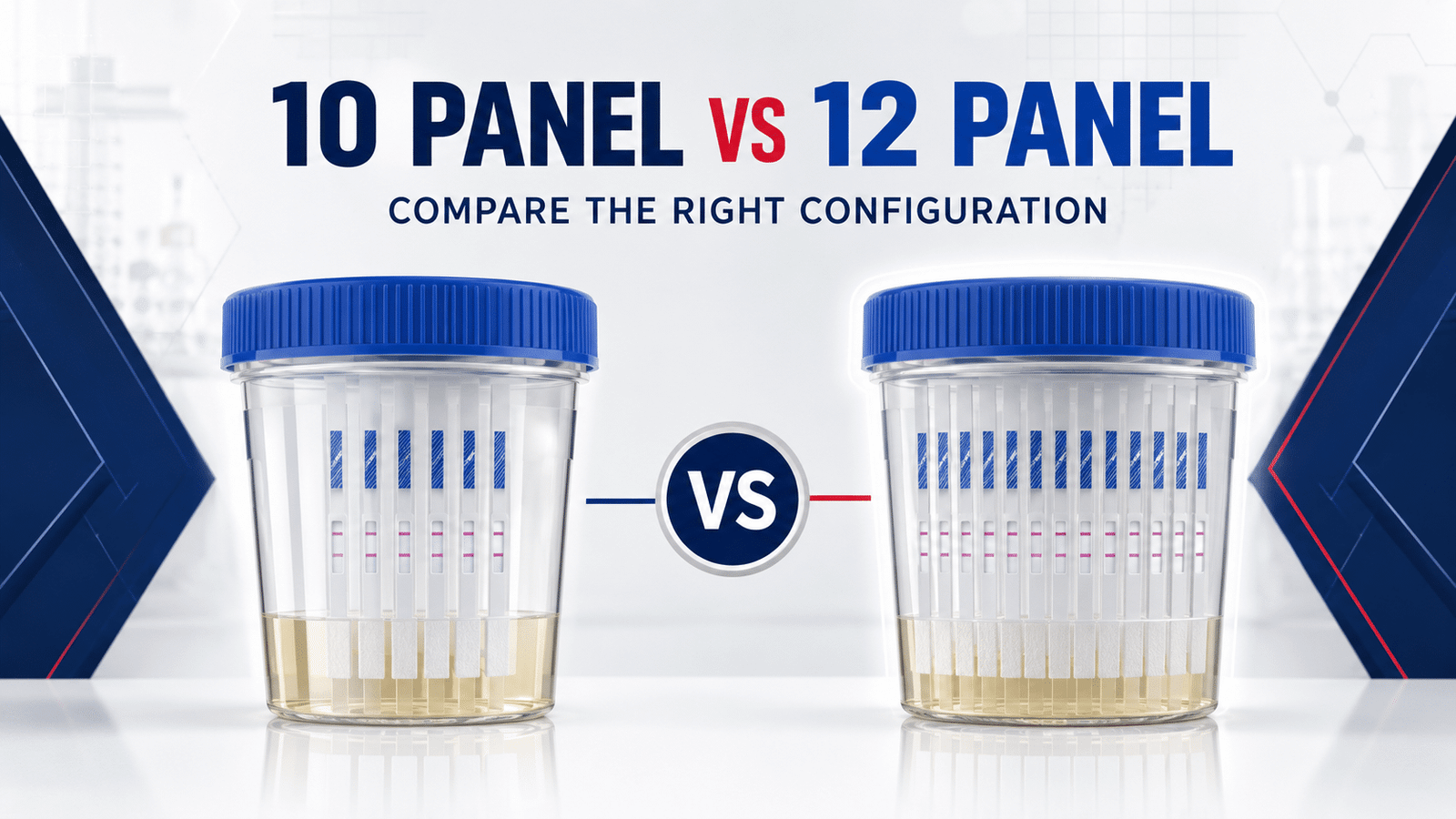

The main difference between a 10 panel vs 12 panel drug test is the number of drug or drug-class assays included in the device. A 10-panel cup contains 10 screening panels, while a 12-panel cup contains 12. However, the two additional panels are not universal. Buyers must compare the exact drug abbreviations, cutoff levels and intended-use classification listed for each product.
For organizations that need broader screening, the 12 panel drug test cup collection includes configurations for PCP, TCA, EtG, fentanyl, K2, kratom and specimen-validity indicators. If ten carefully selected panels meet your requirements, a 10 panel drug test cup may provide a more economical option.
The Key Difference Between 10 panel vs 12 panel drug test
A panel is an individual assay designed to screen for a particular drug, metabolite or drug class. Panel count describes how many assays are included, but it does not identify which substances the device tests for.
For example, two different 12-panel cups may share eight or nine common assays while using the remaining panels for different targets. One configuration may contain PCP and barbiturates, while another replaces those targets with EtG and fentanyl.
| Comparison Point | 10 Panel Drug Test | 12 Panel Drug Test | 14 Panel Drug Test |
|---|---|---|---|
| Number of screening assays | 10 | 12 | 14 |
| General coverage | Focused multi-drug screening | Broader multi-drug screening | Expanded or specialty screening |
| Specialty options currently available | Options may include K2, EtG, fentanyl or kratom | Options may include PCP, TCA, EtG, fentanyl, K2, kratom or ADLTX | Options may include EtG, fentanyl, K2, tramadol, gabapentin, PPX, TCA or hCG |
| Specimen-validity indicators | Available on selected products | Available on selected products | Available on selected products |
| Best selection method | Verify all 10 assays | Verify all 12 assays | Verify all 14 assays or analytes |
The table describes current category options rather than one universal panel configuration. Always review the exact product page and current package insert before ordering.
Why Panel Count Does Not Tell You Which Drugs Are Included
A common mistake when comparing a 10 panel vs 12 panel test is assuming that every 12-panel product contains a standard 10-panel configuration plus the same two additional drugs. Manufacturers and testing suppliers can offer different combinations under the same panel count.
Commonly available urine screening abbreviations include:
| Drug or Drug Class | Abbreviation | Important Buying Consideration |
|---|---|---|
| Amphetamine | AMP | Confirm the cutoff level |
| Barbiturates | BAR | Not included in every configuration |
| Buprenorphine | BUP | Frequently included in expanded panels |
| Benzodiazepines | BZO | Confirm the exact assay and cutoff |
| Cocaine metabolite | COC | Cutoff levels can differ by product |
| MDMA/Ecstasy | MDMA | May be separate from methamphetamine |
| Methamphetamine | MET or MAMP | Check the abbreviation used on the device |
| Methadone | MTD | Different from the EDDP metabolite assay |
| Opiates/Morphine | OPI or MOR | Check whether the cutoff is 300 or 2,000 ng/mL |
| Oxycodone | OXY | Usually provided as a separate assay |
| Phencyclidine | PCP | Not present in every 12-panel configuration |
| Tricyclic antidepressants | TCA | Some products include TCA instead of PCP |
| Marijuana metabolite | THC | Confirm the product cutoff |
| Ethyl glucuronide | EtG | Alcohol-metabolite screening requires a dedicated EtG panel |
| Fentanyl | FEN or FYL | Standard panel count does not guarantee fentanyl screening |
| K2/Spice | K2 | Requires a dedicated synthetic-cannabinoid assay |
| Kratom | KRA | Available only in selected specialty configurations |
For a closer look at the available 12-panel combinations, review our guide explaining what a 12 panel drug test detects.
Our 10 panel drug test list and configuration guide compares examples from the current catalog. Also check how OPI 300 differs from OPI 2000 when two cups list the same drug classes.
When a 12 Panel Drug Test Cup Is the Better Fit
A 12-panel cup can be useful when an organization needs broader coverage than its selected 10-panel configuration provides. The additional panel positions can be used for targets that are important to a particular treatment, recovery, correctional or non-regulated workplace testing program.
Current DrugTestingCup.com 12-panel options include configurations with:
- PCP or TCA
- EtG alcohol-metabolite screening
- Dedicated fentanyl screening
- K2 or synthetic-cannabinoid screening
- Kratom screening
- pH, specific gravity and creatinine indicators
- Compact 90mL and Serenity 120mL cup formats
- CLIA-waived and Forensic Use Only options
These features are product-specific. A 12-panel label alone does not confirm that the cup contains fentanyl, EtG, K2, kratom, PCP, TCA or specimen-validity indicators.
Buyers can compare current 12 panel drug test cups by configuration, cup size, intended-use status and quantity pricing.
When a 10 or 14 Panel Cup May Make More Sense
Choose a 10 Panel Cup When
- The selected 10 assays match your written testing requirements
- You do not need additional specialty panels
- Testing cost is a major consideration for a high-volume program
- You have confirmed the required drugs and cutoff levels before ordering
DrugTestingCup.com offers multiple 10 panel drug test cup configurations, including selected products with EtG, fentanyl, K2 or kratom.
Choose a 14 Panel Cup When
- Your program requires more than 12 drug or analyte targets
- You need a particular combination of fentanyl, EtG, K2, tramadol, gabapentin, PPX or TCA
- The exact 14-panel configuration matches your testing policy
- You have verified whether the selected product is CLIA-waived or Forensic Use Only
The 14 panel drug test cup collection includes several expanded and specialty configurations. Fourteen panels are not automatically better; the product must contain the correct assays for the program.
How to Choose the Correct Drug Test Cup
- List the required drugs. Start with the substances your program must screen for rather than selecting by panel count alone.
- Compare the exact abbreviations. Review every abbreviation shown on the product page and device label.
- Verify cutoff levels. The same drug assay can be available with different screening cutoffs.
- Check EtG and fentanyl separately. Neither target should be assumed from the total number of panels.
- Confirm specimen-validity needs. If needed, select a product with integrated pH, specific gravity and creatinine indicators.
- Verify intended-use status. Confirm whether the exact configuration is CLIA-waived, Forensic Use Only or otherwise labeled.
- Review the instructions. Read time, valid interpretation window and activation method can vary between products.
- Compare quantity pricing. Use the live product page to calculate the current unit price for your required quantity.
For instructions on interpreting control and test lines, see how to read a drug test cup. Programs considering integrated pH, specific gravity and creatinine pads can also review our guide to adulterants and specimen validity in drug testing.
Rapid urine cups provide preliminary screening results. A preliminary non-negative result should be handled according to the applicable policy and confirmed using an appropriate laboratory method when required.
Frequently Asked Questions
What is the difference between a 10 panel and 12 panel drug test?
A 10-panel drug test contains 10 screening assays, while a 12-panel test contains 12. The exact drugs are not universal, so the additional two panels must be verified on the individual product page.
Is a 12 panel drug test more accurate than a 10 panel test?
Not necessarily. A 12-panel test screens for more targets, but panel count alone does not determine accuracy. Correct collection, product quality, cutoff levels, timing and result interpretation also matter.
Does every 12 panel drug test include fentanyl?
No. Fentanyl requires a dedicated FEN or FYL panel. Only purchase a configuration that specifically lists fentanyl and its cutoff level.
Does every 12 panel drug test include alcohol?
No. Urine alcohol-metabolite screening requires a dedicated EtG panel. Many 12-panel configurations do not contain EtG.
Which drug test panel is best for employers?
The correct panel depends on the employer’s written policy, industry, job risks and applicable regulations. Employers should select the exact drug configuration that matches those requirements rather than automatically choosing the largest panel count.
Can a rapid 10 or 12 panel cup be used for DOT testing?
Do not assume that an instant cup satisfies DOT testing requirements. DOT-regulated testing must follow the applicable federal collection, laboratory and review procedures.
Is a 14 panel drug test always better than a 12 panel test?
No. A 14-panel product provides more assays, but it may contain targets that your program does not require. The best product is the configuration that matches the required drugs, cutoffs and intended use.
Should a non-negative rapid cup result be confirmed?
A rapid cup produces a preliminary screening result. An appropriate laboratory confirmation method should be used when required by the testing policy, clinical procedure or applicable regulation.
IN THIS ARTICLE