

12 Panel Drug Test List: Common and Specialty Assays
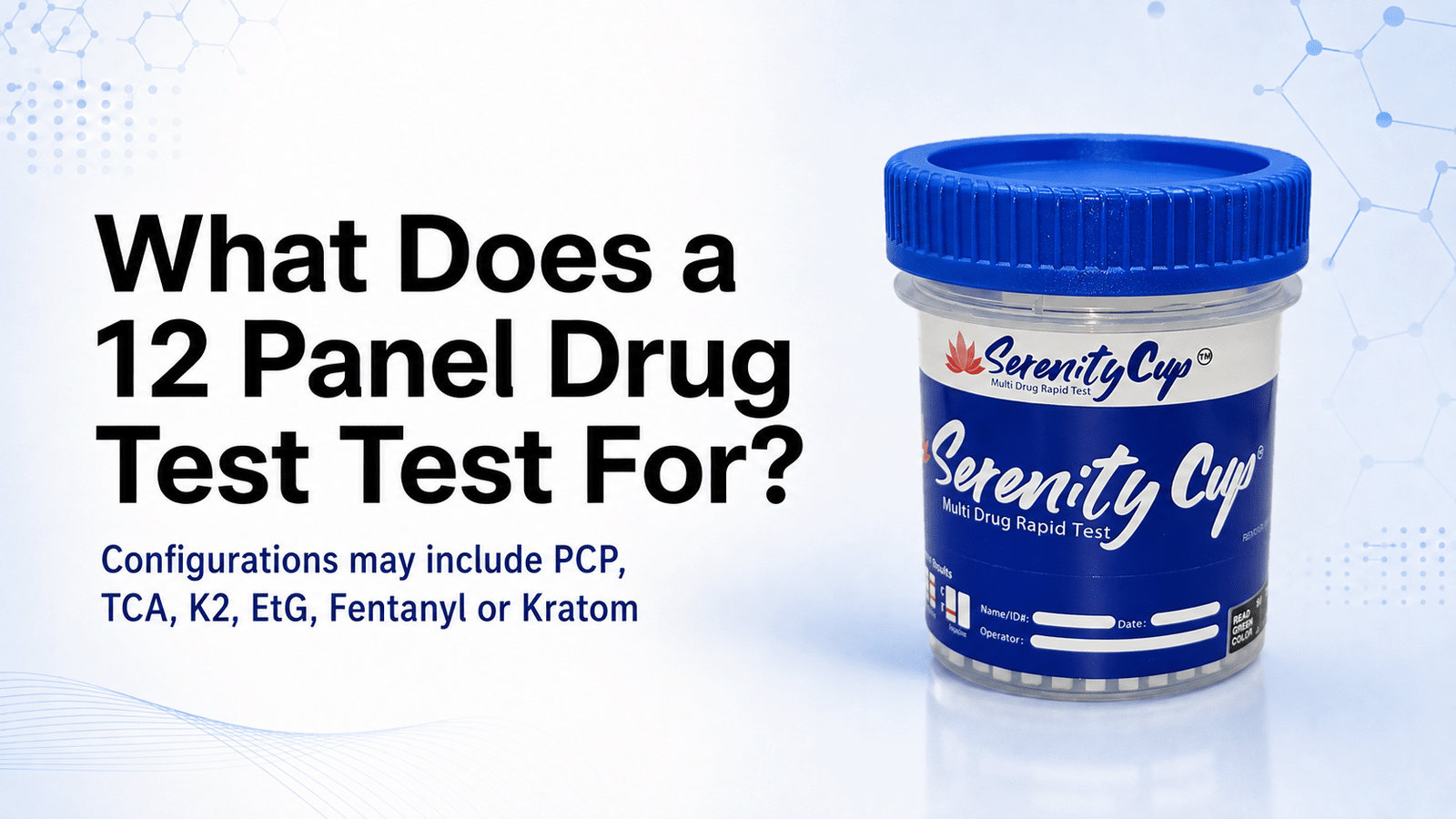
What does a 12 panel drug test test for? It screens a urine specimen for 12 drugs, drug classes or metabolites, but there is no single universal combination used by every 12 panel test. One cup may include PCP, while another replaces PCP with TCA, K2/Spice, EtG, fentanyl, kratom or another specialty assay.
The number “12” describes the number of drug-screening assays included in the device. It does not identify the exact drugs being tested. Before ordering, buyers should compare the complete panel configuration, cutoff levels, intended-use classification and cup size.
You can compare all 12 panel drug test cups available from DrugTestingCup.com and select a configuration that matches your testing program.
How the 12 Drug-Screening Panels Are Selected?
A 12 panel drug test may screen for commonly tested drug classes such as amphetamines, benzodiazepines, cocaine, methamphetamine, opiates, oxycodone, methadone and marijuana metabolites. Depending on the specific device, the remaining assays may include PCP, TCA, barbiturates, buprenorphine, MDMA or specialty targets such as K2, EtG, fentanyl and kratom.
The exact answer must therefore come from the analyte and cutoff table for the product being used. A test should never be selected only because its name contains “12 panel.”
Why 12 Panel Drug Test Configurations Differ
Manufacturers can combine different assays in a 12-panel format. This allows organizations to select a test based on the substances relevant to their program instead of purchasing the same fixed configuration for every testing situation.
Example of a PCP 12 Panel Configuration
The following is an example from a current 90 mL CLIA-waived 12 panel drug test cup. It is one available configuration and should not be treated as the universal definition of a 12 panel test.
| Drug or drug class | Abbreviation | Cutoff level |
|---|---|---|
| Amphetamines | AMP | 1,000 ng/mL |
| Barbiturates | BAR | 300 ng/mL |
| Buprenorphine | BUP | 10 ng/mL |
| Benzodiazepines | BZO | 300 ng/mL |
| Cocaine metabolite | COC | 300 ng/mL |
| MDMA | MDMA | 500 ng/mL |
| Methamphetamine | MET | 1,000 ng/mL |
| Methadone | MTD | 300 ng/mL |
| Opiates/Morphine | OPI/MOR | 300 ng/mL |
| Oxycodone | OXY | 100 ng/mL |
| Phencyclidine | PCP | 25 ng/mL |
| Marijuana metabolite | THC | 50 ng/mL |
Specialty 12 Panel Configurations
Specialty configurations replace one or more conventional assays with targets needed by a particular testing program. Available options include:
- TCA: The 12 Panel TCA Test Cup includes a Tricyclic Antidepressants assay at 1,000 ng/mL.
- PCP: The 12 Panel PCP Drug Test Kit includes a Phencyclidine assay at 25 ng/mL.
- K2/Spice: The 120 mL 12 panel drug test with K2 includes a dedicated K2 assay at 50 ng/mL. Buyers who prefer a smaller format can compare the 90 mL round K2 urine test cup.
-
- EtG and fentanyl: The 12 Panel Drug Test with Alcohol, EtG and Fentanyl includes EtG at 300 ng/mL and fentanyl at 20 ng/mL.
- EtG and fentanyl: The 12 panel drug test with EtG and fentanyl combines both specialty assays in a compact 90 mL cup, with screening cutoffs of 300 ng/mL for EtG and 20 ng/mL for fentanyl.
These specialty assays are included within the 12 total drug panels. They are not automatically added to every conventional 12-panel configuration.
How Does a 12 Panel Urine Drug Test Work?
An integrated urine test cup combines specimen collection and preliminary screening in one device. The internal test strips use immunoassay technology to produce a qualitative result for each included assay.
Collecting and Activating the Test
Collection and activation steps can differ between cup designs. Some devices begin developing after the specimen is collected, while others may require an activation step. Always follow the instructions supplied with the exact product, including the required specimen volume, activation method and result-reading window.
A built-in temperature strip may help evaluate whether the specimen temperature falls within the range stated in the product instructions. Temperature is only one part of specimen assessment and does not replace the complete collection procedure.
Reading the Results
Most competitive immunoassay cups use a control line marked C and a test line marked T:
- Negative: Both the control line and test line appear for that assay. A faint test line should be interpreted according to the product instructions.
- Preliminary non-negative: The control line appears, but the corresponding test line does not appear.
- Invalid: The required control line does not appear. The result should not be reported, and the instructions should be followed for retesting.
Each panel is interpreted separately. A cup can show a negative result for several assays and a preliminary non-negative result for another assay.
For additional examples, review our guide explaining how to read a drug test cup.
Confirmation of Non-Negative Results
A rapid urine cup provides preliminary screening results. A preliminary non-negative result does not identify the exact amount of a substance, establish impairment or determine precisely when exposure occurred.
When confirmation is required, the specimen should be evaluated using an appropriate laboratory confirmation method and the procedures applicable to the testing program. Organizations establishing workplace programs can also review current SAMHSA workplace drug-testing resources.
How to Choose the Right 12 Panel Drug Test
Compare the Exact Drugs and Cutoff Levels
Start by identifying which assays the program actually requires. If PCP screening is necessary, confirm that PCP appears in the product table. If TCA, fentanyl, EtG, K2 or kratom is required, select a configuration that lists that assay specifically.
Cutoff levels are screening thresholds, not detection-window guarantees. Buyers can compare commonly used thresholds in our drug test cutoff level guide.
Verify CLIA-Waived or Forensic Use Only Status
Some 12 panel drug test cups are CLIA-waived, while others are labeled Forensic Use Only. These classifications are not interchangeable.
Confirm the classification on the exact product page and package insert before purchase. A Forensic Use Only product should only be used in settings consistent with its labeling. Read our CLIA-waived drug test cup guide for additional selection information.
Choose Cup Size and Specimen-Validity Features
Compact 90 mL economy cups and larger 120 mL Serenity Cups are available. Cup size does not determine which drugs are included, so buyers should consider both capacity and panel configuration.
Some products also include pH, specific gravity and creatinine indicators. These ADLTX indicators evaluate specimen characteristics. They are not additional drug panels, and an abnormal indicator does not by itself prove that a specimen was intentionally altered.
How Long Can a 12 Panel Drug Test Detect Drugs?
There is no single detection period for an entire 12-panel test. Detection depends on the specific substance or metabolite, cutoff level, specimen type, pattern of exposure, individual metabolism and other factors.
A screening result cannot establish the exact time of use or current impairment. For substance-specific general information, review our urine drug test detection window guide and the instructions supplied with the test.
Who Uses 12 Panel Drug Test Cups?
Depending on the product’s intended-use classification and the requirements of the program, 12-panel cups may be considered by treatment and recovery programs, correctional facilities, probation programs, qualified forensic programs and other organizations that conduct multi-drug urine screening.
Employers, healthcare organizations and regulated programs should confirm that the exact device, collection procedure and testing policy are appropriate for their intended application. A product should not be selected solely because another organization uses a similar panel count.
Compare and Order 12 Panel Drug Test Cups
The best 12 panel drug test is the one whose exact configuration, cutoff levels, cup format and intended-use classification match the testing program. A higher panel count is not automatically a better choice, and two products with the same panel count may serve very different requirements.
Use the 12 Panel Drug Test Cups comparison page to review current PCP, TCA, K2, EtG, fentanyl, kratom and specimen-validity options. Current quantity pricing, availability and shipping information are displayed on each individual product page.
Organizations purchasing larger quantities can also review our guide to ordering drug test cups in bulk.
Frequently Asked Questions
What does a 12 panel drug test test for?
A 12 panel drug test screens for 12 drugs, drug classes or metabolites. The exact combination varies by product and may include PCP, TCA, K2, EtG, fentanyl, kratom or other specialty assays.
Do all 12 panel drug tests screen for the same drugs?
No. The panel count tells you how many assays are included, but it does not define one universal drug list. Always review the complete analyte and cutoff table.
Does a 12 panel drug test include fentanyl?
Only certain configurations include fentanyl. Fentanyl must be specifically listed in the product’s panel configuration and is not automatically included in every 12 panel test.
Does a 12 panel drug test test for alcohol?
A conventional 12-panel test does not automatically include alcohol-related screening. Certain specialty cups include an EtG alcohol-metabolite assay as one of their 12 panels.
Does a 12 panel drug test include PCP or TCA?
It may include PCP or TCA, depending on the configuration. Some products contain PCP at 25 ng/mL, while TCA-specific configurations contain TCA at 1,000 ng/mL.
Are all 12 panel drug test cups CLIA-waived?
No. DrugTestingCup.com carries both CLIA-waived and Forensic Use Only configurations. Verify the classification of the exact product before ordering or using it.
Is a non-negative rapid test result final?
No. A rapid cup produces a preliminary screening result. Preliminary non-negative results should be handled according to the product instructions and confirmed using an appropriate laboratory method when required.
IN THIS ARTICLE