


Drug-Free Workplace Act of 1988: Employer Requirements
The Drug-Free Workplace Act of 1988 requires certain federal contractors and recipients of covered federal grants or financial-assistance awards to make a good-faith effort to maintain a drug-free workplace. It does not require every private employer in the United States to establish a drug-testing program.
The Act generally focuses on written workplace policies, employee awareness, workplace-related criminal drug convictions, agency notifications, and appropriate employer responses. It does not, by itself, require pre-employment, random, post-accident, or reasonable-suspicion drug testing.
Organizations should first determine whether they have a covered federal contract, grant, cooperative agreement, or other financial-assistance award. The exact requirements can depend on the type of award, the applicable federal clause or agency regulation, and whether the recipient is an organization or an individual.
This guide provides general educational information and is not legal advice. Federal contractors and grant recipients should review their actual award documents and consult qualified legal or federal-contracting professionals when necessary.
What Is the Drug-Free Workplace Act?
The Drug-Free Workplace Act of 1988 is codified primarily in Chapter 81 of Title 41 of the United States Code. It establishes drug-free workplace obligations for covered federal contractors and federal grant recipients.
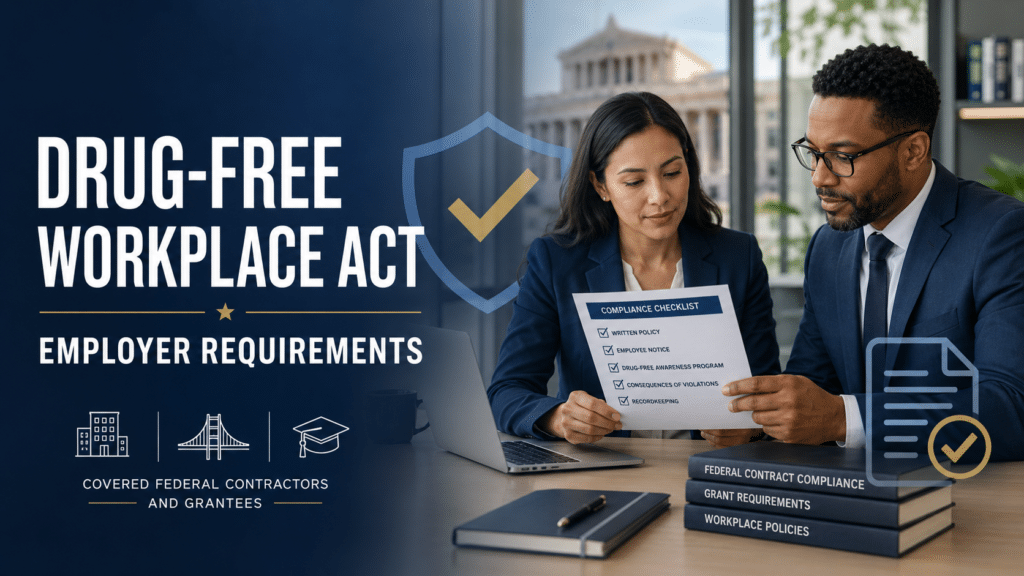
The current federal procurement requirements for contractors are implemented through Federal Acquisition Regulation Subpart 26.5. Drug-free workplace requirements for covered grants, cooperative agreements, and certain financial-assistance awards are addressed through 2 CFR Part 182 and the regulations of the federal agency making the award.
The Act does not create a universal fentanyl-testing requirement; our fentanyl workplace drug testing guide explains how federal-agency, DOT and private-employer programs differ.
The Act is not a universal federal drug-testing law for all employers. It also should not be confused with DOT drug-testing regulations, federal employee testing requirements, state drug-free workplace programs, or an employer’s voluntary drug-testing policy.
Drug-Free Workplace Act Requirements at a Glance
| Question | General answer |
|---|---|
| Does the Act apply to every private employer? | No. It applies to covered federal contractors and recipients of covered federal financial-assistance awards. |
| Does the Act require employee drug testing? | No. The Act does not itself require pre-employment, random, post-accident, or reasonable-suspicion testing. |
| Is a written drug-free workplace statement required? | Yes, for covered organizations. The statement must prohibit specified unlawful controlled-substance activity in the workplace and identify potential actions for violations. |
| Is an employee-awareness program required? | Yes. Covered organizations must establish an ongoing drug-free awareness program. |
| Must employees report workplace drug convictions? | Covered employees must provide written notice of a qualifying workplace criminal drug conviction no later than five calendar days after the conviction. |
| Must the employer notify the federal agency? | Yes. The covered organization generally must notify the appropriate federal agency or contracting officer within ten calendar days after learning of the conviction. |
| Must a convicted employee automatically be terminated? | No. The employer generally must take appropriate personnel action, up to and including termination, or require satisfactory participation in an approved assistance or rehabilitation program. |
| Are DOT testing requirements part of this Act? | No. DOT drug and alcohol testing requirements arise under separate transportation laws and regulations. |
Who Must Comply With the Drug-Free Workplace Act?
Covered Federal Contractors
Federal Acquisition Regulation Subpart 26.5 applies to covered federal procurement contracts. The current FAR generally applies the drug-free workplace requirements to contracts above the applicable simplified acquisition threshold, subject to stated exceptions.
FAR exceptions can include:
- Contracts at or below the applicable simplified acquisition threshold, except for certain contracts awarded to individuals
- Contracts for commercial products and commercial services
- Contracts or portions of contracts performed outside the United States and its outlying areas
- Certain undercover law-enforcement contracts
- Contracts where application would conflict with international obligations or applicable foreign law
Thresholds and federal acquisition rules can change. Contractors should check the current solicitation, award, incorporated clauses, and FAR 52.226-7 Drug-Free Workplace clause instead of relying on an older fixed-dollar figure.
The current FAR defines a covered contractor employee as an employee directly engaged in performing work under the government contract. This includes direct-cost employees and other contract employees whose involvement in contract performance is more than minimal.
Federal Grant and Financial-Assistance Recipients
Organizations receiving covered federal grants, cooperative agreements, or other applicable financial-assistance awards may be subject to the drug-free workplace requirements implemented by the awarding agency.
Under 2 CFR Part 182, a recipient other than an individual generally must:
- Make an ongoing good-faith effort to maintain a drug-free workplace
- Publish a drug-free workplace statement
- Establish an ongoing employee-awareness program
- Give the statement to employees engaged in the federal award
- Take required action after learning of a covered employee conviction
- Identify known workplaces connected to the federal award
Organizations should review the awarding agency’s regulations and the terms of the actual award. Agency-specific requirements may determine where notices must be sent and how compliance is documented.
Individuals Receiving Contracts or Awards
Individuals are subject to different requirements than organizations.
An individual federal contractor generally must agree not to engage in the unlawful manufacture, distribution, dispensing, possession, or use of a controlled substance while performing the contract.
An individual recipient of a covered federal financial-assistance award generally must agree not to engage in the prohibited conduct while carrying out activities related to the award. An individual recipient may also have a duty to report a qualifying criminal drug conviction to the awarding agency.
Employers That Are Not Automatically Covered
A private employer is not automatically covered simply because it conducts business in the United States or wants to maintain a drug-free workplace.
The federal Act does not automatically apply to:
- Every private employer
- Every company that sells products or services to another private company
- Every subcontractor or subrecipient
- Every employer that voluntarily conducts drug testing
- Every organization receiving non-federal funding
A subcontractor or subrecipient may still have obligations under another law, contract term, flow-down requirement, state program, licensing rule, or industry-specific regulation. Organizations should review their agreements before assuming that they are either covered or exempt.
What Must a Covered Drug-Free Workplace Statement Include?
A covered organization must publish a statement informing applicable employees that the unlawful manufacture, distribution, dispensing, possession, or use of a controlled substance is prohibited in the workplace.
The statement must also:
- Explain the actions the organization may take against employees who violate the prohibition
- Notify covered employees that following the statement is a condition of employment on the covered contract or award
- Explain the employee’s duty to report a qualifying workplace criminal drug conviction
- State that the written employee notice must generally be made no later than five calendar days after the conviction
The federal requirement concerns unlawful controlled-substance activity in the covered workplace. Employers should avoid expanding the policy into medical questions, off-duty conduct restrictions, or testing requirements without reviewing applicable employment, privacy, disability, marijuana, and state laws.
What Must the Drug-Free Awareness Program Cover?
Covered organizations must establish an ongoing drug-free awareness program.
The awareness program must inform employees about:
- The dangers of drug abuse in the workplace
- The organization’s policy of maintaining a drug-free workplace
- Available drug counseling, rehabilitation, or employee-assistance programs
- Potential penalties for workplace drug-abuse violations
The requirement is to provide an ongoing awareness program—not merely to place a policy in an employee handbook and never discuss it again.
Employers should document when the policy is distributed, when training or awareness activities occur, which employees participate, and when the materials are reviewed or updated.
Which Employees Must Receive the Statement?
For a covered federal contract, the statement generally must be given to employees directly engaged in performing the contract.
For a covered federal financial-assistance award, the statement generally must be given to employees engaged in performing work under the award.
Depending on the applicable federal rules, this can include certain direct-charge employees, indirect-charge employees with meaningful involvement, temporary personnel, or payroll consultants directly engaged in award performance.
Employers should review the applicable contract or award definition before deciding which employees are covered.
Employee Conviction-Notification Requirements
The conviction-notification requirement is narrower than a general duty to disclose every arrest, charge, or criminal matter.
For covered organizational programs, the federal requirement generally concerns a conviction under a criminal drug statute for a violation occurring in the workplace.
Employee Deadline
A covered employee generally must notify the employer in writing no later than five calendar days after a qualifying conviction.
Employer Deadline
After the employer receives the employee’s notice or otherwise learns of the conviction, it generally must notify the appropriate federal agency or contracting officer in writing within ten calendar days.
The notice may need to include:
- The employee’s position title
- The identification number of the affected contract or award
- Notice to each affected federal agency
- Delivery to the agency official, contracting officer, or designated central reporting point
Covered organizations should check the actual contract or award for the required recipient, format, and delivery method.
What Must the Employer Do After a Workplace Drug Conviction?
Within 30 calendar days after learning of a covered employee’s workplace criminal drug conviction, the organization generally must take one of two actions.
- Take appropriate personnel action against the employee, up to and including termination.
- Require the employee to participate satisfactorily in an approved drug-abuse assistance or rehabilitation program.
The Act does not state that every covered conviction must automatically result in termination. The appropriate response can depend on the organization’s written policy, the applicable federal rule, employment law, disability law, collective-bargaining obligations, and the specific circumstances.
Does the Drug-Free Workplace Act Require Drug Testing?
No. The Drug-Free Workplace Act does not itself require covered employers to conduct employee drug tests.
The Act does not independently mandate:
- Pre-employment drug testing
- Random drug testing
- Post-accident drug testing
- Reasonable-suspicion drug testing
- Return-to-duty drug testing
- Testing every employee working on a federal contract or grant
An employer may have separate testing obligations under another federal regulation, such as Department of Transportation rules for certain safety-sensitive transportation employees. Other employers may voluntarily establish lawful non-DOT testing programs.
Employers considering a separate testing program should review the workplace drug-testing compliance requirements and applicable drug-testing laws by state.
Drug-Free Workplace Policy vs Employee Drug Testing
| Requirement or practice | Required by the Drug-Free Workplace Act? | Important distinction |
|---|---|---|
| Written drug-free workplace statement | Yes, for covered organizations | The statement must address prohibited workplace conduct and potential actions for violations. |
| Ongoing awareness program | Yes, for covered organizations | It must address dangers, policy, available assistance, and possible penalties. |
| Pre-employment drug testing | No | Another law or a lawful employer policy may authorize or require it. |
| Random drug testing | No | Random testing may be regulated or restricted by industry and state law. |
| Post-accident drug testing | No | Testing should have a legitimate basis and must not be used to retaliate against injury reporting. |
| DOT drug testing | No | DOT testing is governed by separate transportation regulations. |
| Employee conviction notification | Yes, for covered workplace convictions | The employee generally has five calendar days to notify the employer. |
| Automatic employee termination | No | The employer may take appropriate personnel action or require satisfactory participation in an approved assistance or rehabilitation program. |
How DOT Drug Testing Is Different
The Drug-Free Workplace Act and DOT testing rules are separate federal requirements.
DOT regulations apply to covered safety-sensitive transportation employees and establish specific requirements for:
- Testing reasons
- Specimen collection
- Laboratory testing
- Medical Review Officer review
- Random testing rates
- Return-to-duty and follow-up testing
- Employee refusals
- Recordkeeping
Instant drug-test cups and rapid oral-fluid devices are not substitutes for official DOT drug tests. Employers with regulated transportation employees should review the current DOT drug-test requirements.
How State Marijuana and Employment Laws Affect Workplace Policies
A federal drug-free workplace obligation does not eliminate the need to review state and local employment laws.
State and local rules may affect:
- Pre-employment marijuana testing
- Testing for marijuana metabolites
- Medical-marijuana protections
- Lawful off-duty conduct
- Reasonable-suspicion and random testing
- Employee notice and consent
- Laboratory confirmation
- Disciplinary decisions
- Confidentiality of test results
The federal Act focuses on unlawful controlled-substance activity in the covered workplace. It does not automatically authorize every type of drug test or every employment action in every state.
Employers operating in multiple states should use state-specific policy supplements and obtain legal review rather than applying one testing policy nationwide.
Consequences of Noncompliance
Failure to comply with applicable drug-free workplace requirements can create serious consequences for a federal contractor or financial-assistance recipient.
Depending on the award and federal agency, consequences may include:
- Suspension of contract or award payments
- Termination of the contract or award
- Suspension from federal procurement or financial-assistance programs
- Debarment from future federal contracts or covered awards
- Additional remedies permitted by the contract, award, or agency regulations
Current FAR rules permit federal action when a contractor fails to comply with the applicable Drug-Free Workplace clause or when workplace criminal drug convictions indicate that the contractor has not made a good-faith effort to maintain a drug-free workplace.
Under 2 CFR Part 182, a covered financial-assistance recipient may face suspension of payments, suspension or termination of the award, or suspension and debarment for up to five years.
Drug-Free Workplace Compliance Checklist
- Identify every federal contract, grant, cooperative agreement, and financial-assistance award.
- Review the clauses and agency regulations attached to each award.
- Determine which contracts or awards are covered.
- Identify the workplaces and employees connected to each covered award.
- Publish a compliant drug-free workplace statement.
- Distribute the statement to covered employees.
- Establish an ongoing drug-free awareness program.
- Explain the five-day employee conviction-notification requirement.
- Establish a procedure for the ten-day agency-notification deadline.
- Create a process for appropriate action within 30 days after a covered conviction.
- Document policy distribution, training, notifications, and employer responses.
- Keep medical and employment information confidential.
- Separate Drug-Free Workplace Act compliance from DOT or voluntary non-DOT testing programs.
- Review federal, state, and local legal changes regularly.
Voluntary Drug Testing by Private Employers
Employers that are not required to test under the Drug-Free Workplace Act may still choose to establish a lawful drug-testing program. The program should be based on a written policy and reviewed for federal, state, and local compliance.
A voluntary testing program may address:
- Pre-employment testing
- Random testing when permitted
- Reasonable-suspicion testing
- Post-incident testing
- Return-to-work or follow-up testing
- Laboratory confirmation of non-negative screens
- Medical Review Officer review
- Employee challenges and confidentiality
Rapid drug tests provide preliminary screening results. A non-negative rapid result should not automatically be treated as a final confirmed positive result. Appropriate laboratory confirmation may be necessary before a significant employment or disciplinary decision.
Employers evaluating oral-fluid screening can review the workplace oral fluid drug-testing guide. Organizations with lawful non-DOT testing programs can also compare urine drug-test cups and oral-fluid drug-test configurations.
Frequently Asked Questions
What is the Drug-Free Workplace Act of 1988?
The Drug-Free Workplace Act of 1988 establishes drug-free workplace requirements for certain federal contractors and recipients of covered federal grants or financial-assistance awards. It focuses on written policies, employee awareness, workplace conviction notifications, appropriate employer responses, and good-faith compliance.
Does the Drug-Free Workplace Act apply to every employer?
No. The Act does not apply to every private employer. It applies to covered federal contractors and recipients of covered federal financial-assistance awards. Other employers may have separate obligations under federal, state, local, licensing, or industry-specific rules.
Does the Drug-Free Workplace Act require employee drug testing?
No. The Act does not itself require pre-employment, random, post-accident, or reasonable-suspicion drug testing. Testing may be required under another regulation, such as DOT rules, or implemented through a lawful employer policy.
What must a covered drug-free workplace policy include?
The statement must prohibit the unlawful manufacture, distribution, dispensing, possession, or use of a controlled substance in the covered workplace. It must also explain potential actions for violations and notify covered employees of their conviction-reporting responsibility.
How long does an employee have to report a workplace drug conviction?
A covered employee generally must notify the employer in writing no later than five calendar days after a conviction under a criminal drug statute for a violation occurring in the workplace.
How long does an employer have to notify the federal agency?
The covered organization generally must notify the appropriate federal agency, awarding official, or contracting officer in writing within ten calendar days after learning of the qualifying conviction.
Must the employer fire an employee after a workplace drug conviction?
No. Within 30 calendar days, the employer generally must take appropriate personnel action, up to and including termination, or require the employee to participate satisfactorily in an approved drug-abuse assistance or rehabilitation program.
Are DOT drug tests required by the Drug-Free Workplace Act?
No. DOT drug and alcohol testing requirements arise under separate transportation laws and regulations. DOT-regulated employers must follow the applicable DOT procedures in addition to any other drug-free workplace obligations.