

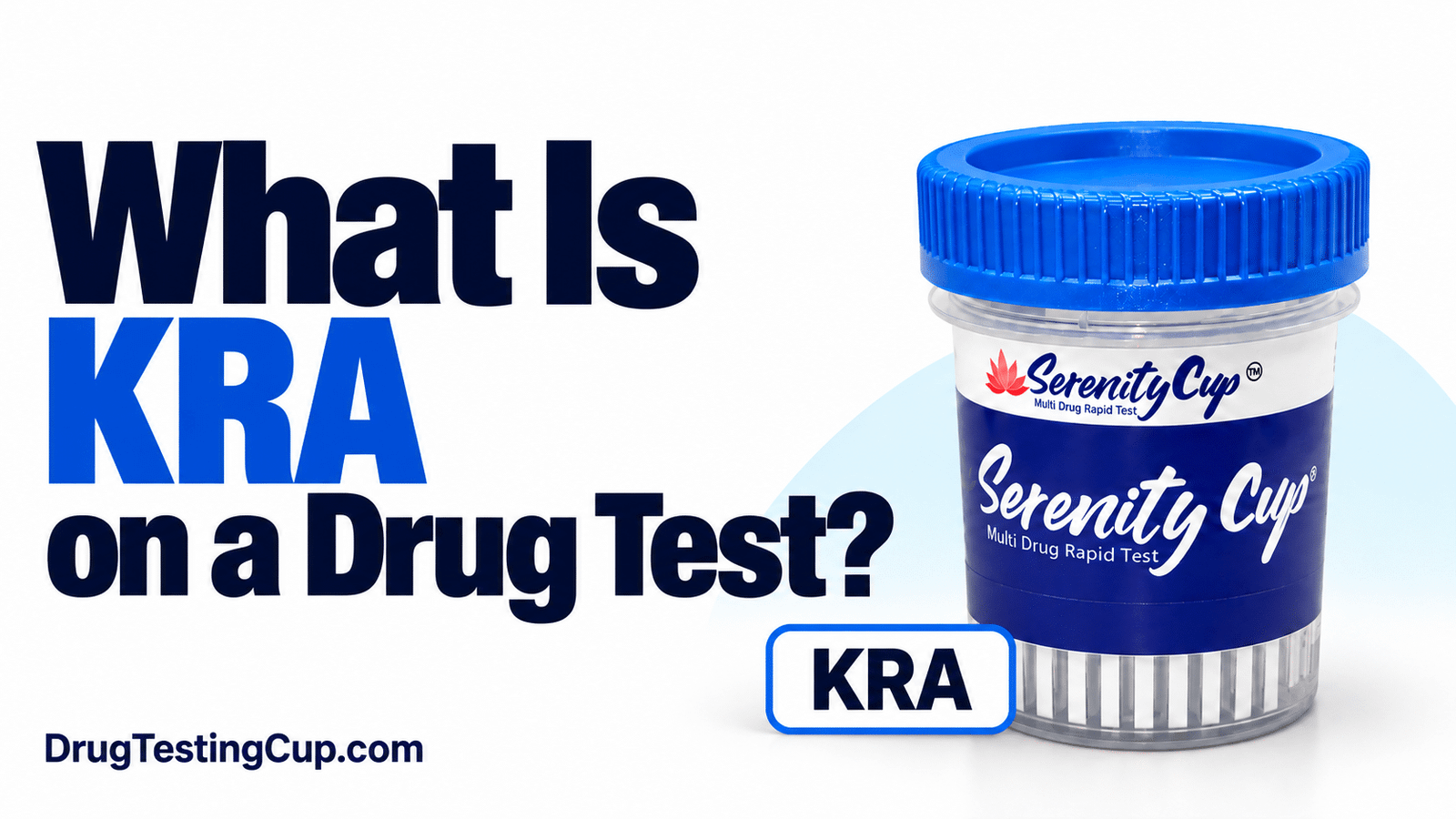

Does kratom show up on a drug test? Not on a standard one. Basic 5-panel and 10-panel urine drug tests do not screen for kratom. Kratom shows up only when the test includes a dedicated kratom panel, usually labeled KRA, or when a laboratory is specifically asked to test for kratom compounds.
That distinction matters because kratom use has grown, and many treatment programs, courts and employers now want to know about it. If your current test does not list KRA, it is not looking for kratom.
This guide explains what kratom is, which compounds drug tests look for, how long kratom may stay in your system, which tests include a kratom panel and how to read the result.
What Is Kratom?
Kratom is a plant whose leaves contain compounds that act on the brain’s opioid receptors. According to the National Institute on Drug Abuse, its best-studied compounds are mitragynine and 7-hydroxymitragynine (7-OH), and mitragynine is broken down into 7-OH in the body.
People report both stimulant-like effects, such as more energy and alertness, and opioid-like or sedative effects, such as relaxation and pain relief. NIDA notes that the FDA has approved no medical uses for kratom and has warned consumers not to use kratom products. Federal and state rules on kratom and concentrated 7-OH products have been changing, so programs should check current regulations in their state.
For more on the difference between kratom leaf and 7-OH products, see our guide Kratom vs. 7-OH: What Is the Difference?
Does Kratom Show Up on a Standard Drug Test?
No. Standard workplace and clinical panels focus on drugs such as THC, cocaine, amphetamines, opiates and PCP. Kratom’s compounds are chemically different from morphine and codeine, and standard opiate (OPI) panels are not designed to detect mitragynine.
Kratom appears on a test only when:
- The cup or dip card includes a KRA panel.
- A single-panel kratom test is used.
- A laboratory runs a test specifically for mitragynine or its metabolites.
Panel count alone does not tell you whether kratom is included. Two 12-panel cups can have completely different drug lists. Our article Does Kratom Show Up on a 12 Panel Drug Test? explains how to check a specific configuration.
How Long Does Kratom Stay in Your System?
Published data on kratom detection in urine are limited, so no standard detection window has been established. The best available pharmacokinetic data come from a 2015 study in which researchers measured mitragynine in nine long-term kratom users. They found an average terminal half-life of about 23 hours, or about one day, with wide variation between people. See Trakulsrichai et al., Drug Design, Development and Therapy.
ARUP Consult notes that elimination generally takes about five half-lives. Applying that rule of thumb to a half-life of about a day suggests kratom compounds could remain detectable for several days after regular use. That is an estimate, not a guarantee, and detection will depend on:
- Frequency of use – daily users accumulate more than occasional users.
- Amount and product type – leaf, extracts and concentrated 7-OH products deliver different amounts of active compounds.
- Individual metabolism – the same study found large differences in half-life between subjects.
- Test design and cutoff – what the assay targets and at what concentration.
The same study found that very little unchanged mitragynine appears in urine, about 0.14% of the dose. That is one reason laboratory methods often look for kratom metabolites as well as mitragynine itself.
Because detection depends so heavily on the individual and the product used, kratom test results should never be used to estimate exactly when someone last used kratom or how much they used. Programs get more reliable information from regular, random testing than from trying to time a single test.
What Does a Kratom Drug Test Detect?
Rapid kratom tests are immunoassays that screen for mitragynine and, depending on the assay, related compounds. Our kratom products list a cutoff of 500 ng/mL, labeled KRA/500.
Laboratory tests use methods such as LC-MS/MS to identify mitragynine and its metabolites, including 7-OH, at lower concentrations. When the source of a positive screen matters, laboratory confirmation provides more detail than a rapid result.
Kratom Testing Products
| Format | Best fit | Product |
|---|---|---|
| Kratom test strips (KRA/500) | Low-cost kratom-only screening with urine in a separate cup | Kratom test strips |
| Kratom dip card (KRA/500) | Single-panel kratom screening in a card format | Kratom dip card |
| Multi-panel cup with KRA | Kratom plus fentanyl, alcohol and standard drugs | 16 panel cup with kratom, EtG and fentanyl |
| Specialty cup | Emerging substances without the standard panels | 6 panel specialty cup with kratom, xylazine and K2 |
Programs that already run a standard urine screen usually add kratom through a multi-panel cup. Programs that only need to check for kratom, or that want to add it on top of an existing test, often use single-panel strips or dip cards.
Before ordering, confirm the cutoff and intended-use labeling on the product page and package insert for each lot.
Who Tests for Kratom?
Kratom testing has become more common in settings where opioid-like substances are a concern:
- Addiction treatment programs – some patients use kratom to self-manage withdrawal, and clinicians need to know about it.
- Sober living homes – many house rules now prohibit kratom and 7-OH products.
- Drug courts, probation and parole – supervision conditions may include kratom.
- Employers – some employers add kratom to safety-sensitive testing outside DOT programs.
Federally regulated DOT drug tests follow a fixed drug list set out in 49 CFR §40.85, which does not include kratom.
How to Choose a Kratom Test for Your Program
Start with the question your program needs answered, then match the format:
- Do you need kratom only? Single-panel strips or dip cards keep the cost per test low and can be added to an existing screen.
- Do you need kratom plus standard drugs? A multi-panel cup with KRA covers kratom and the usual panels from one specimen.
- Do you also monitor fentanyl and alcohol? Choose a configuration that includes FEN and EtG alongside KRA.
- Do you need specimen validity checks? Some cups add pH, specific gravity and creatinine indicators to help flag dilution.
Whatever format you choose, keep the same product and cutoff over time so results stay comparable, and record the lot number and reading time with each result.
Kratom and Other Substances Programs Screen For
Kratom is rarely the only substance a program is concerned about. Programs that add kratom often add other emerging substances at the same time:
- Fentanyl (FEN) – not detected by standard opiate panels.
- Xylazine (XYL) – a veterinary sedative found in the illicit drug supply.
- Synthetic cannabinoids (K2) – not detected by THC panels.
- Alcohol (EtG) – often prohibited in the same settings that prohibit kratom.
Our drug test abbreviations chart lists these panels and the cutoffs our tests use. For volume pricing on kratom tests, request a bulk quote.
How to Read a Kratom Test
Kratom rapid tests use the same line logic as other panels:
- Negative: both the control line (C) and the KRA test line (T) appear, even if T is faint.
- Preliminary non-negative: only the control line appears.
- Invalid: no control line appears.
Read the result within the time stated in the package insert. Our guide to reading a drug test cup explains faint lines and invalid results.
What a Positive Kratom Test Means
A preliminary non-negative KRA result suggests kratom compounds may be present above the cutoff. It does not show how much was used, when it was used or whether the person is impaired. Because kratom products vary widely in strength and composition, results should be interpreted alongside the program’s policy and, when the result is disputed or consequential, laboratory confirmation.
Frequently Asked Questions
Does kratom show up on a drug test?
Not on a standard drug test. Basic 5-panel and 10-panel tests do not screen for kratom. Kratom shows up only when the test includes a KRA panel or a laboratory specifically tests for mitragynine or its metabolites.
How long does kratom stay in your system?
No standard detection window has been established. A 2015 study found that mitragynine has an average half-life of about 23 hours, and elimination generally takes about five half-lives, so kratom could remain detectable for several days after regular use.
Does kratom show up as an opiate on a drug test?
Standard opiate panels target morphine and codeine and are not designed to detect mitragynine. A dedicated KRA panel or laboratory test is needed to screen for kratom.
What does KRA mean on a drug test?
KRA is the abbreviation for the kratom panel. Our kratom tests list it as KRA/500, meaning a screening cutoff of 500 ng/mL.
Does a kratom test detect 7-OH?
Rapid kratom tests screen for mitragynine and, depending on the assay, related compounds. Laboratory tests can identify 7-hydroxymitragynine specifically. Check the package insert for the compounds a rapid test detects.
Is kratom part of a DOT drug test?
No. DOT drug testing follows a fixed list of drugs in 49 CFR §40.85, and kratom is not on that list.
IN THIS ARTICLE