



What is a UA drug test? UA stands for urinalysis. A UA drug test is a drug screen performed on a urine sample to detect recent drug use. It is the most common type of drug test in the United States and is used by employers, probation and parole departments, drug courts, treatment programs and healthcare providers. When someone says they have to “drop a UA” or “do a UA,” they mean they must provide a urine sample for drug testing.
This guide explains how a UA drug test works, what it detects, how collection is done, what observed UAs are, what dilute and invalid results mean and how long results take.
What Does UA Stand For?
UA is short for urinalysis. In a medical setting, a urinalysis can mean a broader examination of urine for signs of infection, kidney problems or diabetes. In drug testing, “UA” almost always refers to a urine drug screen. The terms UA drug test, urine drug screen and urinalysis drug test are used interchangeably.
How a UA Drug Test Works
When a drug is used, the body breaks it down into metabolites, many of which are excreted in urine. A UA drug test looks for these drugs or metabolites. Most testing happens in two stages:
- Screening: An immunoassay test, either a rapid cup or dip card on site or an automated laboratory screen, checks whether each drug is above a set cutoff level.
- Confirmation: Specimens that screen non-negative are tested by GC-MS or LC-MS/MS, which identifies the specific drug and its concentration.
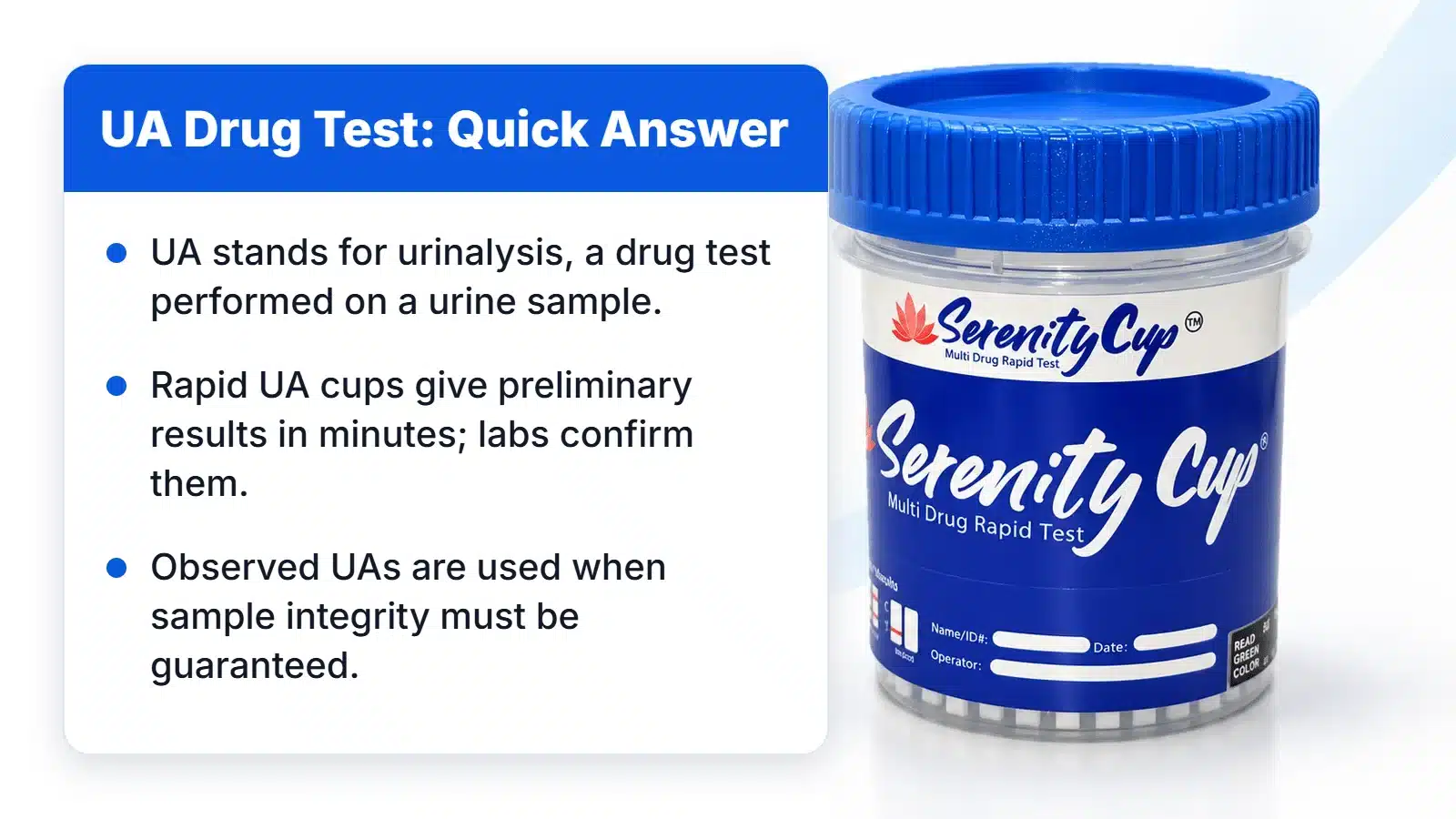
Rapid on-site UAs give preliminary results in about five minutes. Laboratory UAs take longer but provide confirmed results.
What Does a UA Drug Test Detect?
What a UA detects depends on the panel ordered. Common configurations include:
| Panel | Typical Drugs Included |
|---|---|
| 5 panel | THC, cocaine, amphetamines, opiates, PCP |
| 10 panel | 5 panel plus benzodiazepines, barbiturates, methadone, methamphetamine and often oxycodone or MDMA |
| 12 panel | 10 panel plus two more, such as buprenorphine, oxycodone, MDMA or TCA |
| Expanded panels | Fentanyl, EtG (alcohol), K2, kratom, tramadol, gabapentin and others |
For details on specific panels, see our guides to the 5 panel drug test, 10 panel drug test and 12 panel drug test.
How Long Do Drugs Show Up on a UA?
Urine has a longer detection window than saliva or blood, which is one reason UAs are so widely used. Most drugs are detectable for about one to four days after occasional use. Marijuana can be detected for weeks in heavy, daily users, and some long-acting benzodiazepines can be detected for a week or more. See our urine drug test detection windows guide for drug-by-drug ranges.
What to Expect During a UA Collection
- Identification: You show photo ID and may be asked to empty your pockets and remove outer clothing such as jackets.
- Handwashing: You wash your hands, usually without soap, to avoid contaminating the sample.
- Collection: You provide a sample in a collection cup, typically at least 30 to 45 mL, in a restroom where the water may be turned off and the toilet water colored with bluing dye.
- Temperature check: The collector checks the temperature strip within about four minutes. An acceptable range is usually 90 to 100°F.
- Testing or sealing: For a rapid UA, the cup is read on site. For a lab UA, the sample is sealed, labeled and sent with a chain-of-custody form.
What Is an Observed UA?
An observed UA is a urine collection in which a same-gender observer directly watches the urine leave the donor’s body and enter the collection cup. Observed collections are used when the integrity of the sample must be guaranteed, such as in probation and parole supervision, drug courts, treatment programs and certain DOT situations. In DOT testing, observed collections are required for return-to-duty and follow-up tests and in specific situations such as a temperature out of range or signs of tampering.
Observed UAs can feel uncomfortable, but they are a standard and lawful part of many supervision and treatment programs.
Dilute, Invalid and Adulterated UA Results
| Result | What It Means | What Usually Happens |
|---|---|---|
| Dilute | Urine is more watery than normal, based on creatinine and specific gravity | Many programs require a recollection; some treat a dilute negative as a negative |
| Invalid | The test could not produce a valid result, often due to an interfering substance | Recollection, often observed |
| Adulterated | A foreign substance was added to the sample | Usually treated as a refusal to test |
| Substituted | The sample is not consistent with human urine | Usually treated as a refusal to test |
Many rapid UA cups include adulterant strips that check creatinine, specific gravity, pH and oxidants. Learn more in our guide on adulterants in drug testing.
How Long Do UA Results Take?
Rapid on-site UA results are available in about five minutes, but they are preliminary. Laboratory negative results are often reported within one to two business days. Non-negative results take longer because they require confirmation and, in many programs, review by a Medical Review Officer, which can add several days.
What Is a Shy Bladder?
Some people find it difficult to urinate on demand, especially under observation. This is called shy bladder. In DOT testing, a donor who cannot provide enough urine is given up to three hours and may drink up to 40 ounces of fluid. If they still cannot provide a sufficient specimen, they are referred for a medical evaluation to determine whether there is a legitimate medical reason. Non-DOT programs usually have their own shy bladder procedure, often modeled on the DOT approach. Leaving the collection site before the process is complete is generally treated as a refusal to test.
UA vs Other Drug Test Types
Urine is not the only option. Saliva tests detect more recent use and are collected under direct observation without a restroom. Hair tests show a longer history of use, commonly up to about 90 days. Blood tests show what is in the bloodstream now but are invasive and expensive. Most programs choose urine because it balances a useful detection window, low cost and well-established procedures. For a full comparison, read our guide to urine vs saliva vs blood drug tests.
Random UAs in Supervision and Treatment
Probation departments, drug courts and treatment programs often use random UAs, where participants call a phone line or check an app each day to learn whether they must test. Random scheduling makes it harder to time drug use around tests and gives a more accurate picture of ongoing abstinence. Missing a scheduled random UA is usually treated the same as a positive result, so participants should follow the call-in rules carefully.
Who Uses UA Drug Tests?
- Employers for pre-employment, random, post-accident and reasonable suspicion testing
- Probation, parole and pretrial services
- Drug courts and treatment courts
- Addiction treatment and sober living programs
- Pain management clinics and other healthcare providers
- Schools and athletic programs
Tips for Taking a UA
- Bring valid photo ID and arrive on time.
- Tell the collector or program about prescription medications if given the opportunity.
- Drink a normal amount of fluid; excessive water can cause a dilute result.
- Follow the collector’s instructions exactly and do not leave the collection area without permission.
- If you cannot provide enough urine, tell the collector; there are procedures for shy bladder situations.
Rapid UA Test Cups for Programs
Programs that run frequent UAs often use rapid test cups, which combine collection and screening in one device and include a temperature strip. Many also include adulterant checks. Compare configurations in our drug test cups category and our CLIA-waived drug test cups, and see our guide on how to read a drug test cup for training staff.
Key Takeaway
A UA drug test is a urinalysis, a urine drug screen used to detect recent drug use. Rapid UAs give preliminary results in minutes, and laboratories confirm non-negative results. Observed UAs are used when sample integrity must be guaranteed, and dilute, invalid or adulterated samples usually lead to recollection or are treated as refusals. Panel choice determines which drugs the UA detects.
This article is for general educational purposes and is not medical or legal advice.
Frequently Asked Questions
What does UA mean in a drug test?
UA stands for urinalysis. A UA drug test is a drug screen performed on a urine sample.
What does a UA drug test check for?
It depends on the panel. A 5 panel UA checks for THC, cocaine, amphetamines, opiates and PCP, while larger panels add drugs such as benzodiazepines, oxycodone, fentanyl and alcohol metabolites.
What is an observed UA?
An observed UA is a urine collection in which a same-gender observer watches the sample being provided to prevent tampering. It is common in probation, drug court and treatment programs.
How long does it take to get UA results?
Rapid UA results take about five minutes but are preliminary. Laboratory negatives often take one to two business days, and non-negative results take longer because they require confirmation.
What happens if my UA is dilute?
Many programs require a new collection after a dilute result. Some treat a dilute negative as a negative, depending on their policy.
IN THIS ARTICLE