

How do you dispute a false positive drug test? Start by finding out exactly what kind of result you received. A rapid on-site screen is only preliminary and should be confirmed by a laboratory. If the result has already been confirmed, you can provide prescription and medical information to the Medical Review Officer (MRO), ask questions about the testing process and, in many programs, request that a split or retained specimen be tested by a second laboratory.
This guide walks through the steps to dispute a drug test result, explains your options in DOT and non-DOT testing, and covers the information that makes a dispute more effective. It focuses on the process; for the substances that commonly cause unexpected results, see our guide on what can cause a false positive drug test.
Step 1: Find Out What Kind of Result You Have
Drug testing usually happens in two stages, and your options depend on which stage you are in.
| Result Type | What It Means | What to Do |
|---|---|---|
| Preliminary non-negative (rapid screen) | An on-site cup or dip card did not show a test line for one or more drugs | Ask that the specimen be sent for laboratory confirmation before any decision is made |
| Laboratory-confirmed positive | GC-MS or LC-MS/MS identified a specific drug above the confirmation cutoff | Provide information to the MRO and ask about split or retained specimen testing |
| MRO-verified positive | The MRO reviewed the confirmed result and found no legitimate medical explanation | Request split specimen testing if available and follow your program’s appeal process |
Rapid screens use immunoassays that can occasionally react to medications or other substances. Laboratory confirmation identifies the specific compound, which is why it resolves most screening false positives.
Step 2: Ask for Laboratory Confirmation
If you were told you failed based on an on-site test, politely ask whether the specimen will be sent for confirmation. Most well-designed workplace and treatment programs require confirmation before taking action on a non-negative screen. If your program’s policy does not mention confirmation, ask for a copy of the policy so you understand the process.
Step 3: Gather Your Prescriptions and Medication List
Many unexpected results are caused by legitimate medications. Prepare a complete list of everything you have taken recently, including:
- Prescription medications, with the prescriber, pharmacy and dates
- Over-the-counter medicines such as cold remedies, sleep aids and pain relievers
- Supplements and herbal products, including CBD or hemp products
- Recent medical or dental procedures where medications were given
- Foods such as poppy seeds, if relevant to an opiate result
Pharmacy printouts and prescription bottle labels are useful documentation. Do not bring someone else’s prescription; MROs verify prescriptions issued to you.
Step 4: Talk to the Medical Review Officer
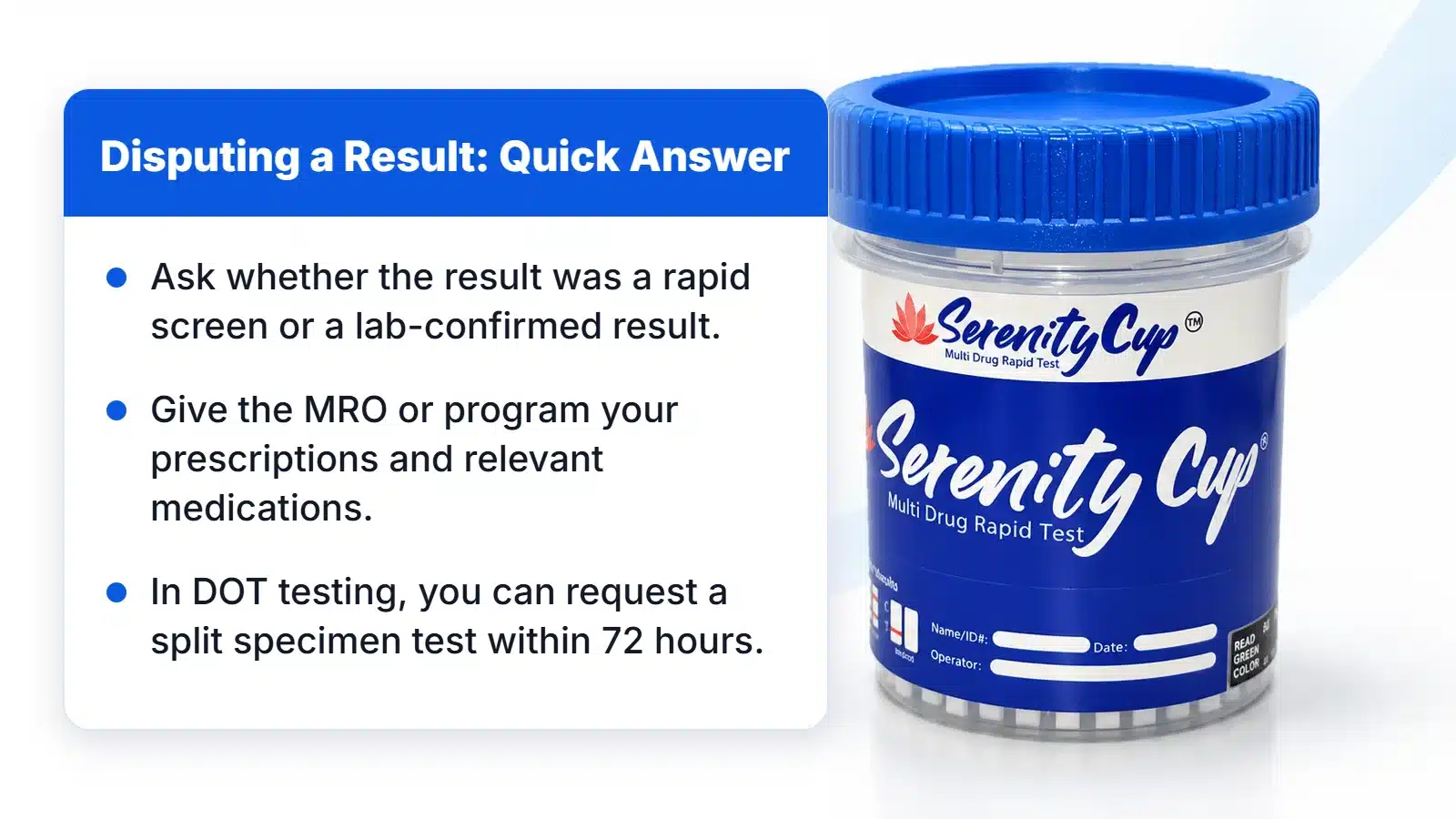
In regulated testing and many non-DOT programs, a laboratory-confirmed positive goes to an MRO, a licensed physician trained in drug testing. Before reporting a positive result to the employer, the MRO attempts to contact you for a verification interview.
During the interview, the MRO asks whether you have a legitimate medical explanation, such as a valid prescription. Answer the call promptly, have your medication information ready and be honest. If the MRO confirms a legitimate medical explanation, the result is reported as negative. Missing the MRO’s call can lead to the result being verified without your input, so keep your contact information current.
Step 5: Request a Split Specimen or Retest
DOT-regulated testing
DOT urine collections are split into two bottles, called Bottle A and Bottle B. If your Bottle A result is verified positive, adulterated or substituted, you have the right to request that Bottle B, the split specimen, be tested at a different HHS-certified laboratory. You must make this request to the MRO within 72 hours of being notified of the verified result. The employer must ensure the test is conducted and may seek reimbursement from the employee depending on its policy. If the split specimen fails to reconfirm the original result, the test is cancelled.
Non-DOT testing
Non-DOT programs set their own procedures. Some collect split specimens; others retain the original specimen so it can be retested. Ask your employer or program whether a split or retained specimen is available, how to request a retest and who pays for it. Some state laws give employees specific rights to a retest, so check the drug testing laws in your state.
Step 6: Review the Collection and Chain of Custody
Procedural errors can affect the validity of a test. You can ask to review your copy of the custody and control form and consider whether:
- Your identity and specimen ID numbers were recorded correctly
- The specimen was sealed and initialed in your presence
- The temperature was checked and recorded within the required time
- Any collection problems were documented
- The laboratory was properly certified for the type of test performed
Not every paperwork error invalidates a result, but significant chain-of-custody problems can be grounds for cancellation in regulated programs.
Step 7: Follow the Formal Appeal or Grievance Process
Employers and programs usually have a written process for disputing results or disciplinary decisions. Submit your dispute in writing, keep copies of everything and note dates and names of people you spoke with. If you are covered by a union contract, contact your representative. If you believe your rights were violated, you may want to consult an employment attorney, particularly in states with detailed drug testing laws.
What Makes a Dispute More Likely to Succeed
- Acting quickly: Deadlines such as the DOT 72-hour split specimen window are strict.
- Documentation: Prescriptions, pharmacy records and medical notes carry weight; explanations alone do not.
- Accuracy: Inconsistent or changing explanations reduce credibility.
- Focusing on the right stage: A screening false positive is usually resolved by confirmation; a confirmed result needs medical or procedural grounds.
Explanations That Usually Do Not Work
Some explanations are generally not accepted for laboratory-confirmed results. Secondhand marijuana smoke rarely explains a confirmed THC positive at standard cutoffs, and CBD or hemp products are not accepted explanations for a confirmed marijuana positive in DOT testing. Taking someone else’s medication is not a legitimate medical explanation, even if it is a common prescription. Learn more in our articles on secondhand smoke and drug tests and CBD and drug tests.
Common Causes of Screening False Positives
| Panel | Substances Reported to Cross-React on Some Screens |
|---|---|
| Amphetamines | Certain decongestants, bupropion, labetalol, some ADHD medications |
| Opiates | Poppy seeds, some fluoroquinolone antibiotics |
| Benzodiazepines | Sertraline, oxaprozin |
| TCA | Cyclobenzaprine, carbamazepine, quetiapine |
| PCP | Dextromethorphan, venlafaxine, some antihistamines |
Cross-reactivity varies by test brand, and laboratory confirmation identifies the actual compound. See our guide to drug test abbreviations for panel names.
Guidance for Employers Handling Disputes
Employers reduce disputes by using a clear written policy, confirming all non-negative screens before taking action, using an MRO for confirmed results and applying the same process to every employee. Rapid tests are valuable screening tools, but decisions should be based on confirmed, reviewed results. Our best practices for drug and alcohol testing cover program design in more detail.
A Simple Dispute Timeline
- Same day: Ask whether the result is a screen or confirmed, and request confirmation if needed.
- Within 24 hours: Gather prescriptions, pharmacy records and a full medication list.
- When the MRO calls: Answer promptly and provide your documentation.
- Within 72 hours of a verified result (DOT): Request split specimen testing from the MRO.
- Within your program’s deadline: Submit a written dispute or grievance and keep copies.
Key Takeaway
To dispute a false positive drug test, first identify whether the result is a preliminary screen or a confirmed result. Ask for laboratory confirmation of any screen, give the MRO complete prescription and medication information, request split or retained specimen testing within the required time, review the chain of custody and use your program’s formal appeal process. Act quickly and keep thorough documentation.
This article is for general educational purposes and is not legal or medical advice. For specific situations, consult your program administrator, an MRO or an attorney.
Frequently Asked Questions
What should I do if I get a false positive drug test?
Find out if the result is a rapid screen or a confirmed result, ask for laboratory confirmation of any screen, provide your prescriptions to the MRO and ask about split or retained specimen testing.
How long do I have to request a split specimen test?
In DOT-regulated testing, you must request the split specimen test from the MRO within 72 hours of being notified of a verified positive result. Non-DOT programs set their own timelines.
Can a rapid drug test be wrong?
Rapid tests are screening tools and can produce preliminary non-negative results from cross-reacting substances. Laboratory confirmation identifies the specific drug and resolves most screening false positives.
Who pays for a retest of a positive drug test?
In DOT testing, the employer must ensure the split specimen is tested and may seek reimbursement from the employee. In non-DOT programs, payment depends on the employer’s policy and state law.
Will an MRO accept my prescription?
An MRO will verify a valid prescription issued to you for the detected medication. Medication prescribed to someone else is not accepted as a legitimate explanation.
IN THIS ARTICLE