

Urine vs Saliva vs Blood Drug Test: Differences, Detection Times and Uses

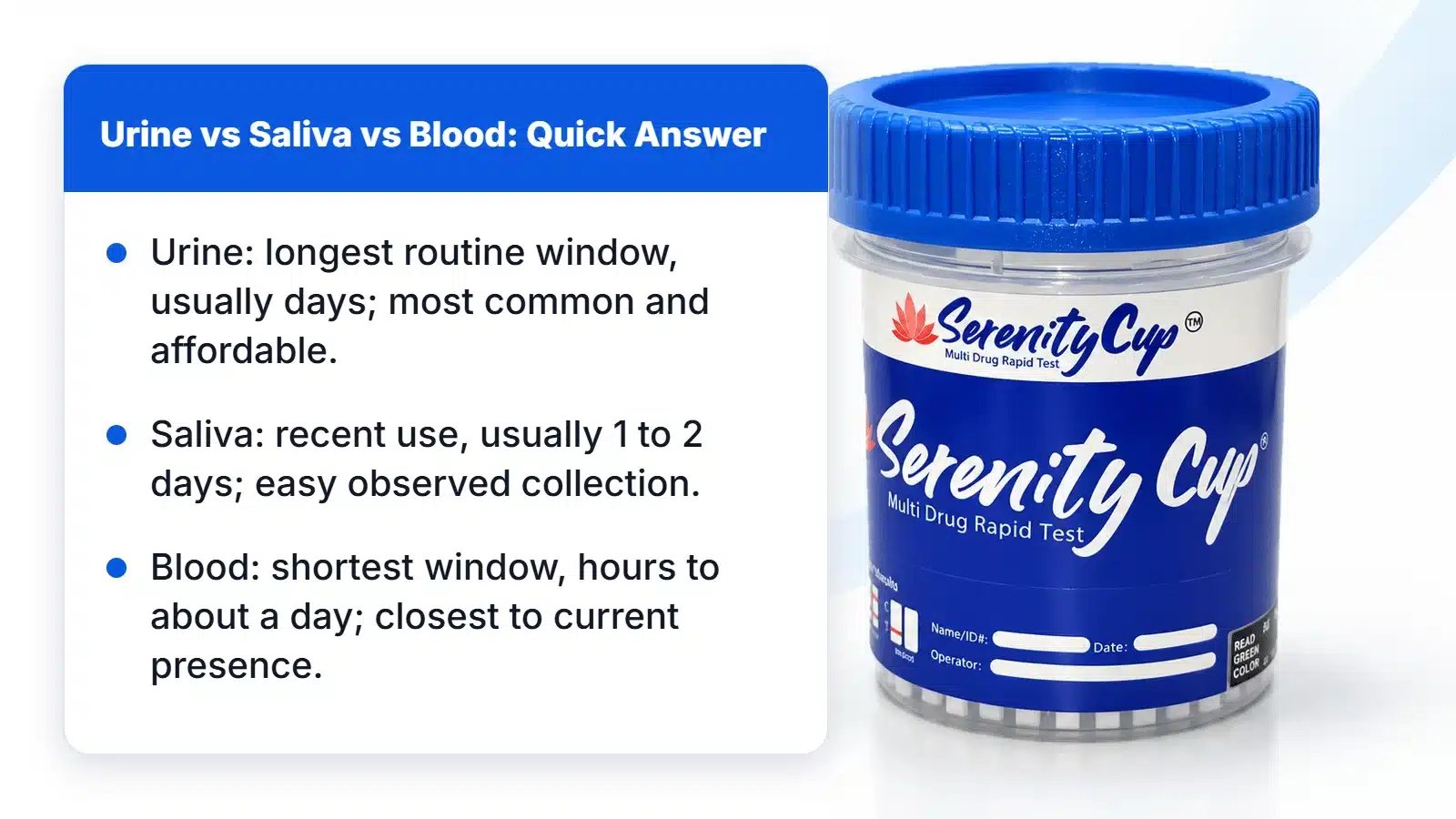
What is the difference between a urine, saliva and blood drug test? The main difference is the detection window. Blood tests show what is in the bloodstream now, usually reflecting use within hours to about a day. Saliva tests detect recent use, typically within one to two days. Urine tests detect drug metabolites over a longer period, often several days and sometimes weeks for heavy marijuana use. Each specimen has strengths that make it the right choice for different situations.
This guide compares the three specimen types side by side, covering detection times, collection, accuracy, cost and the settings where each one is used.
Urine vs Saliva vs Blood: Side-by-Side Comparison
| Feature | Urine | Saliva (Oral Fluid) | Blood |
|---|---|---|---|
| Typical detection window | About 1–4 days for most drugs; longer for heavy THC use | About 1–2 days | Hours to about 1 day |
| What it shows | Past use within the window | Recent use | Drug present in circulation now |
| Collection | Private restroom; observed only when required | Observed swab, no restroom needed | Venipuncture by trained staff |
| Invasiveness | Low | Very low | High |
| Rapid on-site options | Widely available (cups, dip cards) | Available (swab devices) | Rare; usually laboratory only |
| Cost | Low | Low to moderate | High |
| Tampering risk | Higher without observation | Low, because collection is observed | Very low |
| Common uses | Employment, probation, treatment, clinical | Post-accident, reasonable suspicion, roadside | Hospitals, impaired driving, forensic cases |
Urine Drug Tests
Urine is the most widely used specimen in drug testing. It contains drug metabolites that the body excretes over time, which gives it a longer detection window than saliva or blood. Rapid urine test cups provide results in minutes and are available in many panel configurations, from single-drug tests to 20 or more panels.
The main limitation of urine testing is that it shows past use, not current impairment. A person can test positive days after the effects of a drug have worn off. Urine collections can also be diluted or tampered with, which is why many cups include temperature strips and adulterant checks.
Urine is the required specimen for federally regulated workplace testing under DOT rules, and it remains the standard for most employers and treatment programs. Browse our urine drug test cups to compare configurations.
Saliva (Oral Fluid) Drug Tests
Saliva tests detect drugs present in oral fluid, which closely reflects recent use. Collection is simple: the donor places a swab in the mouth for a few minutes under direct observation. Because the collector watches the entire process, substitution and adulteration are difficult.
The shorter detection window is both an advantage and a limitation. It makes saliva tests useful when the question is whether someone used a drug recently, such as after an accident. It also means saliva tests miss use that occurred several days earlier. For a deeper comparison, read our guide on mouth swab vs urine drug tests and our explanation of the swab drug test process. Browse oral fluid drug tests for available panels.
Blood Drug Tests
A blood drug test measures the parent drug and metabolites circulating in the bloodstream. Because most drugs are cleared from blood relatively quickly, blood has the shortest detection window of the three. Its strength is that it gives the best indication of what is in the body at the time of collection.
Blood testing requires a trained phlebotomist, sterile equipment, careful handling and laboratory analysis. That makes it more expensive and less practical for routine screening. It is used mainly in hospitals and emergency departments, in impaired-driving investigations, in post-mortem and forensic toxicology, and in some clinical monitoring situations.
How Long Do Drugs Stay in a Blood Test?
Blood detection windows are short and vary by drug, dose and test sensitivity. The estimates below are commonly cited ranges.
| Drug | Blood | Saliva | Urine |
|---|---|---|---|
| THC (occasional use) | Hours, up to about 1 day | About 1–3 days | About 1–3 days |
| Cocaine | About 1–2 days (metabolites) | About 1–2 days | About 1–3 days |
| Amphetamines | About 12–24 hours | About 1–2 days | About 1–3 days |
| Opiates (heroin, morphine) | About 6–12 hours | About 1–2 days | About 1–3 days |
| Benzodiazepines | Hours to days, depending on the drug | About 1–2 days | About 1–7 days or longer |
| Alcohol | About 12 hours | About 12–24 hours | About 12 hours (ethanol); EtG up to about 80 hours |
These are general estimates. Frequent use, high doses and highly sensitive laboratory methods can extend detection. For urine-specific details, see our urine drug test detection windows guide.
Which Test Is Most Accurate?
Accuracy depends more on the testing method than on the specimen. Rapid on-site tests, whether urine or saliva, are screening tools that give preliminary results. Laboratory confirmation by GC-MS or LC-MS/MS provides definitive identification of specific drugs in any specimen type.
Blood is often described as the most accurate for showing current presence, because concentrations in blood relate most closely to what is active in the body. Urine is the most established for detecting use over a period of days. Saliva sits between the two and is valued for collection integrity.
Which Test Best Shows Impairment?
No drug test directly measures impairment. Blood concentrations come closest, because they reflect drugs currently circulating, but even blood levels do not translate into a precise impairment threshold for most drugs. Saliva tests indicate recent use, which is more relevant to impairment than urine. Urine results show only that use occurred within the detection window. Impairment decisions should be based on observed behavior and documented signs, with testing as supporting evidence.
Choosing the Right Specimen for Your Program
Pre-employment and random testing
Urine is the usual choice because it has a longer window and low cost. Saliva is a growing alternative where observed collection and convenience matter more than window length.
Post-accident and reasonable suspicion
Saliva is well suited because it reflects recent use and can be collected on site. Some programs also use urine to capture a wider window.
Treatment and probation
Urine remains standard for frequent monitoring, often combined with occasional observed saliva collections to reduce tampering.
Clinical, emergency and forensic settings
Blood is used when current drug levels matter, such as overdose management, impaired-driving cases and toxicology investigations.
Cost and Turnaround Compared
Rapid urine cups and saliva devices give preliminary results on site within minutes, and only non-negative results need to go to a laboratory. That keeps the cost per test low for high-volume programs. Blood tests almost always go to a laboratory, require a trained collector and special handling, and typically take one to several days for results. For most routine programs, the combination of rapid urine or saliva screening with laboratory confirmation of non-negatives offers the best balance of speed, cost and accuracy.
Specimen Integrity and Tampering
Each specimen type has different vulnerabilities. Urine can be diluted, substituted or adulterated if collection is unobserved, which is why temperature checks and validity strips are important. Saliva collection is observed from start to finish, so tampering is much harder, although donors should not eat, drink or put anything in their mouth for a waiting period before collection. Blood collection is performed directly by a trained professional, making it the most secure but also the least practical for routine use. Learn more in our guide on adulterants in drug testing.
What About Hair Testing?
Hair testing is a fourth option with the longest window, commonly up to about 90 days for a standard sample. It is used to show patterns of use over time but does not detect very recent use, because hair takes several days to grow out of the scalp. Hair tests are laboratory-only and cost more than urine or saliva screening.
Key Takeaway
Urine, saliva and blood drug tests answer different questions. Urine shows use over the past several days and is the most common and affordable option. Saliva shows recent use and offers observed, tamper-resistant collection. Blood shows what is in the body now, but it is invasive, costly and has the shortest window. The right choice depends on what your program needs to know and how quickly.
This article is for general educational purposes and is not medical or legal advice.
Frequently Asked Questions
What is the difference between a urine, saliva and blood drug test?
Urine detects use over the past several days, saliva detects recent use within about one to two days, and blood shows drugs present in the bloodstream now, usually within hours to about a day.
How long do drugs stay in a blood test?
Most drugs are detectable in blood for a few hours to about a day or two, depending on the drug, dose and test sensitivity.
Which drug test has the longest detection window?
Among the three, urine has the longest routine window. Hair testing has an even longer window, commonly up to about 90 days.
Is a saliva drug test more accurate than urine?
Both are accurate screening methods when used correctly. Saliva better reflects recent use and is harder to tamper with, while urine detects use over a longer period.
Why are blood drug tests used less often?
Blood tests are invasive, require trained staff and laboratory analysis, cost more and have short detection windows, so they are used mainly in clinical and forensic settings.
IN THIS ARTICLE