

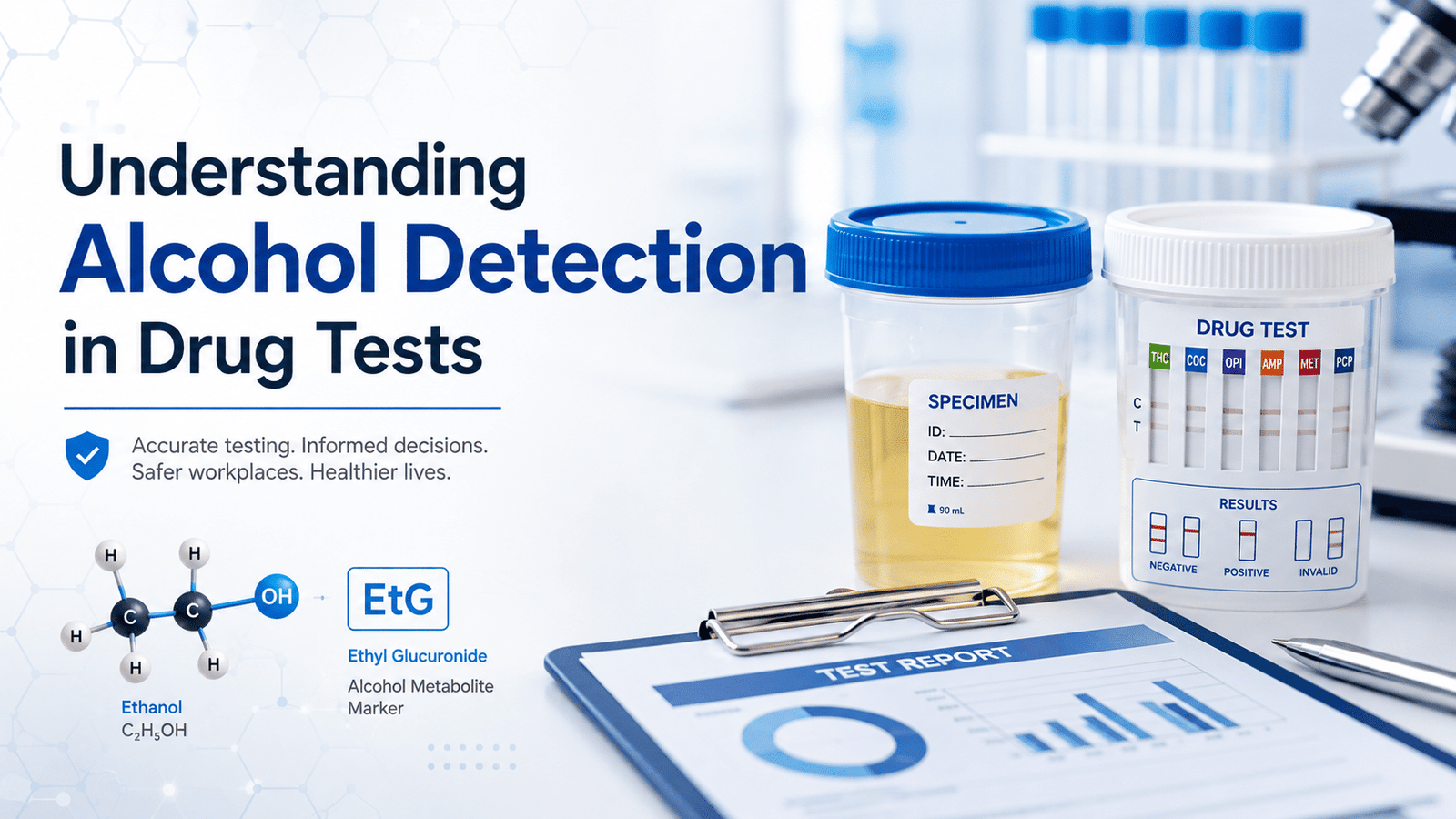

An alcohol urine test may screen directly for ethanol or for an alcohol-related metabolite such as ethyl glucuronide, commonly abbreviated as EtG. Rapid EtG urine tests are designed to identify evidence of relatively recent alcohol exposure for a longer period than tests that detect ethanol itself.
An EtG drug test provides a preliminary qualitative screening result. It does not determine current intoxication, measure impairment, calculate how much alcohol was consumed, or establish the exact time of consumption.
Organizations requiring combined drug and alcohol-metabolite screening can review the 12 panel drug test with alcohol, EtG and fentanyl. This specific Forensic Use Only configuration contains an EtG assay at 300 ng/mL as one of its 12 screening panels.
Does Alcohol Show Up on a Drug Test?
Alcohol does not show up on a standard 5, 10 or 12 panel urine drug test, because those panels screen for drugs, not ethanol. Alcohol is only detected when the test includes an alcohol-specific assay, such as an EtG panel on a urine cup, or when a separate breath, saliva or blood alcohol test is performed.
Urine alcohol testing usually looks for ethyl glucuronide (EtG), a metabolite that stays in urine much longer than alcohol itself; it is commonly cited as detectable for up to about 80 hours, depending on how much was consumed. Breath and blood tests reflect recent drinking over a matter of hours. DOT-regulated alcohol testing uses breath or saliva screening devices, not urine.
How an EtG Urine Test Detects Alcohol Exposure
What is EtG?
EtG stands for ethyl glucuronide. It is a direct metabolite produced after ethanol is processed by the body. Instead of screening only for ethanol, an EtG urine test looks for this metabolite in a urine specimen.
Because EtG can remain detectable after ethanol itself is no longer measurable, it may provide a longer period for identifying relatively recent alcohol exposure. However, detection is affected by the test cutoff, specimen timing, exposure level, individual metabolism, urine concentration, and testing method.
The Medical University of South Carolina explains that EtG may remain present in urine longer than alcohol in blood or breath. Its published time estimates should be treated as general educational guidance rather than a guaranteed detection period for every rapid test.
Do standard drug tests include alcohol?
Alcohol is not automatically included in every urine drug test. A standard multi-panel test may screen for drugs such as THC, cocaine, amphetamines, opiates, PCP, benzodiazepines, or methamphetamine without containing an alcohol-related assay.
When alcohol-metabolite screening is required, buyers should verify that EtG appears in the product’s exact analyte list. A panel number by itself does not confirm that EtG is included.
Alcohol Urine Test vs EtG Urine Test
The phrase “alcohol urine test” may refer to different testing methods. Understanding what the selected test measures is essential when choosing a device or interpreting a result.
| Testing method | What it detects | Primary purpose | Measures current impairment? |
|---|---|---|---|
| Urine ethanol test | Ethanol in urine | Shorter-term alcohol detection | No |
| EtG urine test | Ethyl glucuronide metabolite | Preliminary screening for relatively recent alcohol exposure | No |
| Multi-panel cup containing EtG | EtG plus the other listed drugs or drug classes | Combined preliminary urine screening | No |
| Breath alcohol test | Alcohol concentration in breath | Different testing purpose and procedure from an EtG urine screen | Depends on the applicable testing procedure and instrument |
An EtG drug test should not be treated as a substitute for a breath alcohol procedure when the purpose of testing is to evaluate current alcohol concentration under a specific workplace or regulatory program.
How Long Can Alcohol Be Detected in Urine?
There is no single alcohol or EtG detection window that applies to every person, exposure, specimen, and test. Detection depends first on whether the test measures ethanol or EtG.
EtG generally provides a longer detection period than ethanol itself. Research and clinical sources commonly discuss EtG detection extending for approximately 48 hours and sometimes 72 hours or longer under certain circumstances. These estimates are not a guarantee that every exposure will produce a detectable result for that period.
Factors that may affect EtG detection include:
- The amount and frequency of alcohol exposure
- Time between exposure and specimen collection
- Individual metabolism
- Urine concentration and hydration
- Test cutoff level
- Specimen handling
- Testing methodology
- Incidental exposure to alcohol-containing products
A test using an EtG/300 cutoff and a test using an EtG/500 cutoff should not be expected to have identical screening characteristics. Buyers should review the specifications and manufacturer’s instructions for the exact device.
Additional general information is available in our drug detection times guide.
How to Read a Rapid EtG Drug Test
A rapid EtG test commonly uses a competitive immunoassay. After the urine specimen is collected and the device is activated, colored lines develop in the Control and Test regions.
| Screening result | Line pattern | Meaning |
|---|---|---|
| Negative | Control line and Test line appear | EtG was not detected at or above the applicable screening cutoff |
| Preliminary non-negative | Control line appears but the Test line does not appear | The screening result requires handling according to the testing program and confirmation when applicable |
| Invalid | Control line does not appear | The result should not be reported and testing should be repeated with a new device |
For line-based rapid tests, a visible Test line together with a valid Control line is generally interpreted as negative even when the Test line is faint. Users must follow the package insert supplied with the exact device because procedures and valid reading times can differ.
The darkness of the Test line should not be used to estimate the amount of EtG, the amount of alcohol consumed, or when exposure occurred.
For additional interpretation guidance, read how to read a drug test cup.
Preliminary screening and confirmation
A preliminary non-negative EtG result is not the same as a definitive laboratory-confirmed result. When required by the testing program, policy, or applicable regulations, the specimen should be sent for confirmation using an appropriate laboratory method.
Testing organizations should have written procedures covering specimen collection, result reporting, reported medications or exposures, confirmation, and review of unexpected results.
What Can Affect an EtG Urine Test Result?
EtG testing is sensitive to alcohol exposure, but the result must be evaluated within the limitations of the selected method. Alcohol may be present in products other than alcoholic beverages, including certain hygiene, household, cosmetic, and medical products.
Incidental exposure does not mean that every contact with an alcohol-containing product will produce a preliminary non-negative result. The possible effect depends on the type and level of exposure, the selected cutoff, specimen timing, and the testing method.
Organizations using EtG screening should provide clear instructions about avoiding unnecessary exposure to alcohol-containing products before specimen collection when this is appropriate for the program.
An EtG urine result cannot independently determine:
- Whether the person is currently impaired
- The number or type of drinks consumed
- The exact time alcohol was consumed
- Whether exposure came from an alcoholic beverage
- Whether a preliminary result will be confirmed by a laboratory
Unexpected results should be reviewed according to the organization’s written procedures and confirmed when applicable.
Choosing an Alcohol and EtG Testing Option
Combined 12-panel EtG and drug screening
The 12 Panel Drug Test with Alcohol, EtG and Fentanyl combines urine collection and preliminary screening in one integrated Serenity cup.
Its verified configuration includes:
- EtG alcohol-metabolite screening at 300 ng/mL
- Fentanyl screening at 20 ng/mL
- Ten additional drugs or drug classes
- Integrated urine collection and screening
- Built-in temperature strip
- Preliminary results generally interpreted at approximately five minutes
EtG and fentanyl are included among the product’s 12 total assay panels. This is not a standard 12-panel test with two additional assays added to it.
This specific product is designated Forensic Use Only and is not CLIA waived. It should not be marketed for home, clinical, or ordinary workplace testing. It is intended for appropriate forensic testing environments described on the product page.
Comparing other 12-panel configurations
Not every 12-panel cup includes EtG. Some configurations contain PCP, TCA, K2, kratom, adulterant indicators, or other specialty panels instead.
Buyers can compare all available 12 panel drug test cups and review our guide explaining what a 12 panel drug test detects.
Before purchasing any alcohol urine test, verify:
- The exact analyte or metabolite being screened
- The EtG cutoff level
- The specimen type
- The device’s intended-use classification
- The result interpretation time
- Whether laboratory confirmation is required
- Whether the testing method fits the organization’s program
Frequently Asked Questions
What does an alcohol urine test detect?
An alcohol urine test may detect ethanol or an alcohol-related metabolite such as EtG. Buyers should verify exactly what the selected test is designed to screen.
What is EtG?
EtG stands for ethyl glucuronide, a metabolite produced after ethanol is processed by the body.
Is alcohol included in every drug test?
No. Alcohol or EtG must be specifically included in the testing method or product configuration. A multi-panel drug test does not automatically include alcohol screening.
How long can EtG be detected in urine?
There is no fixed period that applies to every person and test. Detection varies according to exposure, metabolism, specimen timing, urine concentration, cutoff level, and testing method.
Does an EtG result prove current impairment?
No. An EtG result indicates an assay response associated with alcohol exposure. It does not determine current intoxication or impairment.
What does EtG/300 mean?
EtG/300 means the screening assay uses a cutoff of 300 ng/mL. It does not mean the test measures impairment or provides an exact time of exposure.
What does a preliminary non-negative EtG result mean?
It means the rapid test did not produce a negative EtG screening result at the applicable cutoff. The result is preliminary and should be confirmed using an appropriate laboratory method when required.
Which 12 panel drug test includes EtG?
The Serenity 12 panel drug test linked from this guide includes EtG/300 and fentanyl/FYL/20 with ten additional urine screening assays. It is a Forensic Use Only product and is not CLIA waived.
Does alcohol show up on a standard drug test?
No. Standard drug panels do not screen for alcohol. Alcohol is detected only when an EtG panel or a separate alcohol test is included.
IN THIS ARTICLE