
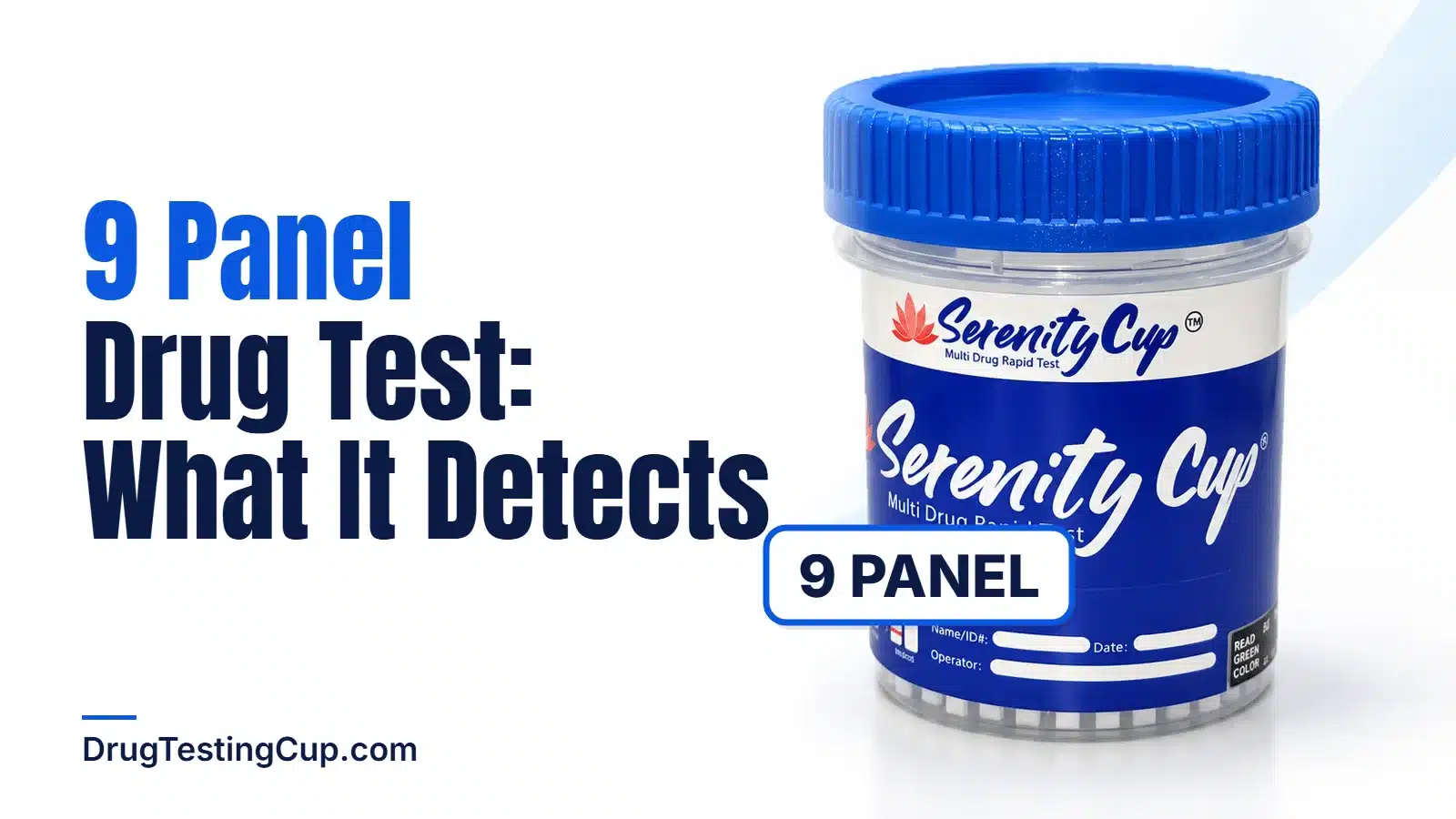

What is a 9 panel drug test? A 9 panel drug test screens a single specimen for nine drugs or drug classes at the same time. It sits between the basic 5 panel test, which covers the core federal drug classes, and the 10 and 12 panel tests used by many treatment and clinical programs. A typical 9 panel drug screen adds prescription sedatives and methadone to the standard illicit drug classes.
This guide explains which drugs are usually included, common cutoff levels, how long each drug can be detected, how the 9 panel compares with other configurations and who uses it.
What Does a 9 Panel Drug Test Test For?
There is no single required 9 panel configuration, but most products draw from the same group of commonly tested drugs. The table below shows a typical 9 panel drug test list with common urine screening cutoffs.
| Panel | Drug or Drug Class | Common Cutoff (ng/mL) |
|---|---|---|
| AMP | Amphetamine | 1000 or 500 |
| BAR | Barbiturates | 300 |
| BZO | Benzodiazepines | 300 |
| COC | Cocaine (benzoylecgonine) | 300 or 150 |
| MET / mAMP | Methamphetamine | 1000 or 500 |
| MTD | Methadone | 300 |
| OPI | Opiates (morphine, codeine) | 2000 or 300 |
| PCP | Phencyclidine | 25 |
| THC | Marijuana (THC metabolite) | 50 |
Some 9 panel configurations replace one of these with oxycodone (OXY), propoxyphene (PPX), MDMA or buprenorphine (BUP). Cutoffs also differ by manufacturer. Always confirm the exact panel list and cutoffs on the product label.
What Is a 9 Panel Drug Screen Used For?
The 9 panel adds four important categories to the basic 5 panel: benzodiazepines, barbiturates, methadone and, in many versions, a second stimulant panel for methamphetamine. These additions make the 9 panel useful when programs need to watch for prescription sedative misuse and opioid treatment medications as well as illicit drugs.
Benzodiazepines
Benzodiazepines such as alprazolam, diazepam and lorazepam are widely prescribed for anxiety and sleep, and they are commonly misused. Detection varies by medication; see our guide on what BZO means on a drug test.
Barbiturates
Barbiturates are older sedatives that are less commonly prescribed today but still appear in some medications and in misuse. Learn more in what BAR means on a drug test.
Methadone
Methadone is used in opioid treatment programs and for pain. A methadone panel helps confirm treatment adherence and detect non-prescribed use. See what MTD means on a drug test.
9 Panel Drug Test Detection Times
Detection windows depend on the drug, dose, frequency of use, metabolism and test cutoff. The ranges below are commonly cited estimates for urine.
| Drug | Commonly Cited Urine Window |
|---|---|
| Amphetamine and methamphetamine | About 1–3 days |
| Barbiturates | About 1–3 days for short-acting; up to several weeks for long-acting |
| Benzodiazepines | About 1–7 days; longer for long-acting types and heavy use |
| Cocaine | About 1–3 days |
| Methadone | About 3–7 days |
| Opiates | About 1–3 days |
| PCP | About 3–7 days |
| THC | About 1–3 days for occasional use; weeks for heavy, daily use |
For a broader overview, read our urine drug test detection windows guide.
9 Panel vs 5, 10 and 12 Panel Drug Tests
| Test | Typical Coverage | Common Users |
|---|---|---|
| 5 panel | THC, cocaine, amphetamines, opiates, PCP | DOT-style and basic workplace screening |
| 9 panel | 5 panel classes plus benzodiazepines, barbiturates, methadone and methamphetamine | Treatment programs, probation, some employers |
| 10 panel | 9 panel classes plus one more, often oxycodone or MDMA | Healthcare, treatment, expanded workplace testing |
| 12 panel | Two or more additional prescription or specialty panels | Pain management, rehab, corrections |
The difference between a 9 and a 10 panel is often a single assay. If oxycodone is a concern, a 10 or 12 panel that includes OXY is usually the better choice, because a standard opiate panel does not reliably detect oxycodone. See our comparison of the 5 panel vs 10 panel drug test and our guide on what a 10 panel drug test tests for.
Who Uses a 9 Panel Drug Test?
- Addiction treatment programs: To monitor for illicit drugs, sedatives and methadone.
- Probation and parole: For broader coverage than a 5 panel at a lower cost than larger panels.
- Employers: In safety-sensitive non-DOT roles where sedative use is a concern.
- Healthcare and clinical settings: For general screening when a specific prescription panel is not needed.
DOT-regulated employers must use the federal 5 panel laboratory test and cannot substitute a 9 panel rapid test. See our DOT vs non-DOT drug testing guide for details.
Urine Cup vs Oral Fluid 9 Panel Tests
Nine panel tests are available as urine cups, urine dip cards and oral fluid devices. Urine tests offer longer detection windows and are the most common choice for routine monitoring. Oral fluid devices detect more recent use and allow observed collection without a restroom. DrugTestingCup.com offers 9 panel oral fluid drug tests, and programs that prefer urine testing can compare 10 panel drug test cups, which cover the same core classes plus one more.
How to Read a 9 Panel Drug Test
- Collect the specimen and check the temperature strip within the required time if using a urine cup.
- Wait for the read time stated in the instructions, usually 5 minutes.
- Check that a control line appears in every panel window.
- A visible test line, even a faint one, means negative for that drug.
- No test line means a preliminary non-negative, which should be confirmed by a laboratory.
See our guide on how to read a drug test cup for a full walkthrough.
Preliminary Results and Confirmation
A 9 panel rapid test is a screening tool. Non-negative results are preliminary and should be confirmed by GC-MS or LC-MS/MS before any decision is made. Confirmation identifies the specific drug and its concentration, and it rules out cross-reactivity from prescription or over-the-counter medications.
Specimen Validity Checks
A drug test is only reliable if the specimen is genuine. Many urine cups include a temperature strip, and some include adulterant (ADLTX) strips that check creatinine, specific gravity, pH and oxidants. These checks help identify dilute, substituted or adulterated samples. A specimen with a temperature outside the acceptable range, usually 90 to 100°F within four minutes of collection, or abnormal validity results should be handled according to your program’s policy, which often means recollection under observation. Learn more in our guide on adulterants in drug testing.
Common Mistakes When Using a 9 Panel Test
- Assuming every 9 panel is the same: Two products with nine panels can test for different drugs.
- Expecting the opiate panel to detect oxycodone or fentanyl: Those drugs need their own panels.
- Reading the result too late: Lines can change after the maximum read time.
- Treating a screen as final: Non-negative results must be confirmed before action is taken.
- Ignoring storage conditions: Heat, humidity and expired devices can affect performance.
Can Prescription Medications Affect a 9 Panel Result?
Yes. Several panels on a 9 panel test will legitimately detect prescribed medications, including benzodiazepines, barbiturates, methadone and amphetamine-based ADHD medications. Some over-the-counter drugs can also cross-react on screening strips. Donors should be given the opportunity to report current medications, and confirmed results should be reviewed against valid prescriptions before any decision is made.
Buying 9 Panel Drug Tests in Bulk
Programs that test regularly usually save by ordering in bulk. When comparing options, look at the exact panel list, cutoffs, whether the device is CLIA-waived or Forensic Use Only, the expiration dating, and whether validity strips are included. Standardizing on one configuration also makes training easier and results more consistent across collectors and locations.
Choosing the Right Panel Count
Start with what your program needs to detect. If your concern is limited to the core illicit drugs, a 5 panel may be enough. If you need to monitor sedatives and methadone, a 9 panel covers them. If prescription opioids such as oxycodone, or specialty drugs such as fentanyl, buprenorphine or alcohol (EtG), matter to your program, a 10, 12 or larger panel is the better fit. Our 2026 guide to workplace drug testing can help employers decide.
Key Takeaway
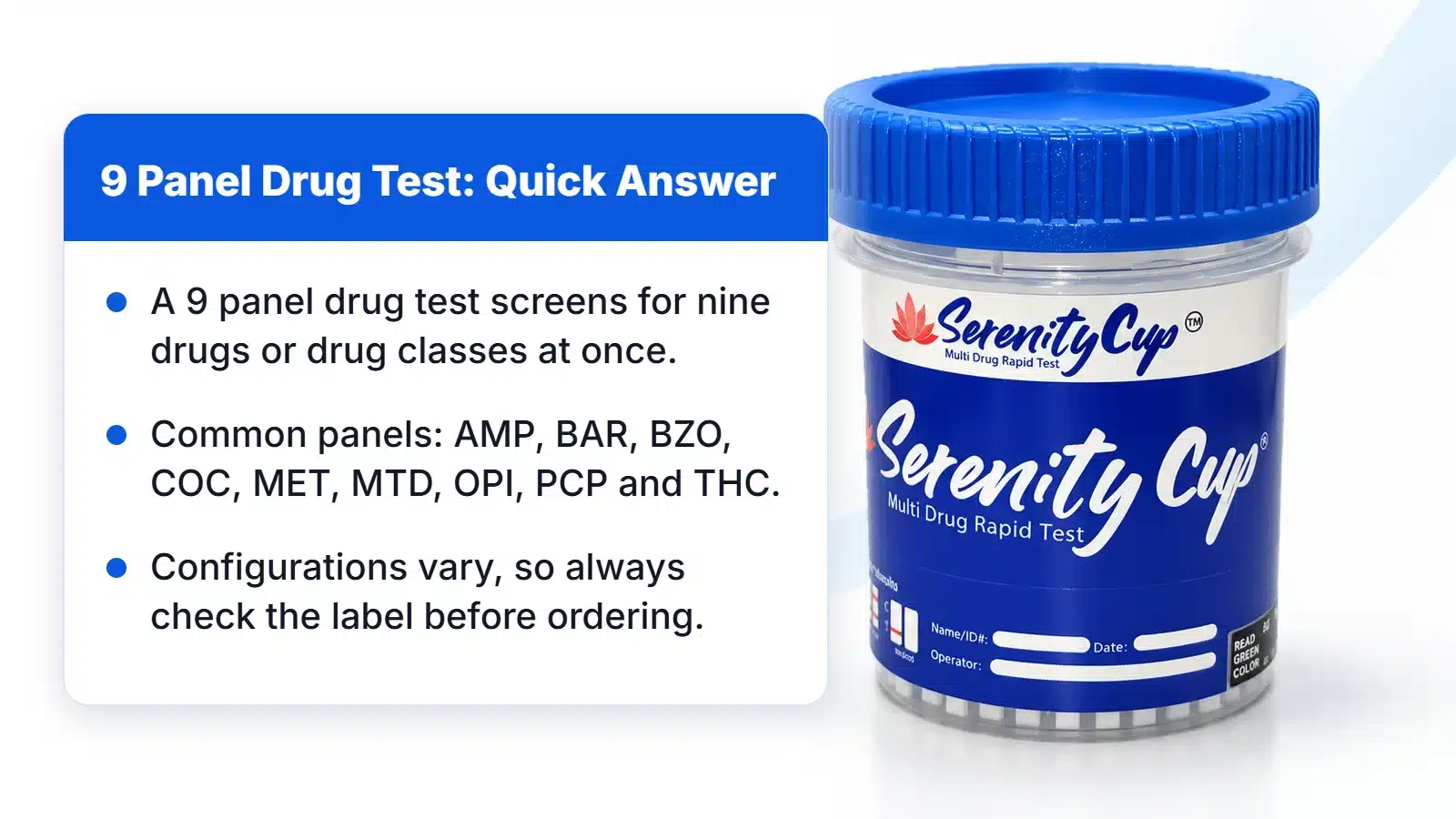
A 9 panel drug test screens for nine drugs or drug classes, usually amphetamine, barbiturates, benzodiazepines, cocaine, methamphetamine, methadone, opiates, PCP and THC. It adds sedatives and methadone to the basic 5 panel, making it useful for treatment and supervision programs. Configurations vary, so always check the label, and confirm non-negative results with a laboratory.
This article is for general educational purposes and is not medical or legal advice.
Frequently Asked Questions
What does a 9 panel drug test test for?
A typical 9 panel drug test screens for amphetamine, barbiturates, benzodiazepines, cocaine, methamphetamine, methadone, opiates, PCP and THC. Some versions swap in oxycodone or another panel.
What is the difference between a 9 panel and a 10 panel drug test?
Usually one assay. A 10 panel adds another drug, often oxycodone or MDMA, to the nine classes in a typical 9 panel.
Does a 9 panel drug test detect alcohol?
No. A standard 9 panel does not include alcohol. Alcohol requires an EtG panel or a separate alcohol test.
Does a 9 panel drug test detect oxycodone?
Only if it includes an OXY panel. A standard opiate panel does not reliably detect oxycodone.
Can a 9 panel test be used for DOT testing?
No. DOT-required testing must use the federal laboratory-based panel. Rapid 9 panel tests are suited to non-DOT programs.
IN THIS ARTICLE