

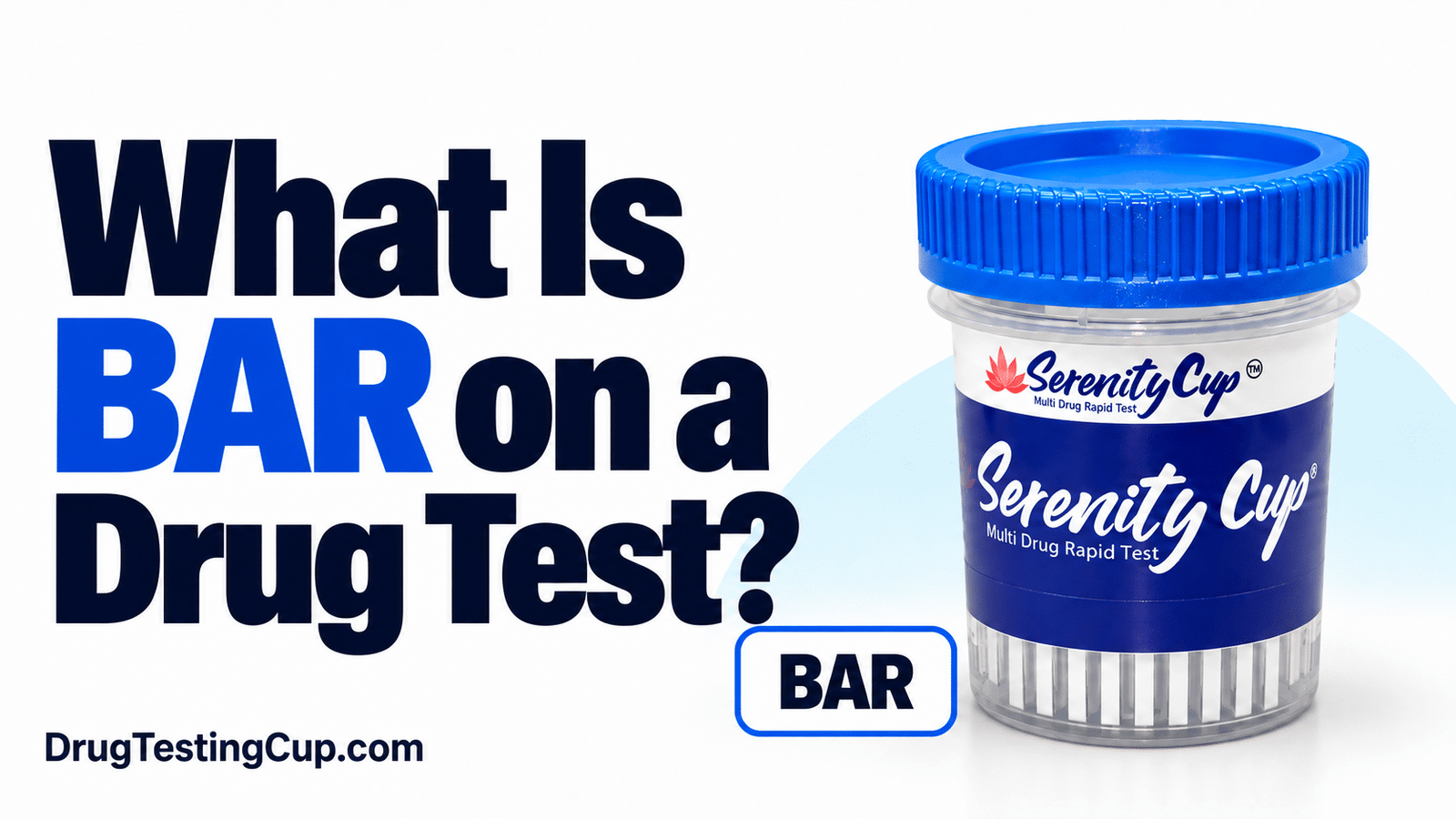

What is BAR on a drug test? BAR is the abbreviation for barbiturates, a class of sedative drugs that includes butalbital, phenobarbital, secobarbital and pentobarbital. On a drug test cup or dip card, the BAR panel screens urine for these drugs, usually at a cutoff of 300 ng/mL, printed as BAR/300.
Barbiturates are prescribed far less often than they once were, but they still show up in testing, mostly through headache medicines that contain butalbital and seizure treatment with phenobarbital. This guide explains what the BAR panel detects, why results can last longer than people expect, which tests include it and how to read and confirm the result.
What is BAR on a drug test?
BAR stands for barbiturates. Some labs use BARB for the same panel. It is a class test: the antibody is usually calibrated to secobarbital and reacts with other barbiturates to different degrees.
| Label | Meaning | Common rapid cutoff |
|---|---|---|
| BAR | Barbiturates | 300 ng/mL |
| BARB | Same class on some lab reports | Varies by lab |
| BZO | Benzodiazepines (a different sedative class) | 300 ng/mL |
BAR and BZO are both sedative panels but test for different drug classes. See What Is BZO on a Drug Test? and the full drug test abbreviations chart.
What Drugs Does the BAR Panel Detect?
- Butalbital, found in combination headache medicines such as Fioricet and Fiorinal
- Phenobarbital, used to treat seizures (MedlinePlus phenobarbital information)
- Secobarbital and pentobarbital, used less often in modern practice
- Amobarbital and butabarbital, depending on the device’s cross-reactivity
In everyday testing, butalbital headache medication is one of the most common reasons for a non-negative BAR result. That is a legitimate prescription, which is why every BAR screen needs review before any conclusion.
What Does BAR/300 Mean?
The number is the screening cutoff in nanograms per milliliter. A BAR/300 test reads non-negative when barbiturates in the sample reach 300 ng/mL, measured against the reference compound. Below that, it reads negative. The cutoff says nothing about impairment, dose or when the drug was taken. Our drug test cutoff levels guide explains cutoffs in more detail.
How Long Do Barbiturates Show Up in Urine?
Barbiturates have very different half-lives. Short-acting drugs such as butalbital and secobarbital are usually detectable for a few days. Phenobarbital is long-acting and can remain detectable for weeks, particularly with ongoing use. Dose, frequency and individual metabolism also matter. The ARUP Consult detection windows table lists published estimates. Treat them as ranges, not guarantees.
Is BAR Part of a DOT Drug Test?
No. The DOT test covers marijuana, cocaine, amphetamines, opioids and PCP, and the initial cutoff table in 49 CFR §40.85 does not include barbiturates. BAR appears on expanded non-DOT panels used by clinics, pain management practices, treatment programs and courts.
Which Tests Include a BAR Panel?
| Format | Example |
|---|---|
| Single-panel dip card | Barbiturate Drug Test (BAR/300) |
| 13-panel cup | 13 Panel Urine Drug Test with MOP & EtG (BAR/300) |
| Multi-panel cups | 12 panel drug test cups and larger |
| Expanded cups | 18 Panel Test Cup with Xylazine & Kratom |
BAR is not part of most 5-panel or basic 10-panel employment tests. If barbiturates matter to your program, check the product’s drug list. Our guide to what a 10 panel drug test tests for shows which configurations include it.
Who Tests for Barbiturates?
Barbiturate screening is most common in programs that monitor sedative use closely:
- Pain management and primary care clinics reviewing all controlled medications a patient takes
- Addiction treatment and detox programs, because barbiturates and other sedatives add to the risk of overdose when combined with opioids or alcohol
- Courts, probation and corrections running expanded panels
Combining sedatives such as barbiturates, benzodiazepines and alcohol with opioids increases the risk of breathing problems, so many programs screen for BAR and BZO on the same cup.
How to Read a BAR Result
- Negative: a control line and a test line next to BAR, even if faint.
- Non-negative (preliminary positive): a control line and no test line next to BAR.
- Invalid: no control line. Retest with a new device.
Read inside the time window in the package insert. See our guide to reading a drug test cup for each pattern.
Confirming a BAR Result
A rapid BAR result is preliminary. Ask about prescriptions, especially headache medicines and seizure medication, and confirm non-negative screens with a laboratory method such as GC-MS or LC-MS/MS. Confirmation identifies the specific barbiturate, which helps the program decide whether the result matches a prescription.
Buying BAR Drug Tests in Bulk
Clinics and treatment programs usually order BAR as part of a 12-panel or larger cup, with single-panel BAR dip cards for add-on testing. Request a bulk quote with your panel list and volume, or browse all urine drug test cups.
Frequently Asked Questions
What does BAR mean on a drug test?
BAR means barbiturates, a class of sedatives that includes butalbital, phenobarbital, secobarbital and pentobarbital.
What is the cutoff for BAR on a drug test?
Most rapid urine tests list BAR at 300 ng/mL. Check the package insert for your device.
Can headache medicine cause a positive BAR result?
Yes. Medicines such as Fioricet and Fiorinal contain butalbital, a barbiturate that the BAR panel is designed to detect.
How long do barbiturates stay in urine?
Short-acting barbiturates are usually detectable for a few days. Phenobarbital is long-acting and can remain detectable for weeks with ongoing use.
Is BAR the same as BZO?
No. BAR screens for barbiturates and BZO screens for benzodiazepines. Both are sedatives, but they are different drug classes.
Is BAR included in a DOT drug test?
No. The DOT drug test does not screen for barbiturates. BAR appears on expanded non-DOT panels.
IN THIS ARTICLE