

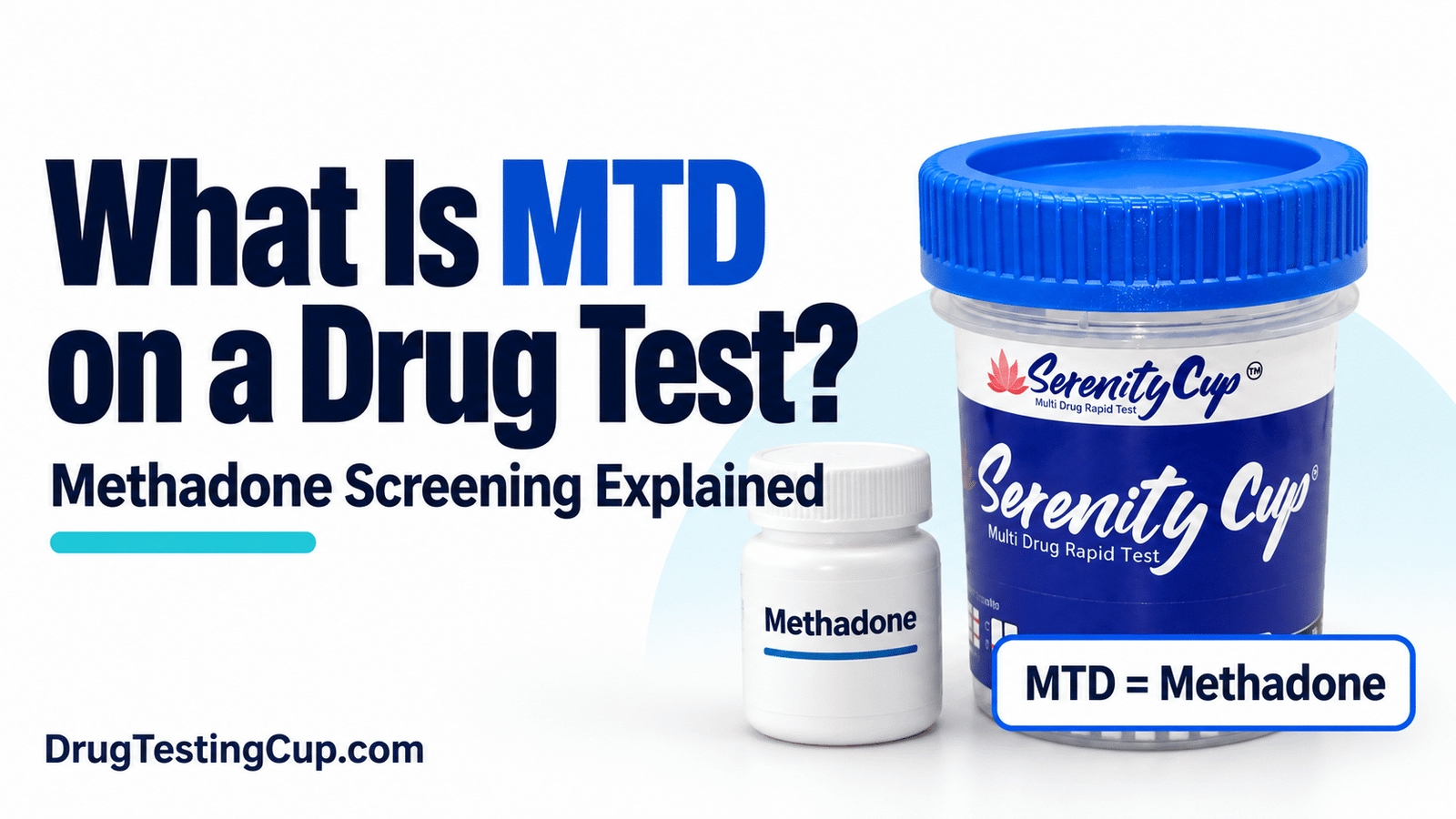

What is MTD on a drug test? MTD is the standard abbreviation for methadone. When you see MTD on a drug test cup, dip card or lab report, it identifies the panel that screens urine for methadone, a long-acting synthetic opioid used in opioid treatment programs and, less often, for pain. On most rapid tests the label is written as MTD/300, meaning the methadone panel uses a screening cutoff of 300 ng/mL.
MTD is not a generic “opioid” result. It is a dedicated methadone assay, and it appears on a test only when that test was configured to include it. Many workplace panels, including the federally regulated DOT five-panel, do not screen for methadone at all.
This guide explains what the MTD panel detects, what the 300 ng/mL cutoff means, how MTD differs from EDDP, how long methadone may remain detectable in urine, how to read an MTD result, and which testing formats fit common programs.
What is MTD on a drug test?
MTD stands for methadone. The abbreviation is used across urine drug test cups, single-panel dip cards, test strips and oral fluid devices so that a panel list fits into a small label.
You may see methadone listed in slightly different ways depending on the manufacturer:
| Label on the test | What it means |
|---|---|
| MTD | Methadone panel |
| MTD/300 | Methadone panel with a 300 ng/mL screening cutoff |
| EDDP | A separate panel for the main methadone metabolite |
| OPI, MOP, OXY, BUP, FEN | Other opioid-related panels that do not replace an MTD panel |
If you are reviewing a full panel list and want to decode the other abbreviations as well, our drug test cutoff levels guide lists common panels with their typical cutoffs.
What Is Methadone and Why Is It Tested?
Methadone is a synthetic opioid agonist. It is FDA-approved for treating opioid use disorder and for certain types of pain, and it is sold under brand names including Dolophine and Methadose. Because it has a long half-life, methadone can be dosed once daily in treatment settings. See the MedlinePlus methadone information page for patient-oriented details.
In the United States, methadone for opioid use disorder is dispensed through certified Opioid Treatment Programs (OTPs). Federal rules for these programs, found in 42 CFR Part 8, include drug testing as part of patient care. SAMHSA’s methadone overview describes how these programs operate.
That treatment context is why methadone screening is common. Programs and agencies typically test for MTD to:
- Confirm treatment adherence in OTPs and medication-assisted treatment programs.
- Identify unexpected methadone use in people who are not prescribed it.
- Support monitoring requirements in drug courts, probation, parole and correctional settings.
- Screen in rehab and sober living where house rules or treatment plans require broader opioid coverage.
What Does MTD/300 Mean? Understanding the Cutoff
The number after the slash is the screening cutoff, expressed in nanograms per milliliter of urine. On an MTD/300 test, a sample is screened against a methadone threshold of 300 ng/mL. The methadone single-panel tests and most multi-panel cups and dip cards in our catalog list MTD at 300 ng/mL.
A cutoff is an analytical threshold. It is not:
- The dose of methadone someone took.
- A measurement of impairment.
- A precise indicator of when methadone was last taken.
Rapid tests are qualitative. They report a negative or preliminary non-negative result relative to the cutoff; they do not report an exact concentration. Programs that need a numerical value should work with a laboratory that offers quantitative testing.
MTD vs EDDP: Parent Drug vs Metabolite
Methadone is broken down in the body into EDDP (2-ethylidene-1,5-dimethyl-3,3-diphenylpyrrolidine). ARUP Consult lists EDDP as methadone’s metabolite in its drug half-lives and urine detection windows table.
MTD and EDDP are usually separate panels:
| Panel | Target | Typical rapid-test cutoff | What it helps answer |
|---|---|---|---|
| MTD | Methadone (parent drug) | 300 ng/mL | Is methadone present above the cutoff? |
| EDDP | Methadone metabolite | 100 ng/mL (some multi-panel devices list 300 ng/mL) | Has the body metabolized methadone? |
Testing for both can be useful in treatment monitoring. Because EDDP is produced when the body processes methadone, its presence alongside MTD is consistent with methadone having been taken and metabolized, rather than added directly to a urine sample. Interpretation of MTD and EDDP patterns should follow the program’s clinical protocol and, where results matter, laboratory confirmation.
For metabolite-specific screening, see our EDDP drug test (EDDP/100) dip card.
How Long Does Methadone Stay in Urine?
ARUP Consult lists methadone with a half-life of 15–55 hours and an estimated urine detection window of 1–14 days. Source: ARUP Consult.
That wide range reflects how differently methadone behaves from person to person. Detection can be affected by:
- Dose and duration – daily maintenance dosing tends to extend detection compared with a single exposure.
- Metabolism – individual liver enzyme activity varies considerably.
- Urine pH and hydration – both can influence how much methadone appears in a given sample.
- Test design – the cutoff and analytical method of the specific test.
ARUP notes that these windows are estimates and recommends consulting the laboratory about detection limits for specific assays. The range should not be used to predict the exact day a specific person will test negative.
Which Tests Include an MTD Panel?
Methadone is not part of every drug screen. The DOT five-panel used in federally regulated transportation testing does not include methadone, and many basic workplace panels leave it out as well. Expanded panels used in treatment, criminal justice and clinical settings commonly add it.
Panel count alone does not tell you whether MTD is included. Two 12-panel cups can screen for different drug lists. Before ordering, check the full analyte list on the product page or package insert. For example:
- Many 12 panel drug test cups include MTD/300 alongside OPI, OXY and BUP.
- Expanded urine drug test cups from 13 to 28 panels typically keep MTD and add specialty panels such as fentanyl, EtG, kratom or xylazine.
- Some oral fluid devices, such as the 4 panel saliva drug test with OPI, MTD, PCP and PPX, include methadone for observed collection.
Single MTD Test or Multi-Panel Cup: Which Format Fits?
Choose the format around the question your program needs answered.
| Format | Best fit | Product |
|---|---|---|
| Single-panel MTD dip card | Methadone-only screening, adherence checks, low cost per test | Methadone Drug Test (MTD/300) Dip Card |
| Single-panel MTD dip strip | Methadone-only screening with urine collected in a separate cup | Methadone Test Strips – MTD/300 |
| Single-panel EDDP dip card | Metabolite screening alongside an MTD test | EDDP Drug Test (EDDP/100) |
| Multi-panel cup or dip card with MTD | Broad screening where methadone is one of many required targets | Drug test cups |
OTPs and MAT clinics that run frequent adherence checks often prefer single-panel MTD tests, sometimes paired with EDDP, because the cost per test stays low. Probation departments, drug courts and rehab centers that need broader opioid and stimulant coverage usually choose a multi-panel cup that already includes MTD.
How to Read MTD Results on a Cup or Dip Card
Always follow the instructions supplied with the specific test and lot. Most lateral-flow MTD tests use the same line logic:
- Negative: a control line (C) and a test line (T) both appear. Even a faint T line is usually read as negative.
- Preliminary non-negative: only the control line appears; no line forms in the MTD test region.
- Invalid: no control line appears. Retest with a new device.
Read the result within the window stated in the package insert. Many single-panel dip cards are read at 5 minutes, and results should not be read after the stated limit. Our guide to reading a drug test cup explains faint lines and invalid results in more detail.
Preliminary Results and Confirmation Testing
A rapid MTD drug test result is a screening result. Immunoassays can occasionally react to substances other than the target drug, and some medications have been reported to cross-react with certain methadone immunoassays. The package insert for each test lists the compounds evaluated for cross-reactivity.
When a non-negative MTD result is unexpected, disputed or will drive an important decision, confirm it with a laboratory method such as GC-MS or LC-MS/MS. ARUP’s drug testing overview explains how screening and confirmation testing work together.
A positive MTD screen also does not, by itself, show misuse. Many people tested for methadone are taking it exactly as prescribed. Results should be interpreted against the person’s prescriptions and the program’s policy.
Buying MTD on drug screen in Bulk
Before placing a volume order, confirm:
- Target: whether you need MTD only, MTD plus EDDP, or a multi-panel device that includes MTD.
- Cutoff: that MTD/300 matches your program’s requirements.
- Specimen and format: urine cup, dip card, dip strip or oral fluid.
- Intended use: CLIA-waived or Forensic Use Only labeling, matched to your setting.
- Supply: monthly volume, expiration dating and reorder schedule.
DrugTestingCup.com supplies single-panel methadone tests, EDDP tests and multi-panel cups with MTD at case pricing for treatment programs, clinics, correctional facilities and distributors. Request a bulk quote with your panel requirements and monthly quantity.
Frequently Asked Questions
What does MTD stand for on a drug test?
MTD means methadone. It identifies the panel that screens for methadone, a synthetic opioid used in opioid treatment programs and for some types of pain. On most rapid tests it appears as MTD/300, meaning a 300 ng/mL screening cutoff.
Is MTD the same as EDDP?
No. MTD targets methadone itself, while EDDP targets the main metabolite the body produces from methadone. They are usually separate panels with different cutoffs, and some programs test for both.
Does a standard drug test check for methadone?
Not always. The DOT five-panel and many basic workplace panels do not include methadone. A test screens for methadone only when MTD appears in its panel list, so check the exact configuration before testing.
How long is methadone detectable in urine?
ARUP Consult lists an estimated urine detection window of 1–14 days for methadone. Detection varies with dose, duration of use, metabolism, urine pH and the specific test, so this range is not a guarantee for any individual.
What does a positive MTD result mean?
A preliminary non-negative MTD result means methadone may be present above the test’s cutoff. It does not show impairment, dose or misuse, and many people screened for methadone take it as prescribed. Unexpected or disputed results should be confirmed by a laboratory.
What is the cutoff for an MTD urine drug screen?
Most rapid urine tests list MTD at 300 ng/mL. Always check the package insert for the exact cutoff of the device you are using.
IN THIS ARTICLE