


Does Phentermine Show Up on a Drug Test? Amphetamine Screens Explained

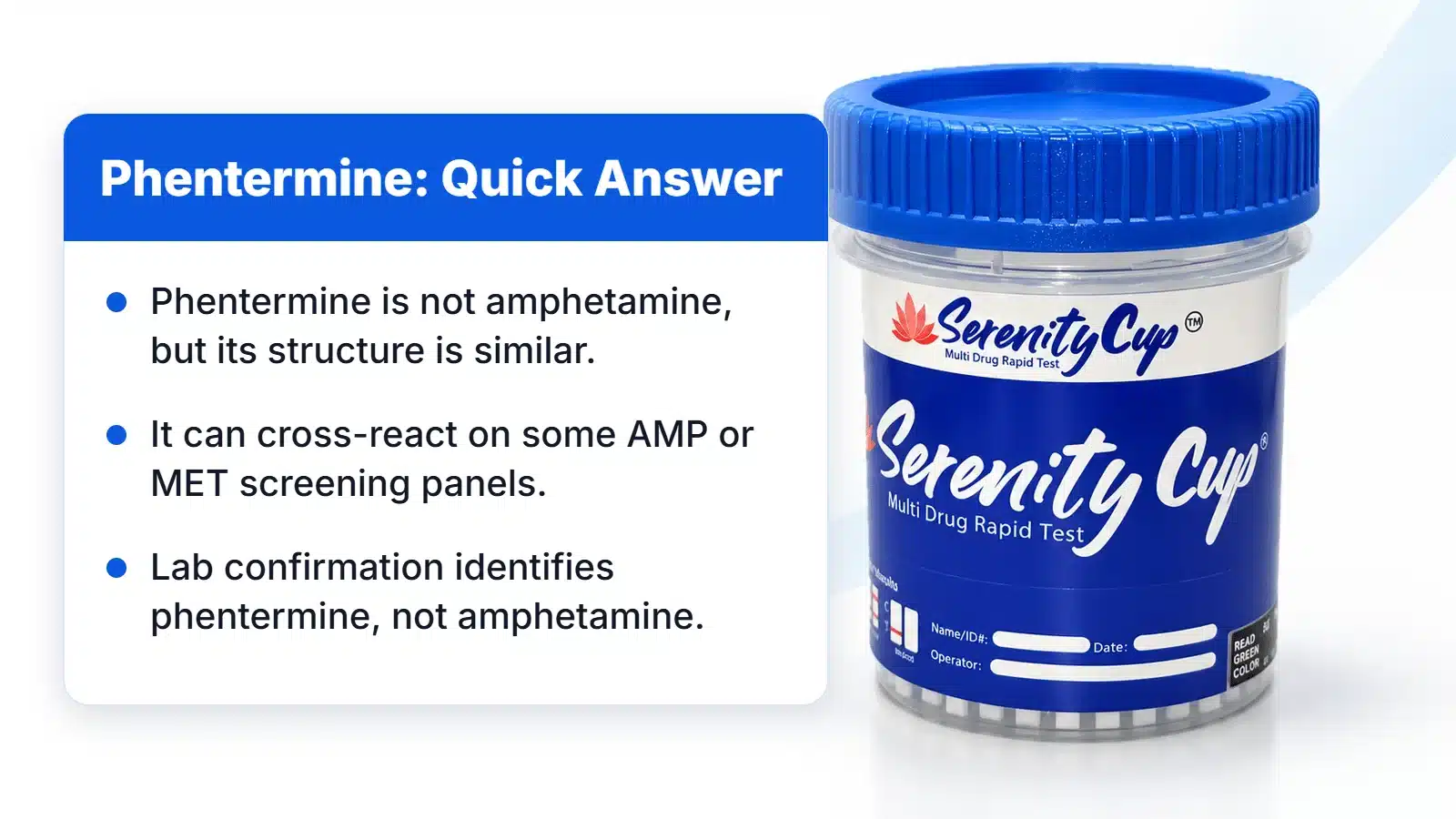
Does phentermine show up on a drug test? Phentermine is not included on standard drug test panels, but it can sometimes cause a non-negative result on an amphetamine (AMP) or methamphetamine (MET) screen. Phentermine is chemically related to amphetamine, and some immunoassay screening strips react to it. Laboratory confirmation, however, identifies phentermine specifically and does not report it as amphetamine.
This guide explains what phentermine is, why it can affect amphetamine screens, how long it stays in your system, how laboratories and Medical Review Officers handle results and what to do if you take phentermine before a drug test.
What Is Phentermine?
Phentermine is a prescription appetite suppressant used for short-term weight loss together with diet and exercise. It is sold under brand names such as Adipex-P and Lomaira, and it is also an ingredient in the combination medication Qsymia (phentermine and topiramate). Phentermine is a Schedule IV controlled substance because it is a stimulant with some potential for misuse.
Phentermine belongs to a group of drugs called sympathomimetic amines. It stimulates the release of norepinephrine and, to a lesser extent, dopamine, which reduces appetite and increases energy. Its effects and structure are similar to amphetamine, though it is generally considered less potent.
Why Phentermine Can Affect Amphetamine Screens
Rapid drug test cups and laboratory screens use immunoassays, which detect drugs by recognizing their chemical shape. Phentermine’s structure resembles amphetamine closely enough that some AMP and MET immunoassays respond to it, especially at higher urine concentrations. Whether a particular test reacts depends on the antibodies used by that manufacturer and the cutoff level.
The product insert for each test lists the compounds evaluated for cross-reactivity, often including phentermine, along with the concentration needed to produce a non-negative result. Some assays require very high phentermine concentrations to react, while others are more sensitive.
| Panel | Effect of Phentermine |
|---|---|
| AMP (amphetamine) | Possible cross-reactivity on some screens |
| MET / mAMP (methamphetamine) | Possible cross-reactivity on some screens |
| MDMA | Uncommon |
| Laboratory confirmation (GC-MS or LC-MS/MS) | Identifies phentermine as phentermine; not reported as amphetamine |
Does Phentermine Show Up as Amphetamine?
On a screening test, phentermine may look like amphetamine because the strip cannot tell the two apart. On a confirmation test, it does not. GC-MS and LC-MS/MS separate and identify individual compounds by their exact mass and structure. Phentermine and amphetamine are different molecules, so a laboratory confirmation will report amphetamine only if amphetamine is actually present.
This means that in a well-run testing program, a phentermine user should not receive a confirmed amphetamine positive solely because of phentermine. Problems arise mainly when decisions are made on rapid screening results without confirmation. Learn more about the panel in our guide on what AMP means on a drug test.
Do Drug Tests Specifically Look for Phentermine?
Standard workplace panels, including DOT testing, do not test for phentermine. Some laboratory panels used in clinical settings, sports testing or forensic toxicology can identify phentermine directly when ordered. Sports organizations commonly list phentermine among prohibited stimulants, so athletes should check their organization’s rules.
How Long Does Phentermine Stay in Your System?
Phentermine has a relatively long half-life of about 20 hours, so it takes several days to be cleared from the body. Commonly cited detection windows are:
| Specimen | Commonly Cited Detection Window |
|---|---|
| Urine | About 1–4 days; sometimes longer with daily use |
| Saliva | About 1–2 days |
| Blood | Up to about 1 day |
| Hair | Up to about 90 days |
People who take phentermine daily will have it present in urine continuously during treatment. Whether it causes a screening reaction depends on the concentration and the specific test.
Factors That Affect Phentermine Detection
- Dose and formulation: Higher doses produce higher urine concentrations.
- Daily use: Continuous use maintains steady levels.
- Urine pH: Like amphetamine, phentermine is excreted faster in acidic urine and more slowly in alkaline urine.
- Kidney function: Reduced kidney function slows elimination.
- Hydration: Concentrated urine increases measured levels.
- Test brand and cutoff: Cross-reactivity varies widely between assays.
Taking Phentermine Before a Drug Test
If you take phentermine as prescribed, you do not need to stop it before a drug test unless your prescriber advises you to. Instead:
- Keep your prescription and pharmacy information available.
- Report your medications if you are given the opportunity during collection.
- If a rapid amphetamine screen is non-negative, ask that the specimen be sent for laboratory confirmation.
- If the Medical Review Officer contacts you, provide your prescription details.
Because confirmation identifies phentermine rather than amphetamine, most phentermine-related screening results resolve at the confirmation stage. If amphetamine is genuinely present, the MRO will look for a separate prescription that explains it.
Phentermine in DOT-Regulated Jobs
Phentermine is not part of the DOT drug panel, and a DOT laboratory confirms amphetamines specifically, so phentermine alone should not cause a verified DOT positive. However, stimulants can affect fitness for duty, and medical certification standards for commercial drivers and pilots may require disclosure and evaluation of medications. Employees in these roles should discuss phentermine with their medical examiner.
Other Medications That Can Cross-React on Amphetamine Screens
Phentermine is one of several medications reported to cause non-negative amphetamine screens on some assays. Others include certain decongestants such as pseudoephedrine, the antidepressant bupropion, the blood pressure medication labetalol, the antipsychotic aripiprazole in some reports and the ADHD medications that genuinely contain amphetamine. See what can cause a false positive drug test for a broader list, and our article on how to dispute a false positive drug test if you believe a result is wrong.
Guidance for Employers and Clinics
Employers using rapid test cups should not take action on an amphetamine screen alone. Confirm all non-negative screens by laboratory testing and use MRO review where possible. Clinics that prescribe phentermine, such as weight management practices, may want to give patients a short letter or medication card they can present if questions arise during workplace testing. For stimulant screening, compare cups with separate AMP and MET panels in our 10 panel drug test cups and 12 panel drug test cups categories.
Phentermine vs Other Weight Loss Medications on Drug Tests
| Medication | Type | Effect on Standard Drug Screens |
|---|---|---|
| Phentermine (Adipex-P, Lomaira) | Stimulant appetite suppressant | May cross-react on some AMP or MET screens |
| Phentermine and topiramate (Qsymia) | Combination product | Same as phentermine; topiramate is not on standard panels |
| Semaglutide and tirzepatide | GLP-1 based injectables | Not detected on standard drug panels |
| Naltrexone and bupropion (Contrave) | Combination product | Bupropion has been reported to cross-react on some amphetamine screens |
| Orlistat | Fat absorption blocker | Not detected on standard drug panels |
Phentermine in Oral Fluid Tests
Oral fluid devices also use immunoassays, so a phentermine user could occasionally see a non-negative amphetamine or methamphetamine result on a saliva test, generally within a day or two of the last dose. As with urine testing, laboratory confirmation identifies the actual compound. Learn how saliva and urine testing compare in our guide to urine vs saliva vs blood drug tests.
Phentermine Misuse and Safety
Phentermine can raise heart rate and blood pressure, cause insomnia and nervousness, and in rare cases lead to serious heart or lung problems, particularly when combined with other weight loss drugs or stimulants. Taking more than prescribed or using phentermine without medical supervision increases these risks. Phentermine is intended for short-term use as part of a supervised weight management plan.
Counterfeit and Online Weight Loss Pills
Weight loss pills bought online without a prescription, or marketed as “herbal” alternatives, sometimes contain undeclared stimulants, including phentermine-like compounds, sibutramine or even amphetamine. These products can cause unexpected drug test results that a laboratory confirms as a real stimulant. Because there is no prescription to verify, the result may not be overturned. Using only prescribed, pharmacy-dispensed medication avoids this problem.
Does Phentermine Cause Impairment?
At prescribed doses, phentermine is not generally considered impairing in the way sedatives are, but it can cause restlessness, dizziness or poor sleep, which may affect alertness the next day. Employers in safety-sensitive roles should handle medication concerns through their fitness-for-duty process rather than through the drug test alone.
Key Takeaway
Phentermine is not on standard drug test panels, but because it resembles amphetamine, it can sometimes cause a non-negative amphetamine or methamphetamine screen. Laboratory confirmation identifies phentermine specifically and does not report it as amphetamine. If you take phentermine, keep your prescription information available and ask for confirmation of any non-negative screen.
This article is for general educational purposes and is not medical or legal advice. Do not change prescribed medication without talking to your prescriber.
Frequently Asked Questions
Does phentermine show up on a drug test?
Phentermine is not on standard drug panels, but it can cause a non-negative result on some amphetamine or methamphetamine screening tests because of its similar structure.
Will phentermine show up as amphetamine on a lab test?
No. Laboratory confirmation by GC-MS or LC-MS/MS identifies phentermine as phentermine and does not report it as amphetamine.
How long does phentermine stay in your system?
Phentermine is commonly detectable in urine for about 1 to 4 days after the last dose, sometimes longer with daily use.
Should I stop phentermine before a drug test?
Not unless your prescriber advises it. Keep your prescription information available and request laboratory confirmation of any non-negative screen.
Is phentermine part of a DOT drug test?
No. DOT testing does not include phentermine, and DOT laboratories confirm amphetamines specifically.
IN THIS ARTICLE