

Does Vyvanse Show Up on a Drug Test? Lisdexamfetamine Testing Explained

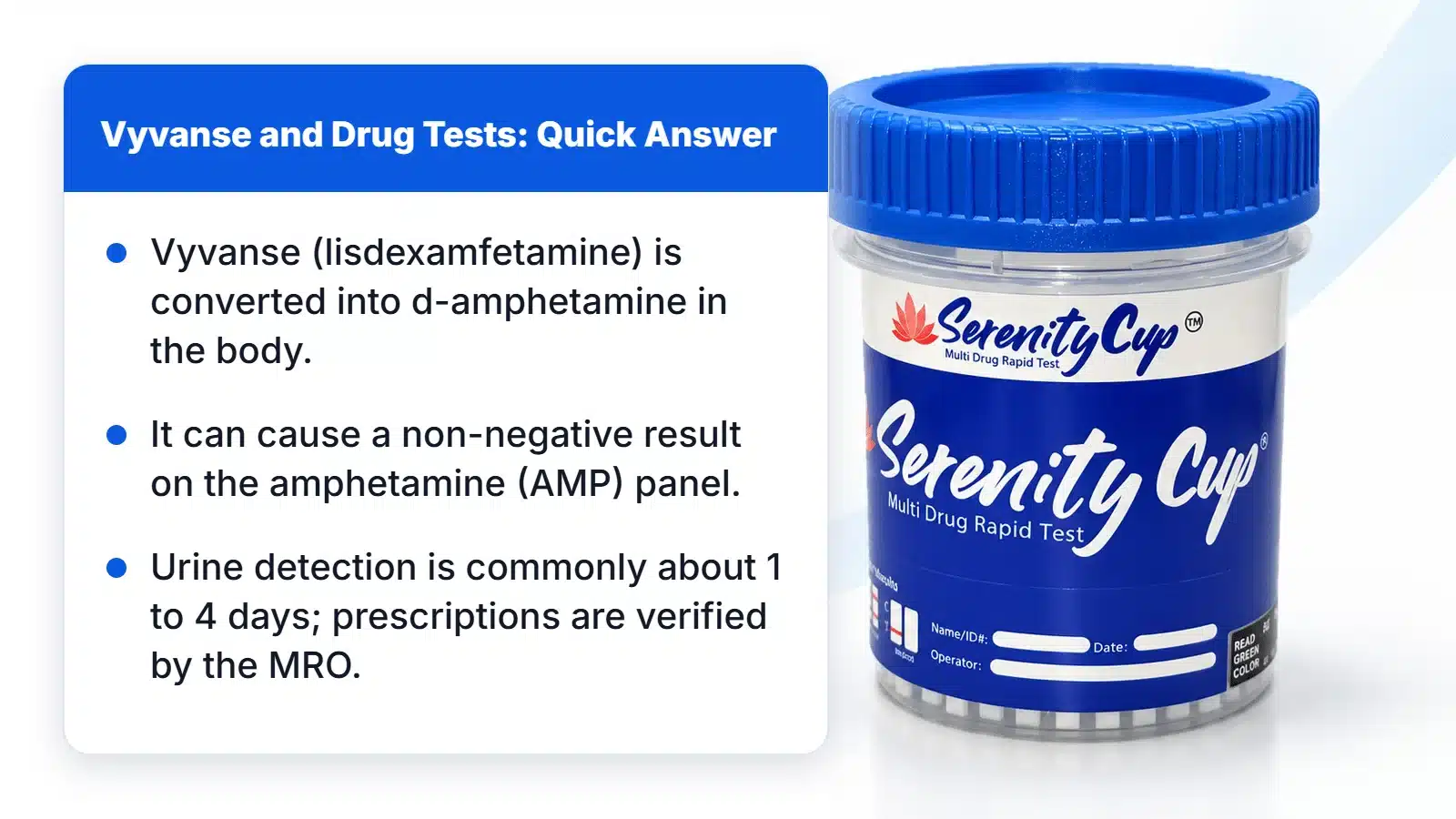
Does Vyvanse show up on a drug test? Yes, it can. Vyvanse (lisdexamfetamine) is a prodrug, which means it is inactive until the body converts it into d-amphetamine. Drug tests that include an amphetamine (AMP) panel can detect that amphetamine, so Vyvanse can produce a non-negative amphetamine screen. A valid prescription is the key factor in how a confirmed result is handled.
This guide explains how Vyvanse is processed, which panels it affects, how long it stays in your system, how it compares with Adderall and what to do if you take Vyvanse before a drug test.
What Is Vyvanse?
Vyvanse is a prescription stimulant approved for attention-deficit/hyperactivity disorder (ADHD) and moderate to severe binge eating disorder in adults. It is a Schedule II controlled substance. Vyvanse was designed as a prodrug so that it releases amphetamine gradually, which provides a long duration of action and may reduce some forms of misuse.
How Vyvanse Becomes Amphetamine
After Vyvanse is swallowed, enzymes in the blood, mainly associated with red blood cells, split lisdexamfetamine into the amino acid L-lysine and d-amphetamine. The d-amphetamine produces the medication’s effects and is eventually eliminated in urine, partly unchanged. Because drug tests detect amphetamine, they detect Vyvanse use in the form of its active drug.
Which Drug Test Panels Detect Vyvanse?
| Panel | Does Vyvanse Affect It? |
|---|---|
| AMP (amphetamine) | Yes, d-amphetamine from Vyvanse can produce a non-negative screen |
| MET / mAMP (methamphetamine) | No, Vyvanse does not produce methamphetamine |
| MDMA | No |
| Laboratory confirmation | Identifies amphetamine; some labs can also identify lisdexamfetamine |
The amphetamine panel is included on almost every drug test, from basic 5 panel workplace tests to large expanded panels. Learn more in our guide on what AMP means on a drug test.
How Long Does Vyvanse Stay in Your System?
Vyvanse’s effects typically last about 10 to 14 hours. The d-amphetamine it produces has a half-life of roughly 10 to 12 hours in adults, which leads to the following commonly cited detection windows:
| Specimen | Commonly Cited Detection Window |
|---|---|
| Urine | About 1–4 days after the last dose |
| Saliva | About 1–2 days |
| Blood | Up to about 1 day |
| Hair | Up to about 90 days |
People who take Vyvanse daily will usually test non-negative for amphetamine on any day they are tested, because the medication is present continuously.
Factors That Affect Vyvanse Detection
- Dose: Higher doses produce more amphetamine.
- Daily vs occasional use: Continuous use keeps amphetamine levels steady.
- Urine pH: Acidic urine speeds amphetamine excretion; alkaline urine slows it and extends detection.
- Kidney function and age: Reduced kidney function slows elimination.
- Test cutoff: Rapid AMP panels commonly use 1000 ng/mL or 500 ng/mL cutoffs; laboratory confirmation is more sensitive.
Vyvanse vs Adderall on a Drug Test
Both Vyvanse and Adderall produce amphetamine, so both can trigger the AMP panel. Adderall contains a mixture of amphetamine salts that are active immediately, while Vyvanse releases d-amphetamine gradually. On a laboratory test, both appear as amphetamine. Neither produces methamphetamine. For more on Adderall, see does Adderall show up on a drug test.
Other ADHD medications behave differently. Methylphenidate products such as Ritalin and Concerta are not amphetamines and usually do not trigger the AMP panel. Learn more in our article on how long Ritalin stays in your system.
Taking Vyvanse Before a Drug Test
If you take Vyvanse as prescribed, do not stop it before a drug test unless your prescriber advises you to. Instead:
- Keep your prescription information and pharmacy records available.
- Report your medications if the collection process allows it.
- If your screen is non-negative, expect the specimen to be confirmed by a laboratory.
- In regulated programs, the Medical Review Officer will contact you to verify your prescription before reporting the result.
When the MRO verifies a valid prescription for amphetamine, the confirmed result is generally reported as negative to the employer. The MRO may separately raise a safety concern if a medication could affect the ability to perform safety-sensitive duties.
Vyvanse in DOT-Regulated Jobs
DOT testing includes amphetamines. A DOT-regulated employee with a valid Vyvanse prescription can have a confirmed amphetamine result verified as negative by the MRO. Separately, agency medical standards, such as those for commercial drivers or pilots, may require evaluation of whether the condition and medication are compatible with safety-sensitive work. Employees should discuss this with their prescriber and, where applicable, their medical examiner.
Can Vyvanse Cause a False Positive for Other Drugs?
Vyvanse produces amphetamine, so an amphetamine result after Vyvanse use is a true positive for amphetamine, not a false positive. It does not cause positive results for methamphetamine, cocaine, opiates or other unrelated panels. If an unexpected methamphetamine result occurs, laboratory confirmation can identify the actual compound and, if needed, distinguish the d and l forms of methamphetamine.
Why Programs Test for Amphetamines
Prescription stimulants are among the most commonly misused prescription drugs, particularly among students and young adults who use them without a prescription to stay awake or study. Illicit amphetamine and methamphetamine also remain significant concerns. Testing for amphetamines helps programs identify non-prescribed use, while MRO review ensures that people taking legitimate prescriptions such as Vyvanse are not penalized for following their treatment.
How Laboratories Confirm Amphetamine
When an AMP screen is non-negative, the laboratory uses GC-MS or LC-MS/MS to identify and measure amphetamine. Federal workplace testing confirms amphetamine at 250 ng/mL. Some laboratories can also identify lisdexamfetamine itself, although it is present only briefly. The confirmation result is then reviewed against prescription information by the MRO in programs that use one.
Vyvanse in Oral Fluid Testing
Oral fluid tests can detect amphetamine after Vyvanse use, generally for about one to two days after the last dose. Because saliva collection is observed and detects recent use, it is used for post-accident and reasonable suspicion testing in some programs. A daily Vyvanse user is likely to screen non-negative for amphetamine on an oral fluid test as well as on a urine test.
Vyvanse for Students and Athletes
Sports organizations often treat stimulants differently from workplace programs. Collegiate and professional athletic programs commonly ban stimulants unless the athlete has an approved medical exception documented in advance. Students and athletes who take Vyvanse should follow their organization’s process for documenting ADHD medication before they are tested, because a prescription alone may not be enough to avoid a sanction in those programs.
What Collectors and Program Staff Should Know
Collectors should not ask donors to stop taking prescribed medication, and they should not interpret results based on a donor’s description of their prescriptions. The collector’s role is to complete the collection correctly and record any information the donor offers. Interpreting the result against a prescription belongs to the MRO or designated reviewer.
Testing Options for Stimulant Monitoring
Programs that monitor prescribed stimulants, such as some treatment and clinical programs, typically use multi-panel cups with separate AMP and MET panels, followed by laboratory confirmation. Compare options in our 10 panel drug test cups and 12 panel drug test cups categories.
Vyvanse, Impairment and Workplace Safety
At prescribed doses, Vyvanse typically improves attention and focus in people with ADHD rather than impairing them. However, side effects such as insomnia, anxiety or an elevated heart rate can occur, especially when a dose is changed. Taking more than prescribed, or combining stimulants with alcohol or other drugs, increases risk. Employers in safety-sensitive industries usually address medication safety through fitness-for-duty policies and medical review rather than through the drug test result alone.
Detection After Stopping Vyvanse
After the last dose, amphetamine levels in urine decline over the next few days. Most people will fall below the rapid AMP cutoff within about two to four days, depending on dose, urine pH and individual metabolism. Laboratory tests with lower cutoffs can detect it slightly longer. Stopping prescribed Vyvanse to “clear” before a test is unnecessary when an MRO process is in place, and it can disrupt treatment.
Key Takeaway
Vyvanse is converted to d-amphetamine, so it can cause a non-negative result on the amphetamine panel of a drug test, commonly for about 1 to 4 days after the last dose. It does not cause methamphetamine positives. If you take Vyvanse as prescribed, keep your prescription information available; the MRO verifies valid prescriptions before reporting confirmed results.
This article is for general educational purposes and is not medical or legal advice. Do not change prescribed medication without talking to your prescriber.
Frequently Asked Questions
Does Vyvanse show up on a drug test?
Yes. Vyvanse is converted into d-amphetamine, which can cause a non-negative result on the amphetamine (AMP) panel.
How long does Vyvanse stay in your urine?
Amphetamine from Vyvanse is commonly detectable in urine for about 1 to 4 days after the last dose.
Will Vyvanse show up as methamphetamine?
No. Vyvanse produces amphetamine, not methamphetamine, so it should not cause a methamphetamine result.
Will I fail a drug test if I have a Vyvanse prescription?
The screen may be non-negative, but in programs with MRO review, a verified valid prescription leads to the confirmed result being reported as negative.
Does Vyvanse show up differently than Adderall?
Both produce amphetamine and appear the same on standard screens. Laboratory testing reports amphetamine for both.
IN THIS ARTICLE