

Amphetamines vs Methamphetamines: Differences and How Drug Tests Detect Them

What is the difference between amphetamines and methamphetamines? Amphetamine and methamphetamine are closely related stimulants. Methamphetamine has one additional methyl group, which lets it reach the brain more easily and makes it more potent. Amphetamine is widely prescribed for ADHD in medications such as Adderall and Vyvanse, while methamphetamine is mostly encountered as an illicit drug, with one rarely prescribed exception. On a drug test, they are detected by separate panels, AMP and MET, and the relationship between the two results tells a lot about what was used.
This guide explains how the two drugs differ, how the AMP and MET panels work, why methamphetamine use also produces amphetamine, detection times in urine and how laboratories distinguish prescription use from illicit use.
Is Amphetamine Meth?
No. Amphetamine and methamphetamine are different drugs, although they belong to the same family and have similar effects. Methamphetamine is chemically N-methylamphetamine. That small structural difference changes how the drug behaves: methamphetamine crosses into the brain faster, produces stronger and longer-lasting stimulant effects at a given dose and carries a higher risk of addiction and neurotoxicity.
| Feature | Amphetamine | Methamphetamine |
|---|---|---|
| Common forms | Adderall, Vyvanse (as lisdexamfetamine), Evekeo, Dexedrine | Illicit crystal meth, powder; Desoxyn (rare prescription) |
| Medical use | ADHD, narcolepsy, binge eating disorder (Vyvanse) | Very limited (Desoxyn for ADHD and obesity) |
| Potency | Strong stimulant | Stronger central effects |
| Controlled substance schedule | Schedule II | Schedule II |
| Drug test panel | AMP | MET / mAMP |
| Metabolism | Largely excreted unchanged | Partly converted to amphetamine |
How AMP and MET Panels Work
Most multi-panel drug test cups include separate amphetamine (AMP) and methamphetamine (MET or mAMP) strips. Each strip uses antibodies designed to recognize its target drug above a set cutoff. Common rapid cutoffs are 1000 ng/mL or 500 ng/mL for each. Federal workplace testing screens amphetamines at 500 ng/mL and confirms amphetamine and methamphetamine at 250 ng/mL.
Because the two drugs are similar, some cross-reactivity exists between the panels: a high concentration of one drug can sometimes cause a reaction on the other strip. The product insert lists these cross-reactivity values. Learn more about the AMP panel in our guide on what AMP means on a drug test.
Why Meth Use Also Tests Positive for Amphetamine
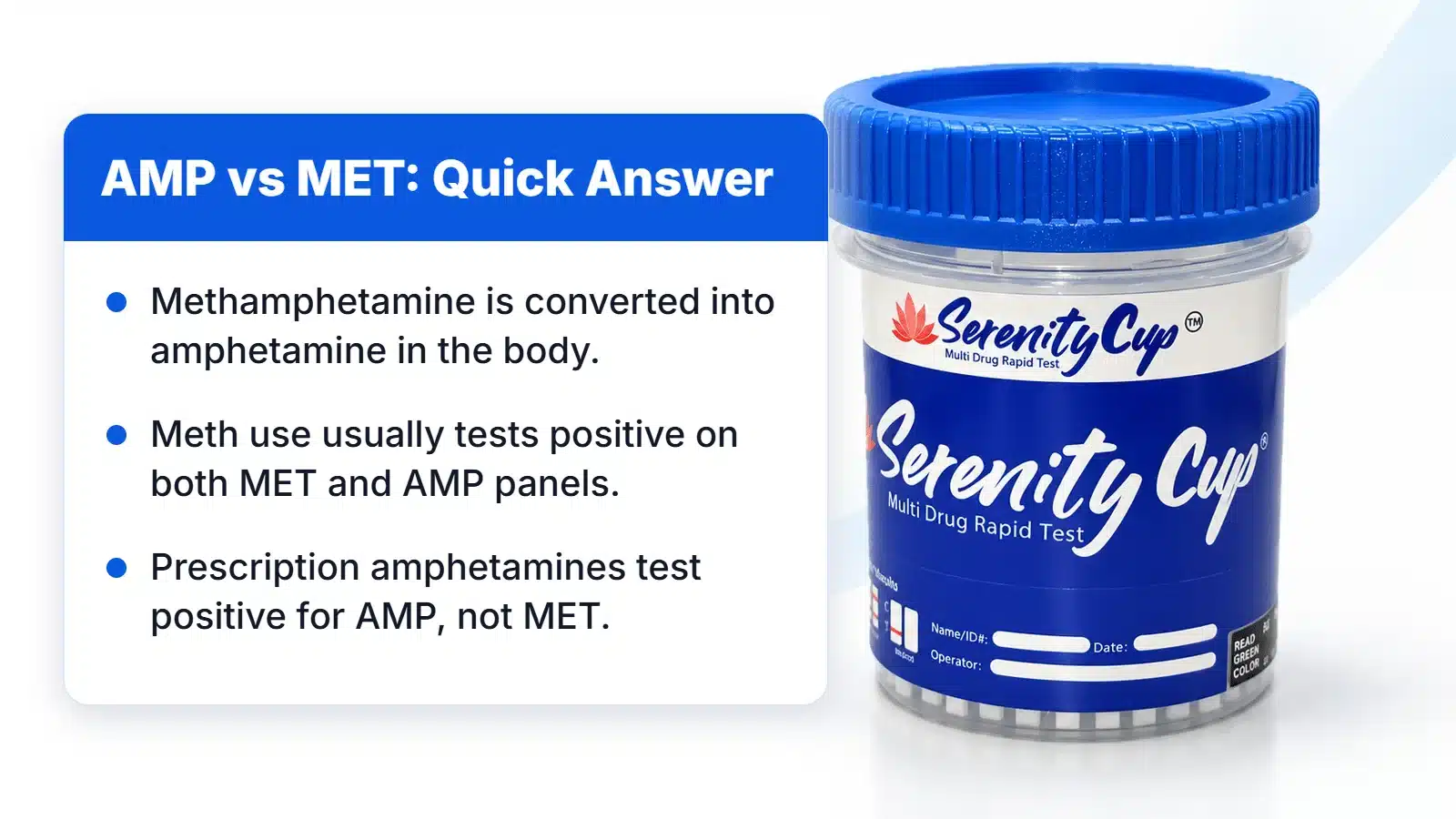
When someone uses methamphetamine, the liver converts part of it into amphetamine. As a result, urine from a methamphetamine user typically contains both methamphetamine and amphetamine. On a rapid cup, this usually means both the MET and AMP panels show non-negative results.
The reverse is not true. Amphetamine is not converted into methamphetamine, so a person taking Adderall or Vyvanse should test non-negative on the AMP panel but negative on the MET panel, unless there is cross-reactivity at very high concentrations.
Reading the pattern
| AMP Panel | MET Panel | Most Likely Explanation |
|---|---|---|
| Non-negative | Negative | Amphetamine use, such as prescribed ADHD medication, or cross-reactivity |
| Non-negative | Non-negative | Methamphetamine use, or high-level amphetamine with cross-reactivity |
| Negative | Non-negative | Methamphetamine below the AMP cutoff, cross-reactivity, or another compound |
These patterns are only clues. Laboratory confirmation is required before drawing conclusions.
Methamphetamines Drug Test in Urine: Detection Times
| Drug | Commonly Cited Urine Detection Window |
|---|---|
| Amphetamine (prescription or illicit) | About 1–4 days |
| Methamphetamine (occasional use) | About 1–4 days |
| Methamphetamine (heavy, repeated use) | Up to about a week or longer |
Both drugs are excreted faster in acidic urine and more slowly in alkaline urine, which is one reason detection times vary between people. Saliva tests generally detect both drugs for about one to two days, and hair tests for about 90 days. See our urine drug test detection windows guide for other drugs.
How Laboratories Tell Them Apart
Confirmation testing
GC-MS and LC-MS/MS identify and measure amphetamine and methamphetamine separately. In federal workplace testing, a methamphetamine result is reported as positive only if amphetamine is also present at or above 100 ng/mL, which confirms that the methamphetamine was metabolized in the body rather than being a contaminant.
d- and l-isomers
Methamphetamine exists in two mirror-image forms. Illicit methamphetamine and the prescription drug Desoxyn are mostly d-methamphetamine, the potent form. Levmetamfetamine (l-methamphetamine) is the active ingredient in some over-the-counter nasal decongestant inhalers and has weak central effects. A laboratory can perform chiral analysis to measure the proportion of each. A result that is predominantly l-methamphetamine is consistent with use of such an inhaler rather than illicit meth.
Prescription Amphetamines and Drug Testing
People taking Adderall, Vyvanse or other prescribed amphetamines will usually screen non-negative for AMP. In programs that use a Medical Review Officer, a valid prescription leads to the confirmed amphetamine result being reported as negative. A confirmed methamphetamine result, on the other hand, is not explained by an amphetamine prescription. Read our guides on Adderall and Vyvanse for details.
Common Cross-Reactants
Some medications and substances have been reported to cause non-negative AMP or MET screens on certain assays, including pseudoephedrine, phentermine, bupropion, labetalol, ranitidine in older reports and some antipsychotics. These do not produce amphetamine or methamphetamine on confirmation testing. See phentermine and drug tests and what can cause a false positive drug test.
Effects and Risks Compared
Both drugs increase alertness, energy and heart rate. Methamphetamine’s stronger and longer-lasting effects make it more likely to cause severe insomnia, paranoia, psychosis, dangerous rises in blood pressure and body temperature, dental problems and long-term changes in brain function with repeated use. Prescribed amphetamine taken at therapeutic doses under medical supervision has a well-established safety profile, although misuse at high doses carries many of the same risks.
Amphetamine and Methamphetamine in Oral Fluid Tests
Oral fluid tests detect the parent drugs in saliva, which reflects recent use, generally within about one to two days. Because methamphetamine is present in saliva as the parent drug, saliva tests tend to show methamphetamine more prominently than its amphetamine metabolite shortly after use. Many saliva devices include both AMP and MET panels. Compare formats in our guide to urine vs saliva vs blood drug tests.
What About MDMA?
MDMA (ecstasy or molly) is another member of the amphetamine family, but many AMP and MET panels react only weakly to it. A dedicated MDMA panel is the most reliable way to screen for it. Learn more in our article on what MDMA means on a drug test.
Methamphetamine Contamination and Secondhand Exposure
People who live in or clean homes where methamphetamine was smoked or manufactured can absorb small amounts of the drug from contaminated surfaces. Research has found that children living in such homes can have detectable methamphetamine in hair and sometimes urine. In workplace and supervision testing, the federal requirement that amphetamine also be present helps separate active use from incidental contamination, but programs should be aware of this possibility when interpreting low-level results.
Treatment Programs and Stimulant Monitoring
Methamphetamine use disorder has no approved medication in the United States, so treatment relies mainly on behavioral approaches such as contingency management, which rewards verified negative drug tests. Frequent urine testing with separate AMP and MET panels is central to these programs, because it provides objective, timely feedback. Programs that serve patients taking prescribed ADHD medication should record those prescriptions so AMP results are interpreted correctly.
Choosing Tests With Both Panels
Programs that want to distinguish prescription amphetamine use from methamphetamine use should choose test cups with separate AMP and MET panels and confirm non-negative results. Most cups in our 10 panel drug test cups and 12 panel drug test cups categories include both. Check the cutoffs on each product page.
Desoxyn: The Prescription Exception
Desoxyn is a prescription form of d-methamphetamine approved for ADHD and, historically, for short-term weight loss. It is rarely prescribed today. A patient taking Desoxyn will test positive for methamphetamine and amphetamine, and in programs with MRO review, a valid prescription is verified in the same way as any other controlled medication. Because Desoxyn prescriptions are uncommon, MROs check them carefully.
Key Takeaway
Amphetamine and methamphetamine are related but different stimulants. Methamphetamine is partly converted into amphetamine, so meth use usually produces non-negative results on both the MET and AMP panels, while prescription amphetamine typically affects only the AMP panel. Laboratory confirmation, including the federal amphetamine requirement and chiral analysis, separates illicit methamphetamine from prescription use and over-the-counter inhalers.
This article is for general educational purposes and is not medical or legal advice.
Frequently Asked Questions
Is amphetamine the same as meth?
No. Methamphetamine is a related but more potent drug with an extra methyl group. Amphetamine is prescribed for ADHD; methamphetamine is mostly encountered as an illicit drug.
Will meth show up as amphetamine on a drug test?
Usually yes. Methamphetamine is partly converted to amphetamine, so meth users typically test non-negative on both the MET and AMP panels.
Will Adderall show up as methamphetamine?
No. Adderall contains amphetamine, which is not converted to methamphetamine. It typically affects only the AMP panel.
How long does meth stay in urine?
Methamphetamine is commonly detectable in urine for about 1 to 4 days after occasional use, and up to a week or longer with heavy use.
Can a nasal inhaler cause a methamphetamine positive?
Some over-the-counter inhalers contain l-methamphetamine. Chiral laboratory analysis can show that a result is predominantly the l-form, which is consistent with inhaler use.
IN THIS ARTICLE