


How Long Does Ketamine Stay in Your System? Drug Test Detection Times

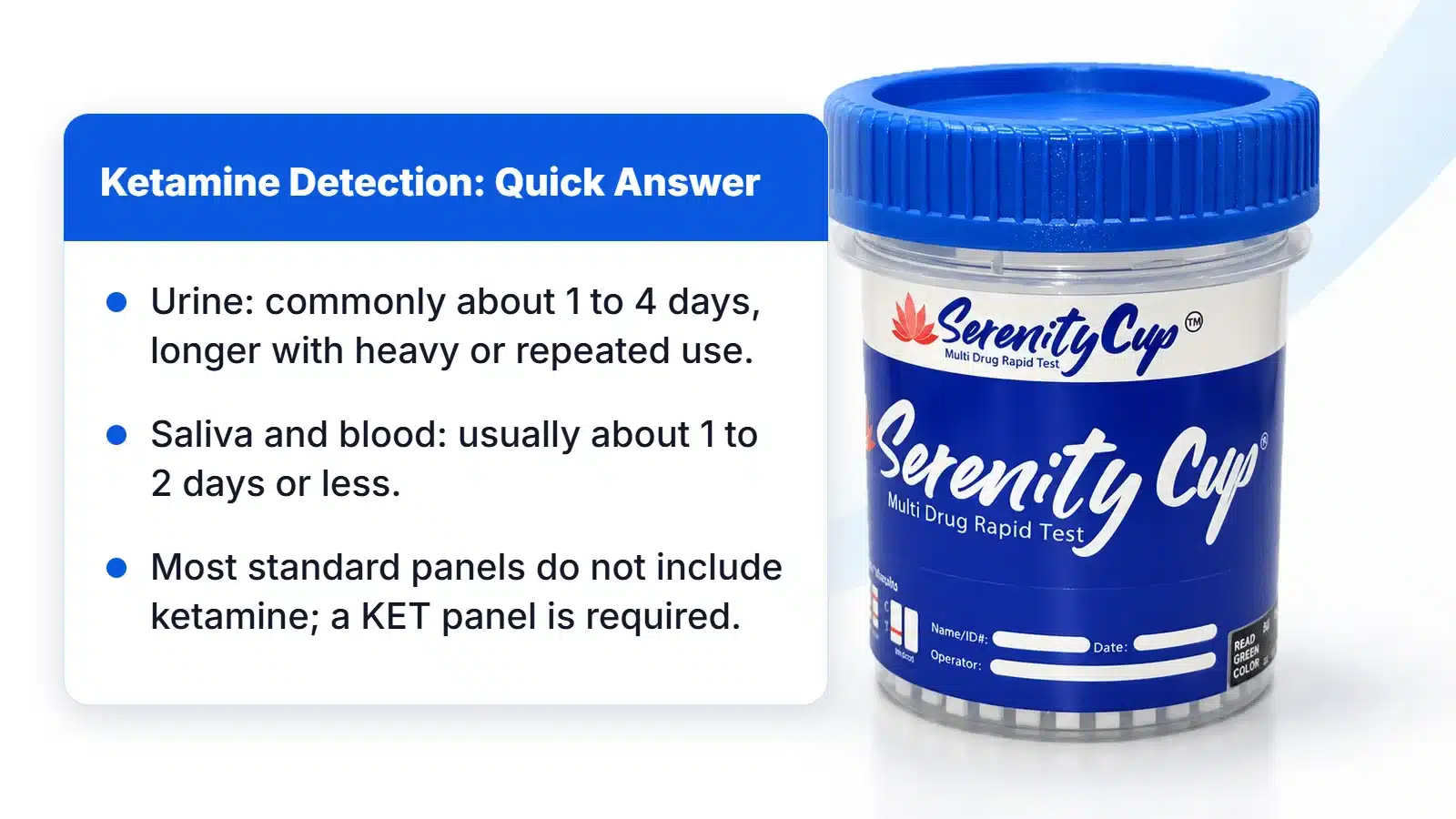
How long does ketamine stay in your system? Ketamine itself is cleared from the body quickly, but its metabolites can remain detectable for longer. In urine, ketamine is commonly detectable for about 1 to 4 days after occasional use, and potentially longer after heavy or repeated use. Saliva and blood windows are shorter, while hair testing can show use over a period of months.
An important detail is that most standard drug tests do not look for ketamine at all. Detection requires a test with a specific ketamine (KET) panel or a laboratory test ordered for ketamine. This guide covers detection windows by specimen, the KET panel, factors that affect results and how testing programs handle ketamine.
What Is Ketamine?
Ketamine is a dissociative anesthetic. It is used in hospitals and veterinary medicine for anesthesia and pain control, and it is increasingly used under medical supervision to treat depression. A related medication, esketamine, is approved as a nasal spray for treatment-resistant depression. Ketamine is a Schedule III controlled substance in the United States.
Ketamine is also misused recreationally for its dissociative and hallucinogenic effects, which is why some drug testing programs include it on expanded panels.
How the Body Processes Ketamine
After use, ketamine is broken down in the liver, mainly into norketamine and then dehydronorketamine. Ketamine has a short half-life of a few hours, but the metabolites remain in the body longer. Drug tests may detect ketamine, norketamine or both, depending on the assay and the laboratory method.
Ketamine Detection Times by Test Type
The windows below are commonly cited estimates. Actual detection depends on dose, frequency, the test cutoff and individual factors.
| Specimen | Commonly Cited Detection Window | Notes |
|---|---|---|
| Urine | About 1–4 days; longer with heavy or repeated use | Most common specimen; detects ketamine and norketamine |
| Oral fluid (saliva) | About 1–2 days | Best for recent use; available on some saliva panels |
| Blood | Up to about 1 day | Used mainly in clinical and forensic settings |
| Hair | Up to about 90 days | Shows a longer history; not useful for very recent use |
Does Ketamine Show Up on Drug Tests?
Ketamine only shows up when the test is designed to look for it. Standard 5 panel workplace tests and most 10 and 12 panel cups do not include ketamine. Programs that need ketamine screening use a device with a dedicated KET panel or send specimens to a laboratory for a ketamine test.
If you are trying to find out whether a specific multi-panel cup includes ketamine, check the panel list on the label. Our guide to what a 12 panel drug test tests for explains how to read configuration lists.
Ketamine and PCP
Ketamine and PCP are both dissociative drugs with related chemical structures, but a PCP panel is designed for phencyclidine and does not reliably detect ketamine. Cross-reactivity between the two on screening assays is generally limited, so a PCP panel should not be used as a substitute for a KET panel. Read more in our article on what PCP means on a drug test.
What Is the KET Panel Cutoff?
Rapid ketamine panels commonly use a urine cutoff of 1000 ng/mL, and some products use a lower cutoff such as 500 ng/mL. Oral fluid devices use much lower cutoffs because drug concentrations in saliva are lower than in urine. Always check the product label and insert for the exact cutoff, because it directly affects the detection window.
Factors That Affect How Long Ketamine Is Detectable
- Dose: Larger doses produce higher metabolite levels that take longer to fall below the cutoff.
- Frequency of use: Repeated or daily use can extend urine detection beyond the typical window.
- Route of use: Snorted, injected and oral ketamine are absorbed and processed differently.
- Metabolism and liver function: Individual differences in liver enzymes change how quickly ketamine is broken down.
- Kidney function and hydration: These affect urine concentration and how quickly metabolites are excreted.
- Test cutoff and method: Laboratory methods with low cutoffs detect smaller amounts for longer.
Medical Ketamine and Drug Testing
People receiving ketamine or esketamine as part of medical treatment may test positive on a KET panel or laboratory test. In regulated workplace programs, a Medical Review Officer reviews confirmed results and contacts the donor to verify any legitimate prescription or medical administration. In treatment and clinical settings, the result is interpreted alongside the patient’s treatment records.
Anyone receiving ketamine therapy who is subject to testing should keep documentation of their treatment available.
How Long Do Ketamine’s Effects Last Compared With Detection?
The effects of ketamine usually last from under an hour to a few hours, depending on the dose and how it is taken. Detection lasts much longer than the effects. A person may feel completely normal while metabolites are still present in urine. This is why a positive test shows past use within the detection window, not current impairment.
Clinical observation, not a urine test, is used to judge whether someone is currently under the influence.
Ketamine Detection Compared With Other Drugs
| Drug | Commonly Cited Urine Window After Occasional Use |
|---|---|
| Ketamine | About 1–4 days |
| Cocaine (benzoylecgonine) | About 1–3 days |
| MDMA | About 1–3 days |
| PCP | About 3–7 days |
| THC (occasional use) | About 1–3 days |
For more detection windows, see our urine drug test detection windows guide.
Ketamine in Forensic and Drug-Facilitated Crime Testing
Ketamine is one of the substances investigators look for in suspected drug-facilitated assaults, because it can cause sedation and memory loss. In these cases, timing is critical. Specimens should be collected as soon as possible, and forensic laboratories use sensitive methods with low cutoffs to extend the window. A standard rapid cup is not suitable for these investigations; anyone who believes they were drugged should seek medical care promptly and ask that specimens be collected for forensic testing.
Can Other Substances Cause a Positive Ketamine Screen?
Like any immunoassay, a KET panel can occasionally react to substances with similar structures, although this is uncommon. The product insert lists the compounds the manufacturer has tested for cross-reactivity. Laboratory confirmation identifies ketamine and norketamine specifically and is the standard way to resolve an unexpected result.
Who Tests for Ketamine?
- Addiction treatment and recovery programs that monitor club and party drugs
- Drug courts and probation programs with expanded panels
- Emergency departments investigating unknown ingestions
- Forensic investigations, including suspected drug-facilitated crimes
- Some employers and schools that choose expanded panels
Ketamine Testing Options
For on-site screening, ketamine is available on selected oral fluid devices such as our 10 panel saliva drug test with ketamine and the 5 panel saliva test with ketamine and K2. Expanded multi-panel options are listed in our 13 to 16 panel drug test cups category. Check each product’s panel list to confirm that KET is included.
As with all rapid tests, a non-negative ketamine screen is preliminary and should be confirmed by a laboratory method such as LC-MS/MS.
Tips for Programs Adding Ketamine to a Panel
- Decide whether you need recent-use detection (oral fluid) or a longer window (urine).
- Confirm the KET cutoff on the device and make sure your laboratory can confirm ketamine and norketamine.
- Update your written policy so donors know which substances are included.
- Set a process for reviewing results from patients receiving medical ketamine or esketamine.
- Train collectors to record any medications the donor reports at the time of collection.
How to Read a Ketamine Test Result
A KET panel is read like any other panel on a rapid test. A control line with a visible test line, even a faint one, is negative. A control line with no test line is a preliminary non-negative. No control line means the test is invalid. Read results at the time stated in the instructions. See our guide on how to read a drug test cup for details.
Key Takeaway
Ketamine is processed quickly, but its metabolites are commonly detectable in urine for about 1 to 4 days, longer with heavy use, and in saliva and blood for a shorter time. Hair can show use for months. Most standard panels do not include ketamine, so testing requires a dedicated KET panel or a laboratory test, and non-negative screens should be confirmed.
This article is for general educational purposes and is not medical or legal advice.
Frequently Asked Questions
How long does ketamine stay in your system?
Ketamine is commonly detectable in urine for about 1 to 4 days after occasional use, longer with heavy use. Saliva and blood windows are shorter, and hair can show use for up to about 90 days.
Does ketamine show up on a standard drug test?
No. Standard 5 panel tests and most 10 and 12 panel cups do not include ketamine. A test with a KET panel or a laboratory ketamine test is required.
What is the cutoff for a ketamine drug test?
Rapid urine ketamine panels commonly use a 1000 ng/mL cutoff, and some use 500 ng/mL. Check the product label for the exact value.
Does a PCP panel detect ketamine?
A PCP panel is designed for phencyclidine and does not reliably detect ketamine. Use a dedicated KET panel for ketamine screening.
Will ketamine therapy show up on a drug test?
It can if the test includes ketamine. Confirmed results are reviewed against medical records, so patients should keep documentation of their treatment.
IN THIS ARTICLE