



What does a faint line on a drug test mean? On most rapid urine drug tests, a faint line in the test (T) region means the result is negative for that drug, as long as the control (C) line is also present. This surprises many people, because pregnancy tests work the opposite way. Drug tests use a different design, called a competitive immunoassay, where the presence of a line means the drug was not detected above the cutoff.
This guide explains why faint lines appear, how to read a very faint line that is almost invisible, when a result is invalid, and what to do if you are unsure.
Why Drug Tests Read Differently From Pregnancy Tests
A pregnancy test uses a sandwich immunoassay: the hormone being tested for helps form the test line, so a line means positive. A drug test strip works in reverse. The test line is formed by a drug-protein conjugate that captures antibody particles as the urine flows across the strip.
When there is no drug in the urine, the antibody particles are free to bind at the test line, and a line appears. When drug is present above the cutoff, the drug binds to the antibodies first, so there are not enough free antibodies to form a visible test line. That is why, on a drug test:
- A line in T means negative.
- No line in T means preliminary non-negative.
Is a Faint Line on a Drug Test Negative?
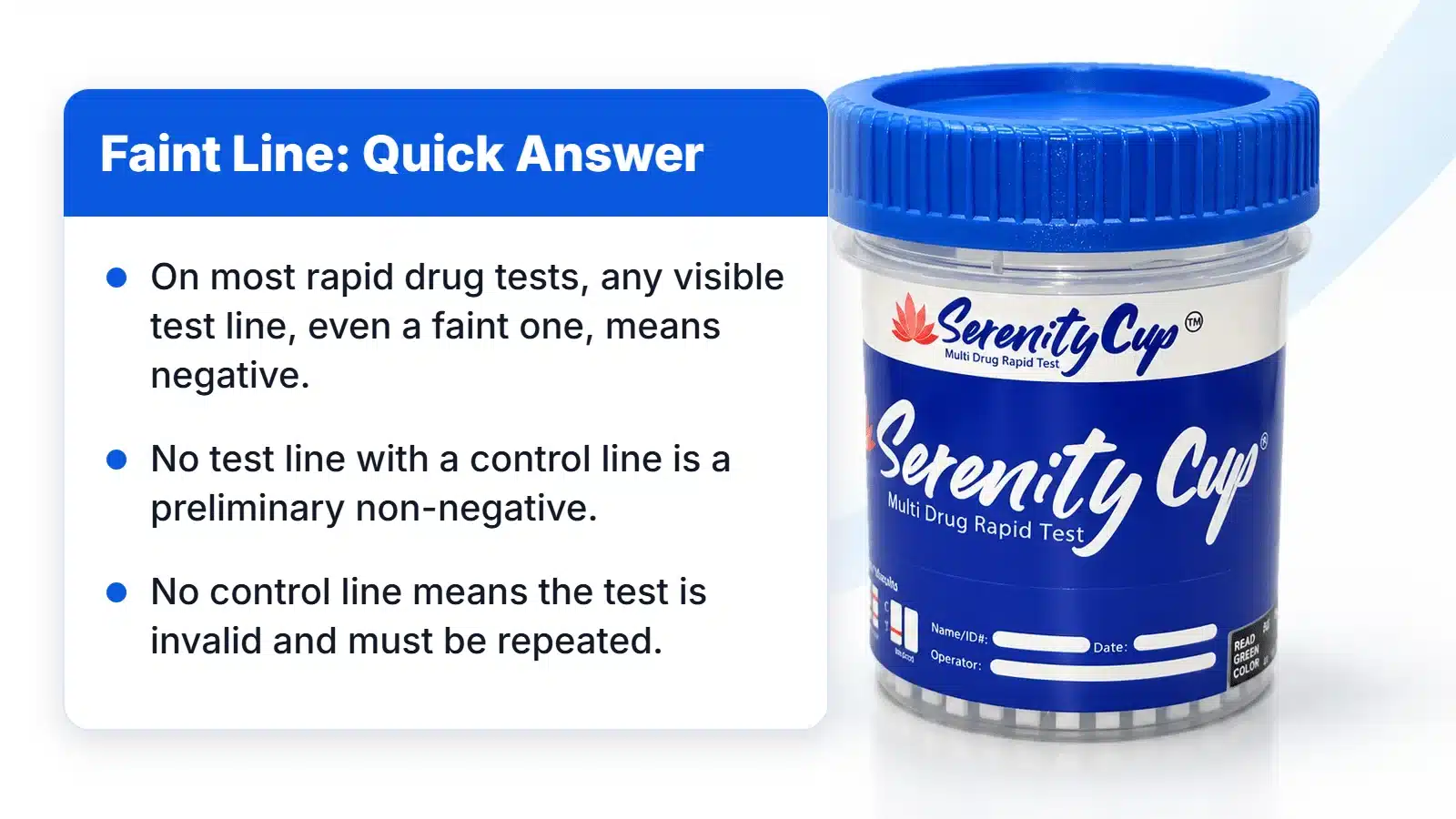
Yes. Manufacturer instructions for rapid urine drug test cups and dip cards consistently state that any visible color in the test region should be read as negative, no matter how light it is. The intensity of the test line is not meant to be interpreted. A dark line and a faint line both mean the drug concentration is below the cutoff for that panel.
The same rule applies to a very faint line on a drug test that is almost invisible. If you can see any colored line in the T region within the read time, under good lighting, it counts as a line.
Why Faint Lines Appear
A faint test line is common and usually has an ordinary explanation.
Drug present below the cutoff
If a small amount of drug or a cross-reacting substance is present, it can bind some of the antibodies without blocking the line completely. The line becomes lighter but still appears. Because the line is visible, the result is still negative at that cutoff.
Normal variation between panels
Each panel on a multi-drug cup has its own chemistry. Some test lines are naturally lighter than others even in a completely drug-free sample. A light line on one panel and a dark line on another is normal.
Sample volume and flow
If too little urine reaches a strip, or the flow is uneven, the line may develop weakly. Filling the cup to the required level and keeping it upright during the read time helps.
Reading too early
Test lines develop over several minutes. Reading before the stated read time can make a line look faint or absent.
How to Read Drug Test Lines Correctly
| What You See | Result |
|---|---|
| Control line and a dark test line | Negative |
| Control line and a faint or very faint test line | Negative |
| Control line and no test line | Preliminary non-negative; send for confirmation |
| No control line, with or without a test line | Invalid; repeat with a new device |
For a complete walkthrough, including temperature strips and adulterant checks, see our guide on how to read a drug test cup.
Read Time Matters
Most rapid urine cups and dip cards are read at 5 minutes, and results should not be interpreted after the maximum time stated in the instructions, often 10 minutes. Reading too late can be misleading, because lines may fade, darken or show evaporation marks as the strip dries. Use a timer, read at the stated time and record the result immediately.
What Is an Evaporation Line?
An evaporation line is a faint, colorless or grayish mark that can appear where the test line would be after the strip begins to dry. It is not a valid result. Evaporation lines are more likely when a test is read well after the read window. To avoid confusion, only interpret lines that have color and appear within the read time.
Tips for Reading a Very Faint Line
- Read under bright, even, white light rather than dim or colored lighting.
- Look straight at the strip instead of at an angle that creates glare.
- Compare each test window with the control line on the same strip.
- Do not tilt or shake the cup to make the line clearer.
- If two people read the result differently, record both observations and follow your program’s procedure, which usually means sending the specimen for confirmation.
When Should a Faint Line Result Be Confirmed?
A faint line is a negative result, so confirmation is not required by the reading rules. However, some programs choose to send specimens for laboratory testing if the line is so faint that staff cannot agree whether it is present, or if other information raises concern. Laboratory confirmation by GC-MS or LC-MS/MS gives a quantitative result and resolves the question.
Any panel with no test line at all is a preliminary non-negative result and should always follow your confirmation process.
Does a Faint Line Mean Someone Used a Small Amount of a Drug?
Not necessarily. A faint line can reflect a small amount of drug, a cross-reacting medication, dilute or concentrated urine, or simply normal variation in the strip. Rapid tests are qualitative: they answer only whether a drug is above or below the cutoff. They cannot tell how much was used or when.
For the same reason, programs should not treat a faint line as a partial positive or as evidence of use. The result is negative at the tested cutoff.
Faint Lines on Oral Fluid Tests
Most oral fluid drug tests use the same competitive immunoassay principle, so a visible test line also means negative on those devices. Read times and specific instructions vary by product, so follow the insert for the device you use. Learn more about how swab devices work in our swab drug test process guide.
Recording Results Properly
Accurate documentation protects both the donor and the program. Record each panel as negative, non-negative or invalid at the time of reading, note the read time, and keep the device or a photo according to your policy. If a line was faint, it is still recorded as negative. Clear records help when a result is later questioned.
Common Myths About Faint Lines
Myth: A faint line means the test is borderline positive
Rapid drug tests do not have a borderline category. The result is either below the cutoff (line present) or at or above the cutoff (no line). A faint line is below the cutoff.
Myth: A darker line means cleaner urine
Line darkness is not a measurement of how drug-free a sample is. Two drug-free samples can produce lines of different intensity on the same panel.
Myth: You can compare faint lines between brands
Different manufacturers use different reagents, membranes and conjugates. Line intensity cannot be compared across products, or even reliably between panels on the same cup.
Myth: Photographing the test later gives a better reading
A photo taken after the read window may show changes that happened as the strip dried. Photos are useful for documentation only when they are taken at the stated read time.
Choosing Reliable Test Cups
Clear, consistent line development starts with a quality device stored and used correctly. Keep cups sealed until use, store them within the temperature range on the label and check expiration dates. Browse our drug test cups and dip card tests to compare configurations.
Key Takeaway
On a rapid drug test, a faint line in the test region is a negative result, even when it is very faint and almost invisible, as long as the control line is present. No test line means a preliminary non-negative, and no control line means the test is invalid. Read results at the stated time under good light, and use laboratory confirmation when a result is non-negative or genuinely unclear.
This article is for general educational purposes. Always follow the instructions supplied with your specific test device.
Frequently Asked Questions
Is a faint line on a drug test negative?
Yes. On rapid urine and oral fluid drug tests, any visible test line, even a faint one, is read as negative as long as the control line is present.
What does a very faint line almost invisible mean on a drug test?
If you can see any colored line in the test region within the read time, it counts as a line and the result is negative for that drug.
Why is one line lighter than the others on my test cup?
Each panel has its own chemistry, so line intensity naturally varies. A small amount of drug below the cutoff or a cross-reacting substance can also make a line lighter.
Can I read a drug test after 10 minutes?
No. Results should be read at the time stated in the instructions. Reading late can produce misleading faint lines or evaporation marks.
Does a faint line mean I used a small amount of a drug?
Not necessarily. Rapid tests are qualitative and cannot measure amount. A faint line simply means the result is below the cutoff.
IN THIS ARTICLE