

What Is TCA on a Drug Test? Tricyclic Antidepressant Screening Explained

What is TCA on a drug test? TCA stands for tricyclic antidepressants, a class of prescription medications used for depression, chronic pain, migraine prevention and sleep problems. A TCA panel on a drug test cup or dip card screens for these medications as a group rather than for one specific drug.
TCA panels appear on many 10, 12 and 14 panel configurations, especially those used in pain management, behavioral health and emergency settings. This guide explains what the TCA panel detects, the common cutoff level, which medications can cause cross-reactivity, and how to read and confirm a TCA result.
What Does TCA Mean on a Drug Test?
On a drug test label, TCA is the abbreviation for the tricyclic antidepressant screening assay. The name “tricyclic” comes from the three-ring chemical structure shared by these medications. Because the immunoassay reacts to that shared structure, one TCA strip can detect several different medications in the class.
TCA is one of many standard abbreviations printed on test cups. For a full list, see our guide to drug test abbreviations.
Which Drugs Does a TCA Panel Detect?
A TCA panel is designed to detect the tricyclic antidepressants most commonly prescribed in the United States. Detection depends on each drug’s cross-reactivity with the specific assay, which is listed in the product insert.
| Medication | Common Brand Name | Typical Use |
|---|---|---|
| Amitriptyline | Elavil (discontinued brand), generics | Depression, nerve pain, migraine prevention |
| Nortriptyline | Pamelor | Depression, nerve pain |
| Imipramine | Tofranil | Depression, childhood bedwetting |
| Desipramine | Norpramin | Depression |
| Doxepin | Silenor, generics | Depression, anxiety, insomnia |
| Clomipramine | Anafranil | Obsessive-compulsive disorder |
Some of these drugs are metabolized into one another. Amitriptyline, for example, is converted to nortriptyline in the body, so both may be present in urine after a single medication is taken.
What Is the TCA Cutoff Level?
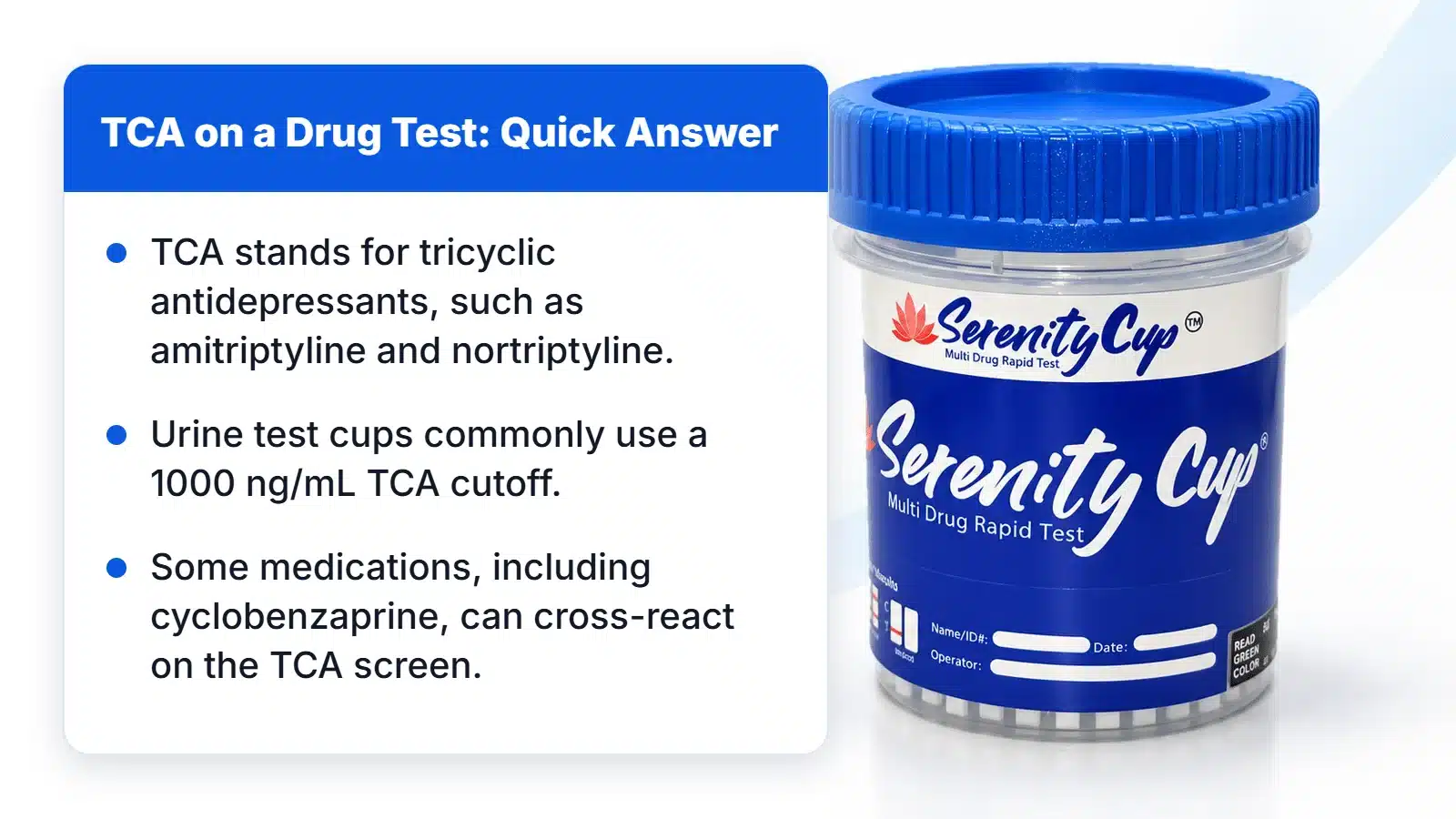
Most rapid urine test cups and dip cards use a TCA cutoff of 1000 ng/mL, usually calibrated to nortriptyline. The cutoff is the concentration at which the test is designed to show a non-negative result. Specimens below the cutoff read negative, even if a small amount of medication is present.
Cutoffs can vary by manufacturer and product, so always check the label and insert for the exact TCA cutoff on the device you use. Our guide to drug test cutoff levels explains how cutoffs work in general.
How Long Do Tricyclic Antidepressants Stay Detectable?
Tricyclic antidepressants generally have long half-lives compared with many other drugs, and they are often taken daily. As a result, they may remain detectable in urine for several days after the last dose, and longer in people who take them regularly. Detection time depends on the specific medication, the dose, how long it has been taken, liver metabolism and the test cutoff.
Because TCAs are usually prescribed for ongoing treatment, a TCA result in a monitored patient is often expected rather than unexpected. The question in clinical settings is usually whether the result matches the prescription.
What Can Cause a False Positive TCA Result?
The TCA immunoassay reacts to a chemical shape, so medications with similar structures can sometimes trigger a non-negative screen. Commonly reported cross-reactants include:
- Cyclobenzaprine (Flexeril): A muscle relaxant with a structure very close to amitriptyline and one of the best-known causes of TCA cross-reactivity.
- Carbamazepine: An anticonvulsant with a tricyclic-like structure.
- Quetiapine: An antipsychotic that has been reported to cross-react on some TCA immunoassays.
- Cyproheptadine and high-dose diphenhydramine: Antihistamines reported in some cases, typically at high concentrations.
Cross-reactivity differs between assays, and the product insert lists the compounds tested by the manufacturer. A non-negative TCA screen should be confirmed by a laboratory method such as LC-MS/MS, which identifies the specific drug present. For more on this topic, read what can cause a false positive drug test.
Why Do Drug Tests Include a TCA Panel?
TCAs are not drugs of abuse in the way opioids or stimulants are, so people are often surprised to see them on a test cup. There are several practical reasons the panel is included.
Overdose risk
Tricyclic antidepressants can be dangerous in overdose because they affect heart rhythm and blood pressure. Emergency departments often screen for TCAs when a patient arrives with an unknown ingestion.
Medication monitoring
Pain management and behavioral health programs use TCA panels to confirm that patients are taking prescribed medications as directed, and to detect TCAs that were not prescribed.
Misuse and diversion
Some TCAs are misused for their sedating effects or in combination with other substances. A TCA panel helps programs identify unexpected use.
Who Uses Drug Tests With a TCA Panel?
- Pain management clinics monitoring prescribed medication
- Behavioral health and psychiatric programs
- Addiction treatment and recovery programs
- Emergency and urgent care settings screening for ingestion
- Some probation and drug court programs that use expanded panels
Most standard workplace programs do not require a TCA panel, but some employers choose 12 or 14 panel cups that include it for broader coverage.
How to Read a TCA Result on a Test Cup
Rapid TCA strips work the same way as other panels on a lateral-flow test. After the urine sample is applied and the read time has passed, look at the TCA window:
- Two lines (C and T): Negative. Any visible test line, even a faint one, counts as a line.
- Control line only (C): Preliminary non-negative for TCA; send for confirmation.
- No control line: Invalid; retest with a new device.
Always read results within the time stated in the instructions. Our guide on how to read a drug test cup walks through the process step by step.
Does a TCA Panel Detect Other Antidepressants?
No. The TCA panel is specific to the tricyclic structure. Most modern antidepressants belong to different classes and are not detected by a TCA strip. These include selective serotonin reuptake inhibitors (SSRIs) such as sertraline, fluoxetine and escitalopram; serotonin-norepinephrine reuptake inhibitors (SNRIs) such as duloxetine and venlafaxine; and atypical antidepressants such as bupropion and mirtazapine.
Standard drug test panels do not screen for SSRIs or SNRIs at all. A few of these medications have been reported to cause cross-reactivity on other panels in rare cases, such as sertraline on some benzodiazepine screens or bupropion on some amphetamine screens, which is another reason confirmation testing matters.
TCA Testing in Pain Management
Low-dose amitriptyline and nortriptyline are commonly prescribed for nerve pain, fibromyalgia and chronic headache. In pain management, urine drug monitoring is used to check adherence to the treatment plan. A TCA result in a patient who has a documented TCA prescription is consistent with treatment. A TCA result in a patient with no prescription, or a negative result in a patient who should be taking the medication, prompts a conversation and often a confirmatory test.
Because low therapeutic doses may produce urine concentrations near or below the 1000 ng/mL screening cutoff, a negative screen does not always mean the medication was not taken. Laboratory testing with a lower cutoff is more sensitive when adherence must be documented. Our pain management urine drug testing guide covers how clinics choose panels for monitoring.
What Happens After a Non-Negative TCA Screen?
- Review the prescription history. Many TCA results are explained by a valid prescription.
- Check for known cross-reactants. Ask about cyclobenzaprine, carbamazepine, quetiapine and similar medications.
- Send for laboratory confirmation. LC-MS/MS identifies which tricyclic, if any, is present and at what concentration.
- Document the outcome. Record the confirmed result and how it was interpreted under your program’s policy.
Rapid TCA Screen vs Laboratory Testing
| Feature | Rapid TCA Screen | Laboratory Confirmation |
|---|---|---|
| Result time | Minutes | Usually one to several days |
| What it identifies | The TCA drug class | The specific medication and concentration |
| Typical cutoff | 1000 ng/mL | Lower, set by the laboratory |
| Cross-reactivity | Possible with similar structures | Distinguishes TCAs from look-alike drugs |
| Best use | On-site screening | Confirming non-negative or disputed results |
Choosing a Test Cup With a TCA Panel
TCA appears on many expanded configurations. Compare options in our 12 panel drug test cups and 14 panel drug test cups categories, and check the exact panel list and cutoffs on each product page before ordering. Programs that only need to screen for tricyclic antidepressants can use our TCA drug test strips.
Key Takeaway
TCA on a drug test means tricyclic antidepressants, a class of prescription medications that includes amitriptyline, nortriptyline and imipramine. Rapid cups commonly screen at 1000 ng/mL, and structurally similar medications such as cyclobenzaprine can cross-react. A TCA screen is preliminary, so non-negative results should be reviewed against prescriptions and confirmed by a laboratory.
This article is for general educational purposes and is not medical or legal advice.
Frequently Asked Questions
What does TCA mean on a drug test?
TCA stands for tricyclic antidepressants, a class of prescription medications that includes amitriptyline, nortriptyline, imipramine, desipramine and doxepin.
What is the cutoff for TCA on a drug test?
Most rapid urine test cups use a TCA cutoff of 1000 ng/mL, usually calibrated to nortriptyline. Always check the product label for the exact cutoff.
Can Flexeril cause a positive TCA test?
Yes. Cyclobenzaprine (Flexeril) has a structure very similar to amitriptyline and is a well-known cause of TCA cross-reactivity on screening tests.
How long do tricyclic antidepressants stay in urine?
TCAs may remain detectable for several days after the last dose, and longer with regular use, depending on the drug, dose and test cutoff.
Is TCA included in a standard workplace drug test?
No. Standard 5 panel workplace tests do not include TCA. It appears on some expanded 10, 12 and 14 panel configurations.
IN THIS ARTICLE