

What Is MDMA on a Drug Test? Meaning, Cutoff and Detection Times

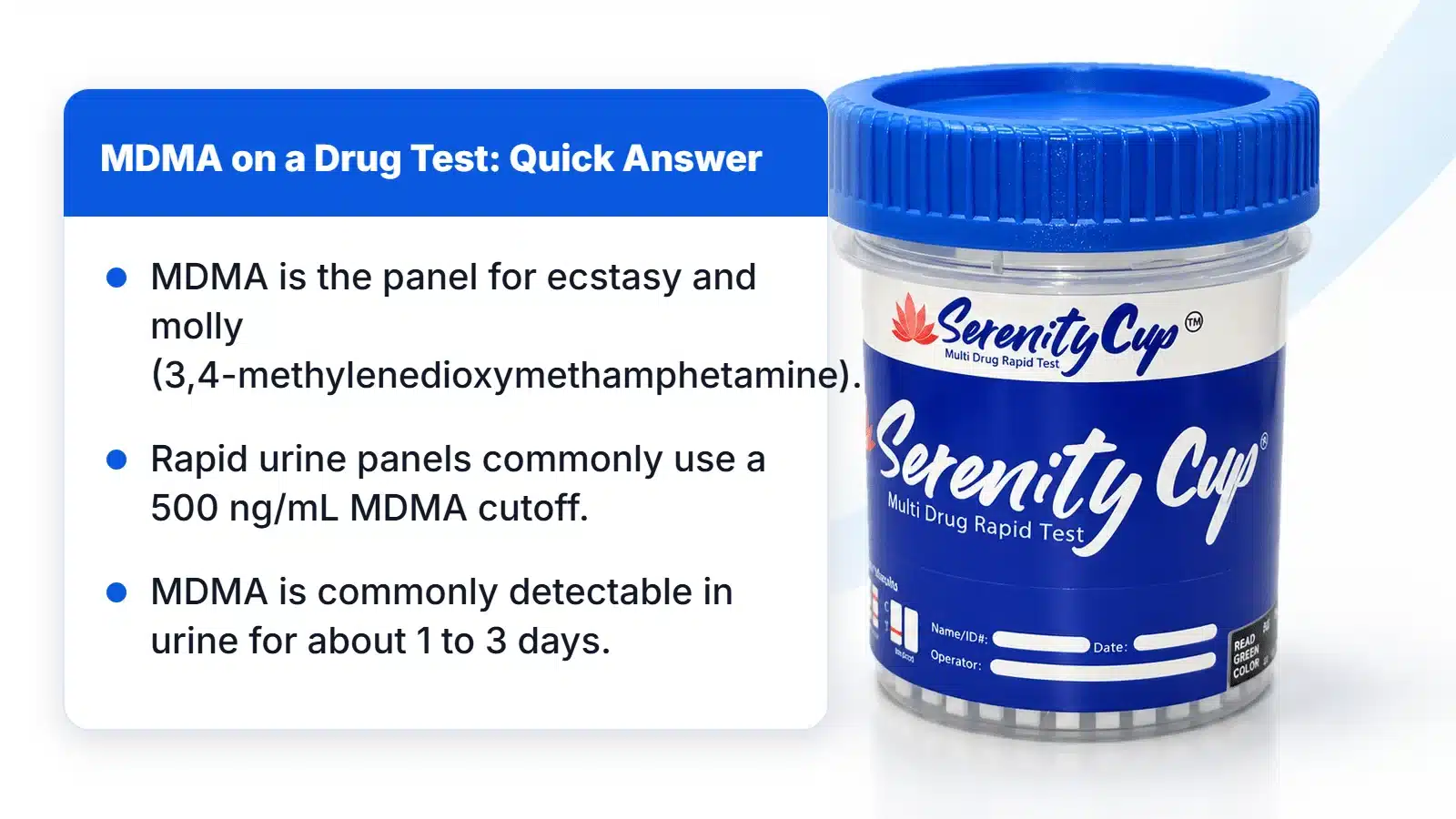
What is MDMA on a drug test? MDMA on a drug test refers to the panel that screens for 3,4-methylenedioxymethamphetamine, the drug commonly known as ecstasy or molly. On rapid test cups and dip cards, the MDMA panel is sometimes labeled MDMA or XTC. It detects MDMA and, to varying degrees, related compounds such as MDA.
MDMA appears on many 10, 12 and larger panel configurations. This guide explains what the MDMA panel detects, the common cutoff, how long MDMA stays in your system, how it relates to amphetamine panels and how to read and confirm a result.
What Is MDMA?
MDMA is a synthetic drug with stimulant and mild hallucinogenic effects. It is a Schedule I controlled substance in the United States. It is sold as tablets (ecstasy) or as powder or crystals in capsules (molly). MDMA increases the release of serotonin, dopamine and norepinephrine, producing feelings of energy, emotional closeness and altered perception.
Street MDMA is frequently adulterated or substituted. Products sold as molly may contain synthetic cathinones, methamphetamine, caffeine or other substances, which can change both the effects and the drug test results.
What Does the MDMA Panel Detect?
The MDMA panel uses an immunoassay designed to recognize MDMA. Many MDMA assays also react to MDA (3,4-methylenedioxyamphetamine), which is both a metabolite of MDMA and a drug in its own right, and sometimes to MDEA. Cross-reactivity varies by manufacturer, so the product insert lists the compounds tested and the concentrations at which they produce a non-negative result.
The MDMA panel is one of many standard drug test abbreviations. See our complete guide to drug test abbreviations.
What Is the MDMA Cutoff Level?
Most rapid urine MDMA panels use a cutoff of 500 ng/mL. This matches the initial testing cutoff for MDMA in federal workplace testing, where laboratories confirm MDMA at a lower concentration. Some products use different cutoffs, so always check the label. Oral fluid devices use much lower cutoffs because drug concentrations in saliva are lower. Our guide to drug test cutoff levels explains how cutoffs are set.
How Long Does MDMA Stay in Urine?
MDMA is commonly detectable in urine for about 1 to 3 days after use, and occasionally up to about 4 days after heavy use. Its half-life is roughly 8 to 9 hours, though this varies between people and with dose.
| Specimen | Commonly Cited Detection Window |
|---|---|
| Urine | About 1–3 days; up to about 4 days with heavy use |
| Saliva | About 1–2 days |
| Blood | About 1–2 days |
| Hair | Up to about 90 days |
Detection depends on the amount taken, frequency of use, metabolism, hydration, urine pH and the test cutoff. MDMA is excreted faster in acidic urine.
Does MDMA Show Up on an Amphetamine Test?
MDMA is chemically related to amphetamine and methamphetamine, but many amphetamine (AMP) and methamphetamine (MET) panels react only weakly to MDMA. A person who used MDMA may test negative on the AMP panel and positive on a dedicated MDMA panel. In federal workplace testing, MDMA is screened as part of the amphetamines drug class with its own specific cutoff. On rapid cups, a separate MDMA panel is the most reliable way to screen for ecstasy or molly.
Learn more about amphetamine panels in our article on what AMP means on a drug test.
What Can Cause a False Positive MDMA Result?
MDMA immunoassays can occasionally cross-react with other substances. Reported examples on some assays include certain amphetamine-related compounds and medications with similar structures. Cross-reactivity is product-specific, so the insert is the best reference. A non-negative MDMA screen should always be confirmed by GC-MS or LC-MS/MS, which identifies MDMA, MDA and related compounds specifically. For more, see what can cause a false positive drug test.
How MDMA Is Processed in the Body
After use, MDMA is absorbed into the bloodstream and broken down in the liver, mainly by the CYP2D6 enzyme. A portion is converted to MDA, which is also psychoactive, and to other metabolites that are eventually excreted in urine. A significant share of MDMA leaves the body unchanged. Because MDMA can slow its own metabolism at higher doses, repeated doses in a short period can lead to disproportionately high blood levels, which is one reason “redosing” is dangerous.
Factors That Affect MDMA Detection
- Dose and redosing: Larger or repeated doses raise concentrations and extend detection.
- Frequency of use: Use on consecutive days can lengthen the window.
- Urine pH: Acidic urine speeds excretion; alkaline urine slows it.
- Metabolism: Genetic differences in CYP2D6 activity affect how fast MDMA is cleared.
- Hydration: Dilute urine can lower concentrations below the cutoff, but dilute specimens may be flagged.
- Purity: Adulterated products may contain little MDMA, or none, and other drugs instead.
MDMA vs MDA vs Methamphetamine
| Compound | Relationship | Typical Panel |
|---|---|---|
| MDMA | Parent drug (ecstasy, molly) | MDMA / XTC |
| MDA | MDMA metabolite and a separate drug | Often detected by MDMA panels |
| Methamphetamine | Related stimulant | MET / mAMP |
| Amphetamine | Related stimulant | AMP |
Who Tests for MDMA?
- Addiction treatment programs monitoring club and party drug use
- Probation, parole and drug court programs
- Schools and youth programs with expanded panels
- Employers that choose 10 or 12 panel tests
- Emergency departments evaluating patients with stimulant toxicity
- Event and festival safety and harm-reduction programs
MDMA Testing Options
MDMA is included on many multi-panel configurations. Examples include our 12 panel dip card with MDMA and several cups in the 10 panel drug test cups and 12 panel drug test cups categories. Check each product’s panel list for MDMA, because not every 10 or 12 panel configuration includes it.
How to Read an MDMA Test Result
- Wait for the read time listed in the instructions, usually 5 minutes.
- Confirm that a control line is visible in the MDMA window.
- A visible test line, even a faint one, means negative.
- No test line means a preliminary non-negative result.
- No control line means the test is invalid and should be repeated.
See our guide on how to read a drug test cup for more detail.
MDMA Risks Programs Should Understand
MDMA can cause dangerous overheating, dehydration or overhydration, high blood pressure, irregular heart rhythms and serotonin toxicity, particularly when taken in hot, crowded environments or combined with other drugs or certain antidepressants. Because street MDMA is often adulterated, a person who believes they took molly may actually have been exposed to other stimulants or to fentanyl. Programs that see this pattern may add fentanyl and synthetic cathinone testing.
MDMA in Oral Fluid Testing
Oral fluid tests can detect MDMA shortly after use, often within minutes to hours, and typically for about one to two days. Because saliva collection is observed, it is useful for event-related and post-incident testing where recent use is the question. Not every saliva device includes MDMA, so check the panel list. Browse our oral fluid drug tests to compare configurations.
Prescription Medications and MDMA Results
MDMA has been studied in clinical research settings, but outside of approved research it is not a prescribed medication, so a confirmed MDMA result is generally not explained by a prescription. Donors should still be given the chance to report any medications, because some medications can cross-react on screening tests and laboratory confirmation will clarify the result.
Does a Positive MDMA Test Mean Impairment?
No. A urine MDMA result shows that MDMA or a related compound was used within the detection window, not that the person is currently under its influence. The effects of MDMA usually last a few hours, while urine detection lasts days. Impairment decisions should rely on observed behavior and documented signs.
Policy Tips for Programs Adding MDMA
Programs adding MDMA screening should update their written policy to list the panel, confirm that their laboratory can confirm MDMA and MDA, and train collectors to recognize when a specimen should be forwarded. Keeping the same configuration across sites makes results easier to compare over time.
Key Takeaway
MDMA on a drug test is the panel for ecstasy and molly. Rapid urine panels commonly use a 500 ng/mL cutoff, and MDMA is usually detectable in urine for about 1 to 3 days. Amphetamine panels may not reliably detect MDMA, so a dedicated MDMA panel is the best screening option. Non-negative results are preliminary and should be confirmed by a laboratory.
This article is for general educational purposes and is not medical or legal advice.
Frequently Asked Questions
What does MDMA mean on a drug test?
MDMA stands for 3,4-methylenedioxymethamphetamine, the drug known as ecstasy or molly. The MDMA panel screens for this drug and often for related compounds such as MDA.
What is the cutoff for MDMA on a drug test?
Most rapid urine MDMA panels use a 500 ng/mL cutoff. Check the product label for the exact value.
How long does MDMA stay in urine?
MDMA is commonly detectable in urine for about 1 to 3 days, and up to about 4 days after heavy use.
Will MDMA show up as amphetamine on a drug test?
Not reliably. Many amphetamine panels react only weakly to MDMA, so a dedicated MDMA panel is the best way to screen for it.
Is MDMA included in a standard 5 panel test?
Rapid 5 panel cups usually do not include a separate MDMA panel. In federal laboratory testing, MDMA is screened within the amphetamines class.
IN THIS ARTICLE