


How Long Does Xanax Stay in Urine? Alprazolam Drug Test Guide

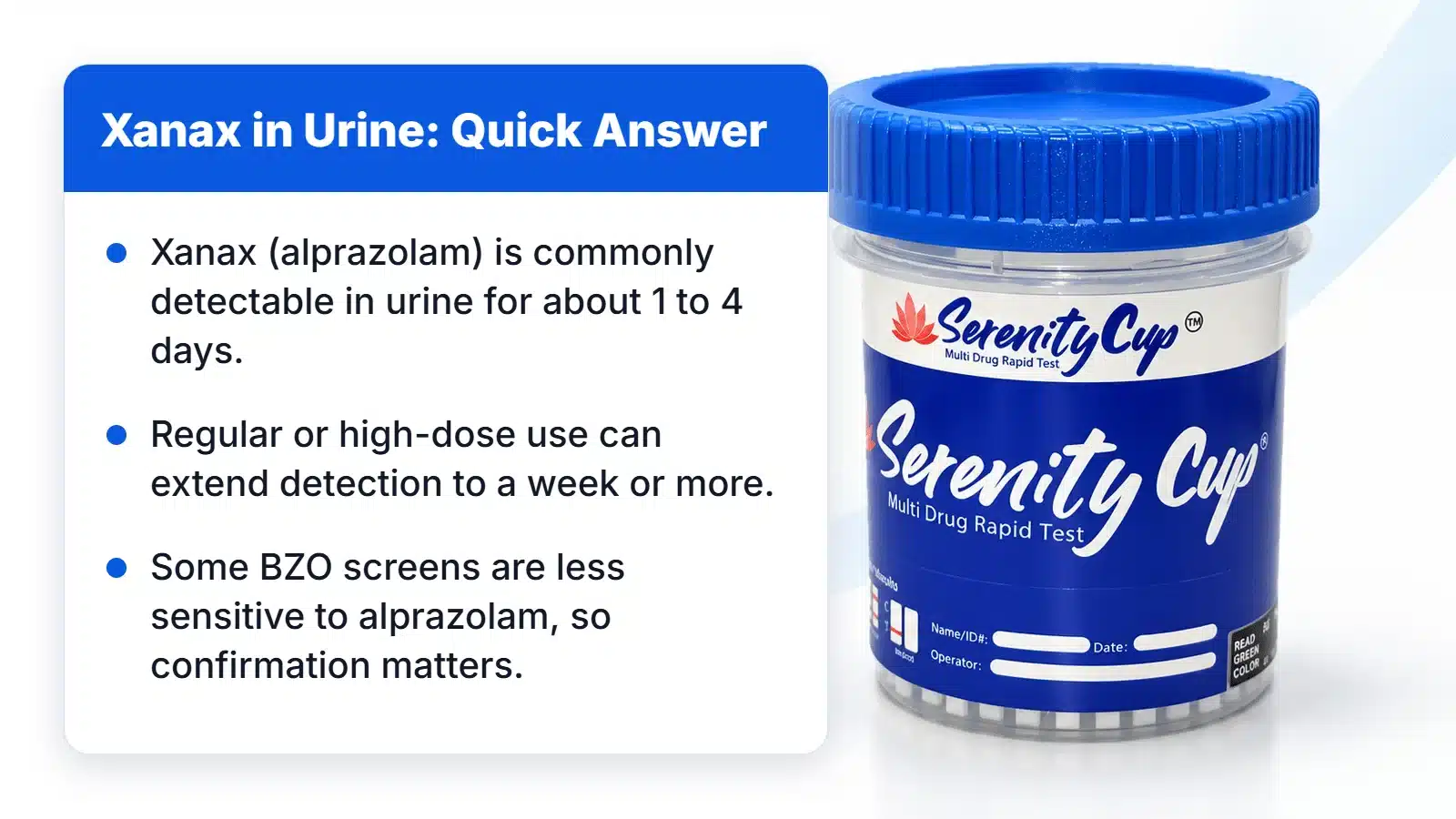
How long does Xanax stay in urine? Xanax (alprazolam) is commonly detectable in urine for about 1 to 4 days after occasional use. With regular or high-dose use, detection can extend to a week or longer. Alprazolam is a short-to-intermediate-acting benzodiazepine, so it clears faster than long-acting benzodiazepines such as diazepam.
There is an important testing detail that many people do not know: some rapid benzodiazepine (BZO) screens are less sensitive to alprazolam’s metabolites than to other benzodiazepines. This guide covers detection times by specimen, how Xanax is processed, why screening results can vary and how to read and confirm a result.
What Is Xanax?
Xanax is the brand name for alprazolam, a benzodiazepine prescribed for anxiety disorders and panic disorder. It works by enhancing the calming effect of GABA in the brain. Alprazolam is a Schedule IV controlled substance because it can cause dependence and is commonly misused. Counterfeit pills sold as Xanax are also a serious concern, because some contain other drugs, including fentanyl or novel benzodiazepines.
How the Body Processes Xanax
Alprazolam is absorbed quickly and broken down in the liver, mainly by the CYP3A4 enzyme, into metabolites including alpha-hydroxyalprazolam. These metabolites are excreted in urine. Alprazolam’s average half-life in healthy adults is about 11 hours, with a wide range between individuals. It takes roughly four to five half-lives for a drug to be mostly eliminated, which helps explain the typical urine detection window.
Xanax Detection Times by Test Type
| Specimen | Commonly Cited Detection Window | Notes |
|---|---|---|
| Urine | About 1–4 days; a week or more with regular use | Most common specimen for screening and monitoring |
| Saliva | About 1–2.5 days | Reflects recent use; benzodiazepine panels available on some swab devices |
| Blood | Up to about 1 day | Used mainly in clinical and forensic settings |
| Hair | Up to about 90 days | Shows a longer pattern of use |
These ranges are general estimates. The actual detection time for any individual depends on the factors described below.
How Long Does 1 mg of Xanax Stay in Urine?
A single 1 mg dose of Xanax in an occasional user is commonly detectable for about 1 to 4 days in urine, depending on the test’s cutoff and sensitivity to alprazolam metabolites. Smaller doses, such as 0.25 mg or 0.5 mg, may fall below the cutoff of a rapid screen sooner. Larger or repeated doses increase the amount of metabolite in urine and extend the window. There is no exact number that applies to everyone.
Does Xanax Show Up on a Drug Test?
Xanax can show up on any drug test that includes a benzodiazepine (BZO) panel. Standard 5 panel workplace tests and DOT tests do not include benzodiazepines. Most 9, 10, 12 and larger panel configurations do. See our guide on what BZO means on a drug test to understand how the panel works.
Why a BZO screen may miss Xanax
Benzodiazepines are a large class of drugs, and a BZO immunoassay does not detect each one equally. Many rapid BZO tests are calibrated to oxazepam at 300 ng/mL. Some of these assays react less strongly to alprazolam’s metabolites, especially at low therapeutic doses. As a result, a person taking prescribed Xanax may sometimes screen negative. Other benzodiazepines, such as clonazepam and lorazepam, are also known to be detected less reliably by some screening assays.
Programs that need to monitor alprazolam use, such as pain management and treatment programs, often rely on laboratory testing by LC-MS/MS, which measures alprazolam and alpha-hydroxyalprazolam directly at lower cutoffs.
Factors That Affect How Long Xanax Stays in Your System
- Dose: Higher doses produce more metabolite and longer detection.
- Frequency and duration of use: Daily use leads to accumulation and a longer window.
- Age: Older adults often clear alprazolam more slowly.
- Liver function: Reduced liver function slows metabolism.
- Body composition: Alprazolam is fat-soluble, and body composition can affect clearance.
- Other medications: Drugs that block CYP3A4, such as certain antifungals and antibiotics, can raise alprazolam levels and slow clearance.
- Extended-release formulations: Xanax XR releases the drug over a longer period.
- Test cutoff and method: Laboratory methods detect smaller amounts for longer than rapid screens.
Prescribed Xanax and Drug Testing
If you take Xanax as prescribed, you should not stop it suddenly before a drug test. Benzodiazepine withdrawal can be dangerous and should only be managed with medical supervision. Instead, keep your prescription information available and report your medications if asked. In regulated programs, a Medical Review Officer verifies valid prescriptions before reporting a confirmed result to the employer.
In non-DOT workplace programs, employers should follow their written policy, which commonly allows donors to provide prescription information after a non-negative result.
Xanax Compared With Other Benzodiazepines
| Benzodiazepine | Duration | Commonly Cited Urine Window |
|---|---|---|
| Alprazolam (Xanax) | Short to intermediate | About 1–4 days |
| Lorazepam (Ativan) | Intermediate | About 1–6 days |
| Clonazepam (Klonopin) | Long | About 5–10 days or longer |
| Diazepam (Valium) | Long, with active metabolites | About 5–10 days; weeks with heavy use |
Counterfeit Xanax and Testing
Pills sold illegally as Xanax are frequently counterfeit. Some contain no alprazolam at all and instead contain fentanyl, other opioids or novel benzodiazepines such as bromazolam. These substances may not be detected by a standard BZO screen, and fentanyl requires its own panel. Treatment and harm-reduction programs that see counterfeit pill use often add fentanyl testing. Learn more in our article on whether fentanyl shows up on a drug test.
Reading and Confirming a Xanax Screen
On a rapid test, a visible line in the BZO window means negative, and no line means a preliminary non-negative. Because of differences in assay sensitivity and the possibility of cross-reactivity, non-negative benzodiazepine screens should be confirmed by a laboratory. Some medications, such as sertraline, have been reported to cause cross-reactivity on certain BZO assays. See our guide on how to read a drug test cup for reading tips.
Xanax Effects vs Detection Time
The calming effects of immediate-release Xanax usually begin within an hour and last several hours. Detection lasts much longer than the effects. A person may feel completely normal while alprazolam metabolites are still present in urine. A positive urine result therefore shows use within the detection window, not current impairment. Blood and saliva results are closer indicators of recent use.
Xanax in Pain Management and Treatment Monitoring
Combining benzodiazepines with opioids increases the risk of dangerous sedation and slowed breathing. For this reason, pain management clinics and opioid treatment programs closely monitor benzodiazepine use. Many programs use rapid cups for routine screening and send specimens to a laboratory when they need to confirm whether a prescribed benzodiazepine is being taken or whether an unprescribed one is present. Our pain management urine drug testing guide explains how clinics choose panels.
Can You Speed Up Xanax Clearance?
No method reliably speeds up how fast the liver processes alprazolam. Drinking large amounts of water may dilute urine, but dilute specimens are flagged by validity checks and often lead to recollection. Products marketed to “flush” drugs are not a reliable or safe solution. The safest approach is to take medication only as prescribed and report it when tested.
Testing Options for Benzodiazepines
Most multi-panel test cups include a BZO panel. Compare options in our 10 panel drug test cups and 12 panel drug test cups categories, and check the BZO cutoff and calibrator listed for each product.
Xanax XR vs Immediate-Release Xanax
Extended-release alprazolam (Xanax XR) is designed to release the medication gradually over the day. Although the drug itself is the same, the longer release can keep blood levels steady for longer and may extend the period during which metabolites are present in urine, particularly with daily use. Detection windows for XR users therefore tend to sit toward the longer end of the typical range.
Key Takeaway
Xanax is commonly detectable in urine for about 1 to 4 days, and longer with regular use. It appears on tests that include a BZO panel, but some rapid screens are less sensitive to alprazolam’s metabolites, so negative results in prescribed users are possible and non-negative screens should be confirmed. Never stop prescribed Xanax suddenly before a test; keep your prescription information available instead.
This article is for general educational purposes and is not medical or legal advice.
Frequently Asked Questions
How long does Xanax stay in urine?
Xanax is commonly detectable in urine for about 1 to 4 days after occasional use, and for a week or more with regular or high-dose use.
Does Xanax show up on a drug test?
Xanax shows up on tests that include a benzodiazepine (BZO) panel. Standard 5 panel and DOT tests do not include benzodiazepines.
Why did my Xanax not show up on a drug test?
Some rapid BZO screens are less sensitive to alprazolam metabolites, especially at low doses. Laboratory tests measure alprazolam more reliably.
How long does 1 mg of Xanax stay in your system?
A single 1 mg dose is commonly detectable in urine for about 1 to 4 days, depending on the test and individual factors.
Should I stop taking Xanax before a drug test?
No. Stopping a benzodiazepine suddenly can be dangerous. Keep your prescription information available and report it if asked.
IN THIS ARTICLE