



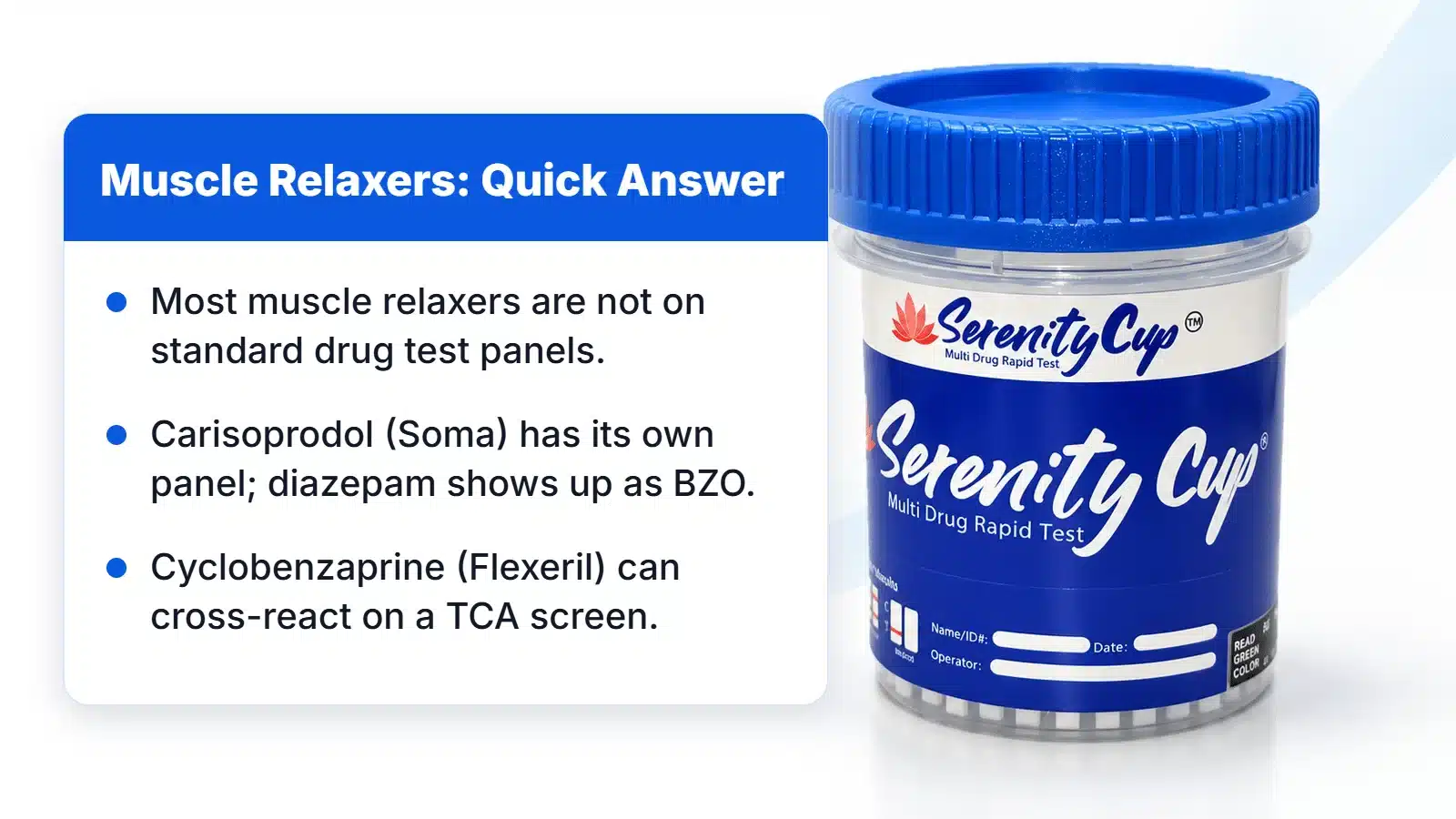
Will a muscle relaxer show up in a drug test? Most muscle relaxers do not show up on a standard drug test, because they are not included in common 5, 10 or 12 panel configurations. There are important exceptions. Carisoprodol (Soma) can be detected with a dedicated panel, diazepam is detected as a benzodiazepine, and cyclobenzaprine (Flexeril) can cause a non-negative result on a tricyclic antidepressant (TCA) screen.
This guide explains which muscle relaxers are detected, which can cause cross-reactivity, how long common muscle relaxers stay in your system and what to do if you take one before a drug test.
Do Standard Drug Tests Look for Muscle Relaxers?
A standard workplace drug test focuses on drugs with high misuse potential: marijuana, cocaine, amphetamines, opiates and PCP. Expanded panels add benzodiazepines, barbiturates, methadone, oxycodone and other substances. Most prescription muscle relaxers are not part of these panels, so they are not specifically detected.
However, a few muscle relaxers are either tested for directly or share chemical features with drugs that are on common panels. Those are the cases that matter.
What Muscle Relaxers Show Up on a Drug Test?
| Muscle Relaxer | Brand Name | Shows Up on Standard Panels? |
|---|---|---|
| Carisoprodol | Soma | Only with a carisoprodol panel or lab test; it is a Schedule IV controlled substance |
| Diazepam | Valium | Yes, as a benzodiazepine on the BZO panel |
| Cyclobenzaprine | Flexeril, Amrix | Not tested directly, but can cross-react on the TCA panel |
| Methocarbamol | Robaxin | No |
| Tizanidine | Zanaflex | No |
| Metaxalone | Skelaxin | No |
| Baclofen | Lioresal | No |
| Orphenadrine | Norflex | Not tested directly; cross-reactivity has been reported on some assays |
Carisoprodol (Soma)
Carisoprodol is the muscle relaxer most often included in drug testing. It is a Schedule IV controlled substance because of its misuse potential, and the body converts it to meprobamate, a sedative. Some expanded test cups and pain management panels include a carisoprodol panel, and laboratories can test for carisoprodol and meprobamate directly.
Diazepam (Valium)
Diazepam is a benzodiazepine that is sometimes prescribed for muscle spasms. Because it is a benzodiazepine, it is detected by the BZO panel on many multi-panel tests. Its long-lasting metabolites can remain detectable for days to weeks with regular use. See what BZO means on a drug test.
Cyclobenzaprine (Flexeril)
Cyclobenzaprine is not a drug of abuse that tests target, but its chemical structure is very similar to the tricyclic antidepressant amitriptyline. As a result, it is a well-known cause of non-negative results on TCA screening panels. Laboratory confirmation can distinguish cyclobenzaprine from true TCAs. Read more in what TCA means on a drug test.
How Long Do Muscle Relaxers Stay in Your System?
Detection time depends on the medication’s half-life, the dose, how long it has been taken and the test method. The estimates below describe typical urine detection in laboratory testing, which uses more sensitive methods than rapid cups.
| Muscle Relaxer | Approximate Half-Life | Commonly Cited Urine Detection |
|---|---|---|
| Cyclobenzaprine | Long, often around 18 hours or more | Several days, longer with daily use |
| Carisoprodol (meprobamate) | Carisoprodol about 2 hours; meprobamate about 10 hours | About 1–3 days for meprobamate |
| Diazepam | Very long, with long-acting metabolites | Days to weeks with regular use |
| Methocarbamol | About 1–2 hours | Usually about 1–2 days |
| Tizanidine | About 2–3 hours | Usually about 1–2 days |
| Baclofen | About 3–4 hours | Usually about 1–2 days |
These are general estimates. Age, liver and kidney function, other medications and individual metabolism can all change how long a muscle relaxer stays in your system.
Can Muscle Relaxers Cause a False Positive?
Yes, in some situations. Immunoassay screening strips react to chemical structures, so a medication that resembles a target drug can produce a non-negative screen.
- Cyclobenzaprine: Can trigger the TCA panel because of its tricyclic-like structure.
- Orphenadrine: Has been reported to cross-react on some methadone and PCP immunoassays.
- Diazepam: Not a false positive, because it is a true benzodiazepine, but it can surprise donors who think of it only as a muscle relaxer.
A laboratory confirmation test identifies the actual compound and resolves these situations. See what can cause a false positive drug test for more examples.
Taking a Prescribed Muscle Relaxer Before a Drug Test
If you take a prescribed muscle relaxer, you do not need to stop it before a drug test unless your doctor tells you to. Instead:
- Tell the collector or program about your current medications if you are given the opportunity.
- Keep your prescription information available.
- If a screen is non-negative, ask about the confirmation process.
- In regulated programs, a Medical Review Officer will contact you to verify a valid prescription before reporting a confirmed result.
Never stop or change a prescribed medication without medical advice. Stopping some medications suddenly, including carisoprodol, baclofen and diazepam, can cause withdrawal symptoms.
Muscle Relaxers and Workplace Safety
Many muscle relaxers cause drowsiness, dizziness and slowed reaction time, especially when they are first started or combined with alcohol or other sedatives. Employers with safety-sensitive roles often focus on fitness for duty rather than on detecting the medication itself. A clear policy that asks employees to report medications that may affect safety is often more useful than adding a muscle relaxer panel.
Muscle Relaxers in Different Specimen Types
| Specimen | How Muscle Relaxers Are Detected |
|---|---|
| Urine | Most common; carisoprodol, meprobamate and diazepam metabolites can be detected with the right panel or lab test |
| Oral fluid | Short window reflecting recent use; specific muscle relaxers are rarely included on saliva devices |
| Blood | Used in clinical, overdose and impaired-driving investigations to measure current levels |
| Hair | Specialized laboratory testing that can show use over weeks to months |
Combining Muscle Relaxers With Alcohol, Opioids or Benzodiazepines
Muscle relaxers add to the sedating effects of alcohol, opioids and benzodiazepines. Combining them increases the risk of excessive drowsiness, impaired coordination and, in serious cases, slowed breathing. Carisoprodol in particular has been misused in combination with opioids. This is one reason pain management programs monitor carisoprodol and benzodiazepines alongside opioid medications, and why a full panel review, rather than a single result, gives clinicians the clearest picture.
Muscle Relaxers Compared With Other Sedatives on Drug Tests
Unlike benzodiazepines and barbiturates, which have their own common panels, most muscle relaxers belong to unrelated chemical groups. That is why there is no single “muscle relaxer panel” that detects them all. A program that needs to monitor these medications must choose specific assays, such as carisoprodol, or use a laboratory panel that lists each medication by name. When reviewing any expanded panel, check the product insert to see exactly which compounds are detected and at what cutoff.
Testing for Muscle Relaxers When Needed
Pain management clinics, addiction treatment programs and some forensic settings may need to monitor carisoprodol or confirm muscle relaxer use. Options include expanded rapid panels that list carisoprodol, and laboratory panels that measure specific muscle relaxers and their metabolites. Programs that need TCA screening, which will also flag cyclobenzaprine for confirmation, can use TCA drug test strips or multi-panel cups from our 12 panel drug test cups category that include TCA.
Questions to Ask Before a Drug Test if You Take a Muscle Relaxer
- Which drugs and panels are included in the test I am taking?
- Is the test a rapid screen, a laboratory test or both?
- How can I report my current prescriptions?
- Will a Medical Review Officer review any confirmed results?
- Who can I contact if I have questions about my result?
Asking these questions helps you understand the process and avoid misunderstandings, especially if you take cyclobenzaprine, carisoprodol or diazepam.
Key Takeaway
Most muscle relaxers will not show up on a standard drug test. Carisoprodol can be detected with a dedicated panel, diazepam shows up as a benzodiazepine, and cyclobenzaprine can cross-react on a TCA screen. If you take a prescribed muscle relaxer, keep your prescription information available, and remember that a non-negative screen is preliminary until confirmed by a laboratory.
This article is for general educational purposes and is not medical or legal advice. Do not stop or change prescribed medication without talking to your doctor.
Frequently Asked Questions
Will a muscle relaxer show up in a drug test?
Most muscle relaxers are not included on standard drug test panels. Carisoprodol can be detected with a specific panel, diazepam shows up as a benzodiazepine, and cyclobenzaprine can cross-react on a TCA screen.
Does Flexeril show up on a drug test?
Flexeril (cyclobenzaprine) is not tested for directly, but it can cause a non-negative result on a tricyclic antidepressant (TCA) panel because of its similar structure.
Does Soma show up on a drug test?
Soma (carisoprodol) does not appear on standard panels, but it can be detected by expanded panels or laboratory tests that include carisoprodol or meprobamate.
How long do muscle relaxers stay in your system?
It depends on the medication. Methocarbamol and tizanidine usually clear within about 1 to 2 days, while cyclobenzaprine and diazepam can remain detectable for several days or longer.
Should I stop my muscle relaxer before a drug test?
No, not without medical advice. Keep your prescription information available and report your medications if asked.
IN THIS ARTICLE