


How Long Does Heroin Stay in Your System? Drug Test Detection Times

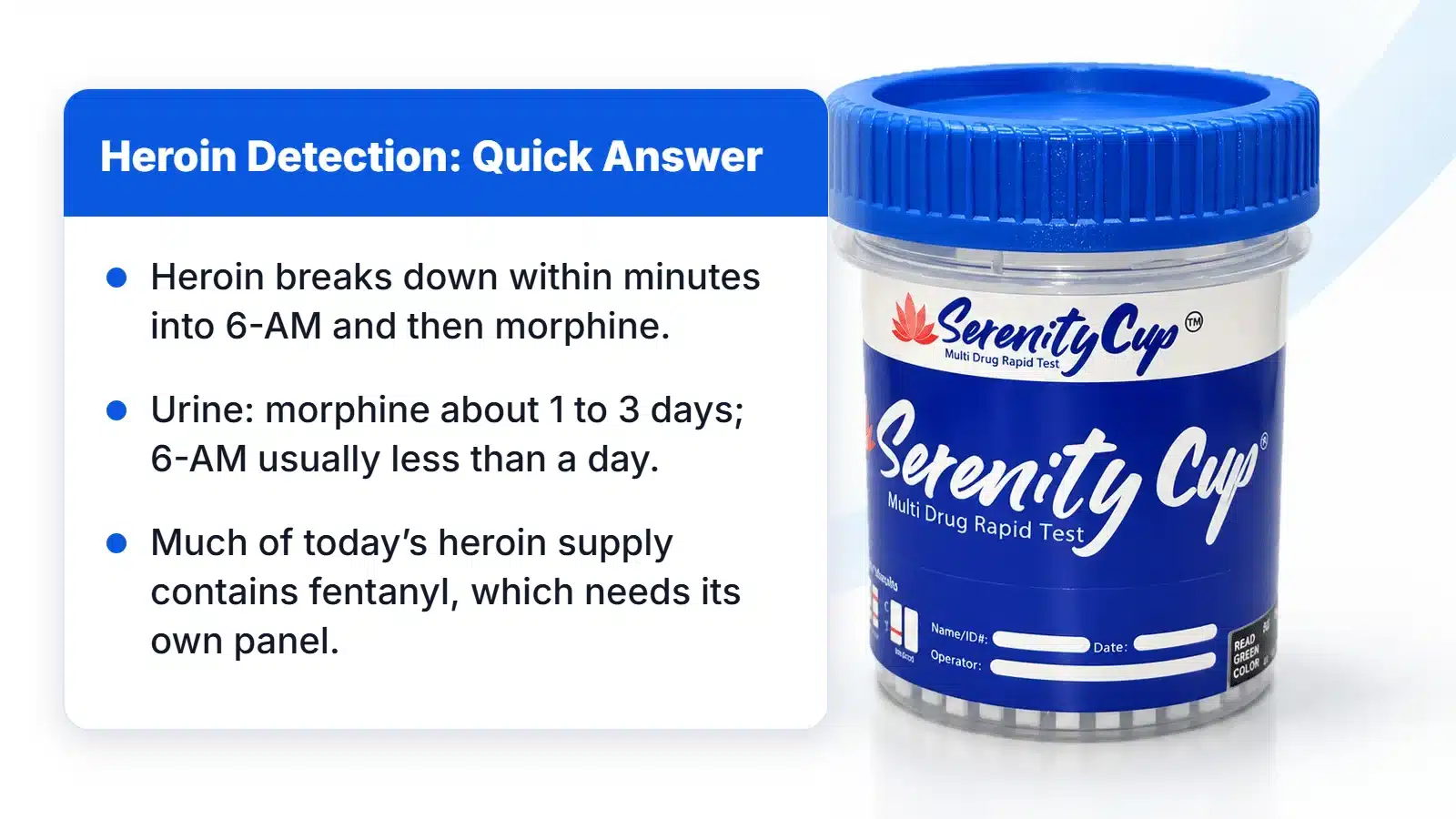
How long does heroin stay in your system? Heroin itself lasts only minutes in the body, but its metabolites can be detected much longer. In urine, morphine from heroin is commonly detectable for about 1 to 3 days after use, and longer after heavy or repeated use. The heroin-specific marker 6-acetylmorphine (6-AM) is usually detectable in urine for a much shorter time, often less than a day. Hair testing can show heroin use for about 90 days.
This guide explains how the body processes heroin, detection times by test type, how drug tests identify heroin specifically, why fentanyl testing has become essential and what affects results.
How the Body Processes Heroin
Heroin (diacetylmorphine) is a semi-synthetic opioid made from morphine. Once it enters the body, it is converted very quickly into 6-acetylmorphine (6-AM), and then into morphine. Heroin’s half-life in the blood is only a few minutes, and 6-AM’s is also short, while morphine remains in the body for longer.
This chain of metabolites is important for drug testing:
- Heroin: Rarely detected because it disappears so quickly.
- 6-AM: A short-lived marker that proves heroin use, because it is not produced by morphine, codeine or poppy seeds.
- Morphine: The main metabolite detected by opiate screens, but it can also come from morphine medication, codeine or poppy seeds.
Heroin Detection Times by Test Type
| Specimen | Commonly Cited Detection Window | Notes |
|---|---|---|
| Urine (morphine) | About 1–3 days; longer with heavy use | Most common specimen; detected by the OPI panel |
| Urine (6-AM) | Usually several hours, up to about 1 day | Confirms heroin specifically |
| Saliva | About 1–2 days | Reflects recent use |
| Blood | Up to about 6–12 hours for metabolites | Used in clinical and forensic settings |
| Hair | Up to about 90 days | Shows a longer history of use |
These ranges are estimates. Actual detection depends on dose, frequency, purity, the test cutoff and individual factors.
Does Heroin Show Up on a Drug Test?
Yes. Heroin use is detected by the opiate panel found on almost every drug test, including standard 5 panel workplace tests. The opiate panel, labeled OPI or MOP on rapid cups, reacts to morphine. Federal workplace testing also screens for 6-AM. On rapid cups, a non-negative opiate screen shows that morphine or a related opiate is present, but it does not identify heroin specifically. Laboratory confirmation identifies 6-AM when it is still present.
OPI 300 vs OPI 2000
Rapid opiate panels typically use either a 300 ng/mL or a 2000 ng/mL cutoff. The 300 ng/mL cutoff detects lower morphine levels and therefore a longer window, which is why it is preferred in treatment programs. The 2000 ng/mL cutoff aligns with federal workplace testing. See our guide on OPI 300 vs OPI 2000 for details, and learn more about the panel in what MOP means on a drug test.
Why 6-AM Matters
Because morphine can come from several legitimate sources, 6-AM is the strongest evidence of heroin use. Under federal workplace testing rules, a confirmed 6-AM result is verified as a heroin positive without the need for further clinical evidence. However, 6-AM clears quickly, so a negative 6-AM result does not rule out heroin use if morphine is present. In that case, the Medical Review Officer evaluates morphine levels, prescriptions and clinical evidence.
Heroin and Fentanyl
In much of the United States, the illicit opioid supply sold as heroin now contains fentanyl, and in many areas fentanyl has largely replaced heroin. This has major implications for drug testing. Fentanyl does not react on standard opiate (OPI) panels, so a person who uses “heroin” that is mostly fentanyl may test negative for opiates. A dedicated fentanyl panel is needed to detect it.
Programs that test for opioid use should include fentanyl screening. Learn more in our guides on whether fentanyl shows up on a drug test and fentanyl detection windows, or browse our fentanyl tests.
Factors That Affect How Long Heroin Stays in Your System
- Amount and purity: Higher doses and stronger products produce more morphine.
- Frequency of use: Regular use extends detection beyond the typical window.
- Route of use: Injection, smoking and snorting affect how quickly heroin is absorbed.
- Metabolism, liver and kidney function: These affect how quickly metabolites are cleared.
- Hydration: Dilute urine lowers concentrations but may be flagged as dilute.
- Test cutoff: Lower cutoffs extend the detection window.
Can Other Substances Cause a Positive Opiate Result?
Yes. Because the opiate screen detects morphine, other sources can produce a non-negative result:
- Prescribed morphine or codeine
- Poppy seed foods, especially at a 300 ng/mL cutoff
- Some antibiotics have been reported to cross-react on certain opiate screens
Laboratory confirmation and MRO review distinguish these from heroin use. Read our article on poppy seeds and drug tests for more.
Heroin Compared With Other Opioids on Drug Tests
| Opioid | Detected by OPI Panel? | Dedicated Panel |
|---|---|---|
| Heroin | Yes, as morphine | 6-AM (laboratory) |
| Morphine | Yes | OPI / MOP |
| Codeine | Yes | OPI / MOP |
| Oxycodone | Not reliably | OXY |
| Fentanyl | No | FEN / FYL |
| Methadone | No | MTD |
| Buprenorphine | No | BUP |
This is why programs that only use an opiate panel can miss many of the opioids in use today.
Heroin Effects vs Detection Time
The effects of heroin usually last a few hours, while morphine can be detected in urine for days. A positive urine result shows that opiate use occurred within the detection window; it does not show that the person is currently under the influence. Blood and saliva tests are closer indicators of recent use.
Opioid Treatment and Drug Test Results
People receiving methadone or buprenorphine treatment for opioid use disorder will test positive for those medications on their dedicated panels, which is expected and shows adherence. Neither medication is detected by the standard opiate panel. In treatment programs, a combination of OPI, fentanyl, methadone and buprenorphine panels helps clinicians see whether patients are taking prescribed medication and whether other opioids are being used.
Who Tests for Heroin?
Almost every drug testing program tests for opiates, which covers heroin’s main metabolite. This includes workplace programs, DOT testing, probation and parole, drug courts, addiction treatment, opioid treatment programs and emergency medicine. Treatment programs often use OPI 300 cups together with fentanyl and buprenorphine panels to monitor recovery.
Heroin Withdrawal and Safety
Stopping heroin after regular use leads to withdrawal, which can begin within hours and include severe discomfort, anxiety, muscle aches, vomiting and diarrhea. While opioid withdrawal is rarely life-threatening on its own, the risk of fatal overdose rises sharply if someone returns to use after a period of reduced tolerance, especially with fentanyl in the supply. Medications such as buprenorphine and methadone are effective treatments for opioid use disorder, and naloxone can reverse an opioid overdose.
If you or someone you know needs help, the SAMHSA National Helpline at 1-800-662-4357 provides free, confidential treatment referrals 24 hours a day.
Recognizing an Opioid Overdose
Signs of an opioid overdose include very small pupils, slow or stopped breathing, blue or gray lips and fingertips, gurgling sounds and unresponsiveness. Call 911 immediately, give naloxone if available and follow the dispatcher’s instructions. Fentanyl-related overdoses can happen very quickly and may require more than one dose of naloxone. Programs that serve people at risk of overdose often keep naloxone on site and train staff to use it.
Testing Options
For programs monitoring opioid use, multi-panel cups that combine OPI, fentanyl, buprenorphine, methadone and oxycodone panels give the most complete picture. Compare options in our 12 panel drug test cups and 13 to 16 panel drug test cups categories, and check the OPI cutoff on each product.
Can Heroin Be Detected After a Single Use?
Yes. A single use of heroin can usually be detected in urine as morphine for about one to two days, depending on the dose and test cutoff. The 6-AM marker may be detectable for only a few hours after a single use, which is why prompt collection matters when programs need to confirm heroin specifically.
Key Takeaway
Heroin is converted to 6-AM and morphine within minutes. Morphine is commonly detectable in urine for about 1 to 3 days, while 6-AM, the heroin-specific marker, usually clears within a day. Opiate screens detect heroin use but cannot distinguish it from other morphine sources, so confirmation matters. Because fentanyl is now common in the heroin supply, opioid testing programs should include a fentanyl panel.
This article is for general educational purposes and is not medical or legal advice.
Frequently Asked Questions
How long does heroin stay in your system?
Heroin breaks down within minutes, but its metabolite morphine is commonly detectable in urine for about 1 to 3 days. Hair can show use for about 90 days.
How long does heroin stay in urine?
Morphine from heroin is usually detectable in urine for about 1 to 3 days, longer with heavy use. The heroin-specific marker 6-AM usually clears within about a day.
Does heroin show up on a 5 panel drug test?
Yes. The opiate panel on a 5 panel test detects morphine, the main metabolite of heroin. Federal laboratory testing also screens for 6-AM.
What is 6-AM on a drug test?
6-AM (6-acetylmorphine) is a metabolite produced only from heroin. A confirmed 6-AM result indicates heroin use.
Will fentanyl show up on an opiate test?
No. Fentanyl does not react on standard opiate panels and requires a dedicated fentanyl test.
IN THIS ARTICLE