


Can poppy seeds make you fail a drug test? Yes, they can. Poppy seeds come from the opium poppy, and their surface can carry traces of morphine and codeine. Eating foods with poppy seeds, such as bagels, muffins or pastries, can produce enough opiate in urine to trigger a positive opiate screen, particularly on tests with a 300 ng/mL cutoff. This is one of the best-known causes of unexpected opiate results.
This guide explains why poppy seeds affect drug tests, how many poppy seeds it may take, how cutoffs change the risk, how long the effect lasts and how laboratories and Medical Review Officers distinguish poppy seeds from opioid use.
Why Poppy Seeds Contain Opiates
Poppy seeds are harvested from Papaver somniferum, the same plant that produces opium. The seeds themselves contain very little opiate, but during harvesting they can become coated with latex from the seed pod, which contains morphine and codeine. Commercial processing and washing reduce this residue, but the amount varies widely depending on the source, how the seeds were cleaned and how they are prepared.
Unwashed or minimally processed seeds can carry much higher levels of morphine than seeds sold for baking. This variability is why the same amount of poppy seeds can produce very different test results.
Do Poppy Seeds Show Up on a Drug Test?
Poppy seeds themselves are not detected. What a drug test detects is morphine and codeine that were on the seeds. The opiate (OPI) panel on a rapid test cup, also labeled MOP on some devices, reacts to morphine and related opiates. If enough morphine from poppy seeds reaches the urine, the result is a non-negative opiate screen, the same result that heroin, morphine or codeine use would produce.
Poppy seeds do not cause positive results for synthetic or semi-synthetic opioids that have their own panels, such as oxycodone (OXY), fentanyl (FYL), methadone (MTD) or buprenorphine (BUP).
How Many Poppy Seeds Does It Take to Test Positive?
There is no single number. Research studies have shown that eating a typical amount of poppy seeds, such as in one or two poppy seed bagels or a slice of poppy seed cake, can produce urine morphine concentrations above 300 ng/mL in some people within a few hours. Higher amounts of seeds, or seeds with more residue, can produce concentrations above 2000 ng/mL.
The result depends on several factors:
- Morphine content of the seeds: This varies by origin, washing and processing.
- Amount eaten: More seeds deliver more morphine.
- Time between eating and testing: Levels usually peak within several hours.
- Urine concentration: Concentrated urine shows higher levels.
- Test cutoff: A 300 ng/mL cutoff is far more likely to be exceeded than 2000 ng/mL.
OPI 300 vs OPI 2000: Why the Cutoff Matters
Opiate screening cutoffs make a large difference to poppy seed risk.
| Cutoff | Where It Is Used | Poppy Seed Risk |
|---|---|---|
| 300 ng/mL (OPI 300 / MOP 300) | Many clinical, treatment and some workplace rapid tests | Higher; ordinary food amounts can exceed it |
| 2000 ng/mL (OPI 2000) | Federal workplace testing and many employment rapid tests | Lower; usually requires large amounts or high-residue seeds |
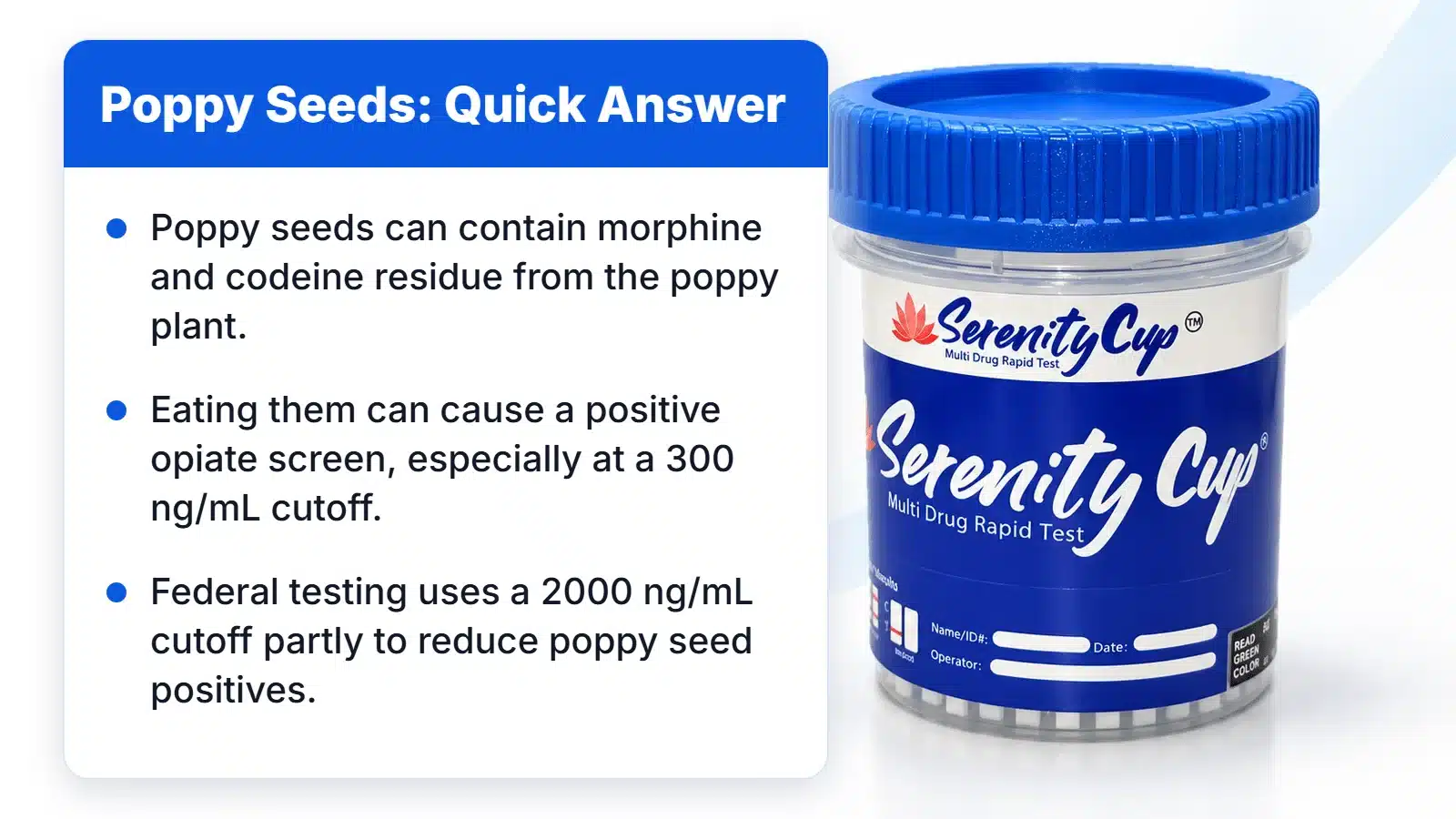
Federal workplace testing raised the opiate screening cutoff from 300 to 2000 ng/mL in the late 1990s, in large part to reduce positive results caused by poppy seeds. Programs that need to detect lower-level opiate use, such as treatment programs, often keep the 300 ng/mL cutoff and rely on confirmation and clinical review. For a detailed comparison, read our guide on OPI 300 vs OPI 2000.
How Long Do Poppy Seeds Affect a Drug Test?
Morphine and codeine from poppy seeds are usually cleared fairly quickly. Urine levels typically peak within several hours of eating and fall below common cutoffs within about one to two days, depending on the amount eaten and the test cutoff. Eating poppy seeds repeatedly over several days can extend this window.
How Laboratories and MROs Tell Poppy Seeds From Opioid Use
A rapid screen cannot tell the difference between poppy seeds and opioid use. That distinction is made during laboratory confirmation and Medical Review Officer review.
6-acetylmorphine (6-AM)
6-AM is a metabolite produced only from heroin. It is not produced from poppy seeds, morphine or codeine. A confirmed 6-AM result indicates heroin use and is not explained by poppy seeds. 6-AM clears quickly, usually within hours, so its absence does not rule out heroin use.
Morphine and codeine levels and ratios
Laboratories measure morphine and codeine separately. Very high morphine concentrations are less consistent with poppy seed consumption. Under federal rules, when morphine or codeine is confirmed below 15,000 ng/mL without 6-AM, the MRO must look for clinical evidence of illicit opioid use, beyond the test result alone, before verifying the result as positive.
Clinical review
The MRO interviews the donor, reviews prescriptions and may look for signs of opioid use. A credible poppy seed explanation, combined with modest morphine levels and no other evidence, can lead the MRO to report the result as negative.
Poppy Seed Tea and Unwashed Seeds
Poppy seed tea, made by soaking or washing large amounts of unwashed seeds, can contain very high and unpredictable amounts of morphine and codeine. It has caused serious overdoses and deaths. Drug test results after poppy seed tea can look the same as results from opioid use. Poppy seed tea should not be considered a safe or harmless product.
Common Foods That Contain Poppy Seeds
Poppy seeds appear in more foods than many people realize, including poppy seed and “everything” bagels, lemon poppy seed muffins and cakes, poppy seed rolls and buns, hamburger buns topped with seeds, poppy seed salad dressings, pastries such as hamantaschen and kolaches, and some Eastern European and South Asian dishes that use poppy seed fillings or pastes. Pastries with thick poppy seed fillings generally contain far more seeds than a light topping on a roll.
Poppy Seeds and Oral Fluid Tests
Oral fluid tests can also detect morphine shortly after eating poppy seeds, mainly because residue can remain in the mouth. Collection protocols that require donors not to eat or drink for a period before the swab help reduce this effect. As with urine testing, any non-negative oral fluid opiate screen should be confirmed by a laboratory.
Advice for People Who Will Be Tested
- If you know you have a drug test coming, consider avoiding poppy seed foods for several days beforehand.
- If you have eaten poppy seeds recently, you can mention it at the time of collection if given the opportunity.
- Keep in mind that the explanation is evaluated during MRO review of confirmed results, not by the collector.
- Be honest about prescription opioids, because those are reviewed separately.
Advice for Employers and Testing Programs
Choose an opiate cutoff that matches your program’s purpose. Workplace programs that want to reduce poppy seed positives often use OPI 2000 rapid tests, which align with federal workplace cutoffs. Treatment and clinical programs that need greater sensitivity may use OPI 300 but should expect occasional poppy seed results and rely on confirmation and clinical review. Compare configurations in our drug test cups category and check the OPI cutoff on each product.
For other common sources of unexpected results, see what can cause a false positive drug test and our guide on what MOP means on a drug test.
Poppy Seeds and Treatment Program Monitoring
In addiction treatment and opioid treatment programs, staff often use OPI 300 tests to monitor for heroin, morphine and codeine use. Patients in these programs should be told in advance that poppy seed foods can affect their results. Clear guidance at intake prevents misunderstandings and supports trust between patients and staff when results are reviewed.
Key Takeaway
Poppy seeds can carry morphine and codeine residue, and eating them can cause a positive opiate screen, especially on tests with a 300 ng/mL cutoff. Federal testing uses a 2000 ng/mL cutoff partly for this reason. The effect usually fades within one to two days. Laboratory confirmation, 6-AM testing and MRO review are how poppy seed results are distinguished from opioid use.
This article is for general educational purposes and is not medical or legal advice.
Frequently Asked Questions
Can poppy seeds make you fail a drug test?
Yes. Poppy seeds can carry morphine and codeine residue, and eating them can produce a positive opiate screen, especially on tests with a 300 ng/mL cutoff.
How many poppy seeds does it take to test positive?
There is no fixed number. Studies have shown that typical food amounts, such as one or two poppy seed bagels, can exceed 300 ng/mL in some people, depending on the seeds and timing.
How long do poppy seeds stay in your system for a drug test?
Morphine from poppy seeds usually falls below common cutoffs within about one to two days, depending on the amount eaten and the test cutoff.
Can poppy seeds cause a positive test for heroin?
Poppy seeds can cause a positive opiate screen, but they do not produce 6-AM, the heroin-specific metabolite used to confirm heroin use.
Do poppy seeds cause a positive result for oxycodone or fentanyl?
No. Poppy seeds contain morphine and codeine, not oxycodone or fentanyl, so they do not trigger OXY or fentanyl panels.
IN THIS ARTICLE